


The Big Picture |

- Ayn Rand Was NOT a Libertarian
- 10 Thursday PM Reads
- Cliff, Stocks, Churchill
- Household Debt In America
- More positive commentary for the US “fiscal cliff”
- 10 Thursday AM Reads
- EIGHT DAYS
- No, Small Probabilities Are Not “Attractive to Sell”: A Comment
- Cheetahs: Full Speed Running in HD Super Slow Mo
- QE4 vs Dead Cat Bounce
- Is China Over-Investing and Does it Matter?
| Ayn Rand Was NOT a Libertarian Posted: 29 Nov 2012 10:30 PM PST
Many people assume that Ayn Rand was a champion of libertarian thought. But Rand herself pilloried libertarians, condemning libertarianism as being a greater threat to freedom and capitalism than both modern liberalism and conservativism. For example, Rand said:
Rand also disagreed with libertarians on foreign policy. For example, most libertarians – including Ron Paul – oppose military intervention against Iran, while the Ayn Rand Institute has supported forceful intervention in Iran. Rand denounced Arabs as "primitive" and "one of the least developed cultures" who "are typically nomads." Consequently, Rand contended Arab resentment for Israel was a result of the Jewish state being "the sole beachhead of modern science and civilization on their (Arabs) continent", while decreeing that "when you have civilized men fighting savages, you support the civilized men, no matter who they are." (Many libertarians were highly critical of Israeli government at the time.) Sandeep Jaitly of Fekete Research says that real libertarians do not follow Rand's philosophy. Murray Rothbard – founder of modern libertarianism, chief academic officer of leading libertarian think tank the Mises Institute, and one of the most important thinkers in the Austrian School of Economics – argued in 1972 that Rand was a champion for her own aggrandizement, not for liberty or reason. Rothbard accused Rand -in a long but must-read essay – of being acting like a typical cult leader:
Postscript: Ayn Rand's main real life hero was apparently a serial killer. See this, this and this. That doesn't mean that she didn't write great books; but it does call her judgment into question. |
| Posted: 29 Nov 2012 01:00 PM PST My afternoon train reading:
What are you reading?
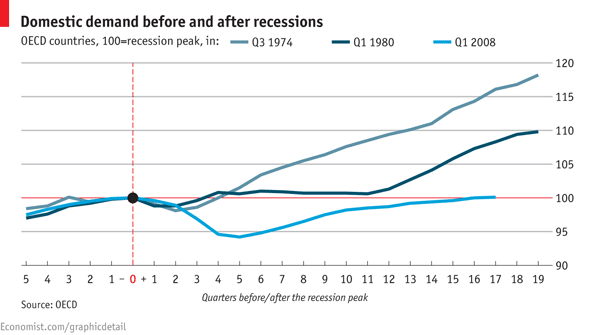
An undemanding recovery |
| Posted: 29 Nov 2012 12:00 PM PST Cliff, Stocks, Churchill
We have written about the Washington charade, including the fiscal cliff and the debt limit. For details see www.cumber.com . Our friend and fishing buddy Jim Bianco summed the situation up in a note. What we like about Jim's work is his numeracy and his intellectual commitment to accuracy. We thank Jim for permission to quote him. "Currently the Treasury is just $81 billion from the $16.394 trillion debt ceiling limit. This limit is expected to be reached in the next two weeks. After that the Treasury will run down its cash balances and 'borrow' from government trust funds and pension funds. This should allow the government to fund itself through February. As a side note, if a private sector company funds itself by running down cash balances and raiding trust and pension funds, everyone goes to jail. When the government does it, it is considered sophisticated asset/liability public sector management." Jim Bianco, November 28, 2012 Meanwhile, financial markets are looking past the political debate. Stock prices are rising worldwide. The US seems to be a leading market among the larger mature ones. Payroll growth in the US continues slowly, and Fed policy remains predictable for a considerable period. Inflation is low and likely to be tame for some time. Cumberland remains fully invested. We expect stocks to go higher and, maybe, much higher. Our bond positions continue to maintain mid-to-longer durations. It is too soon to sell out all the bonds and panic about a future rise in interest rates. That time will come but not for a while. Bond credit decisions are key! This is especially true in the state and local government sector. We worry about states such as Illinois and California. The so-called state fiscal "fixes" of higher taxation and inadequate reforms are not working. California cities remain a danger spot. We are seriously avoiding most of them. General fund balances deteriorate. More trouble lies ahead in the local budgeting arena. The key for an investor is to dig, dig, dig. Research in municipal credits is critical. The old days of "it's insured and AAA" are gone. Now to another correction of a quote we used. We are bullish on intellectual pursuit and the importance of accuracy. In a writing that followed our error with the Tocqueville quote, we cited two attributions to Winston Churchill. We published the links to the verification sources. The exact text we used is, "Winston Churchill said, 'It has been said that democracy is the worst form of government except all the others that have been tried.' Churchill also said, 'You can always count on Americans to do the right thing – after they’ve tried everything else.' ” Well, we were half right. That is better than the zero percentage we scored on Tocqueville. Our friend and another fishing buddy Scott Frew drew on his relationship with a Churchill scholar, who sent the reply copied below. We asked for and obtained permission to reproduce the message. For those who are still reading and enjoy the intellectual pursuit of accuracy, as we do, here is the message that Scott Frew received. Dear Mr Frew Thank you for your email. I have conducted some research on these two quotes using an extensive book we have here on Churchill's words and those misattributed to him by Richard Langworth. It seems that the quote, 'Americans can always be trusted to do the right thing, once all other possibilities have been exhausted' is unattributed to Churchill. He certainly would never have said this publicly, as he was careful about slips such as this, and it cannot be found in the memoirs of his colleagues. The author has it as a 'likely remark' as he did have sentiments like this from time to time during World War II. Of the other quote on democracy Churchill certainly said it, in the House of Commons on 11 November 1947, but he was quoting an unknown predecessor and did not originate the famous remark about democracy. Regards, Thank you, Scott Frew, Philip Cosgrove, and all readers who noted the issues about quotations and accuracy of research. ~~~ David R. Kotok, Chairman and Chief Investment Officer |
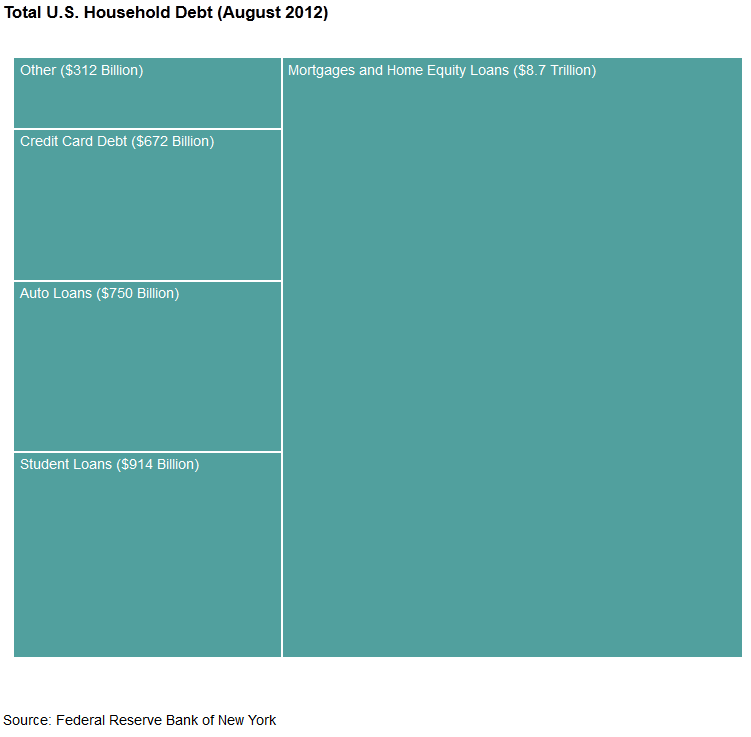
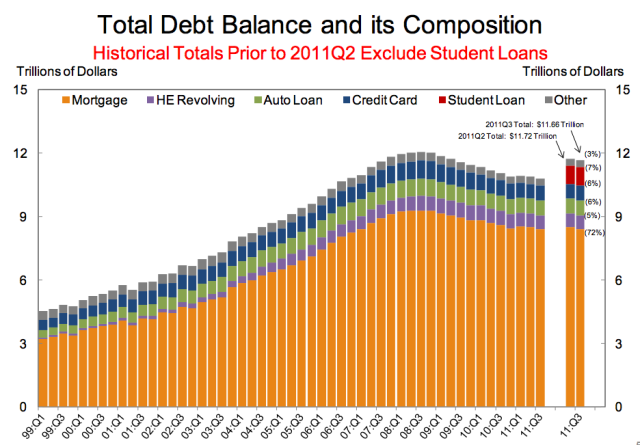
| Posted: 29 Nov 2012 09:13 AM PST I like this chart of U.S. Household Debt — we now owe a bit less than at the peak of the bubble: $11.4 trillion, with Mortgage/home-equity debt still the biggest amount of that debt (by far).
Source: http://www.npr.org/blogs/money/2012/11/21/165657931/household-debt-in-america-in-3-graphs |
| More positive commentary for the US “fiscal cliff” Posted: 29 Nov 2012 08:16 AM PST Australian Q3 business investment rose by +2.8%, Q/Q, higher than the +2.0% expected. However, prospective data is likely to confirm further weakening. I remain short the A$, against the US$ and have increased my short; Output at Toyota’s Chinese plants slumped by 61% in October, with Honda down 54%. However, sales appear to be picking up this month. The future problem, however, is that Japan (if Abe becomes PM) will become more nationalistic and further confrontation with China is likely. I remain short the Yen, against the US$; Japanese retail sales declined by -1.2% Y/Y in October, the most in 11 months, well below the -0.8% Y/Y expected and a reversal of the +0.4% rise in September; Seems like a never ending story – Chinese stocks declined yet again. However, I would be reluctant to short at these levels. If anything, in spite of being bearish on China for some 3 years, I believe a bounce in Chinese equity markets in coming months is more likely. As usual politics in China is the most important factor. The new regime takes over in March and I will be reading their comments, particularly carefully; The Indian Government is to allow MP’s to vote on plans to allow majority ownership by foreign retailers of multi-brand products. No big deal, most would believe, but it has been a major bone of contention in India. It looks as if allies, including some regional parties, will not vote against the proposals. If they do vote against (deemed unlikely), it will be a major setback for the reform plans announced by the finance minister/PM. The PM had to call a vote as the opposition had stalled Parliament. The Indian equity market has been firm recently (up +1.8% today), suggesting that the measures will be passed. The Rupee, which has been particularly weak, rose the most in 2 months and I would expect the trend to continue, as well as the markets; Greek Central Bank emergency lending to their banks rose to E122.79bn in October, as opposed to E100.64bn at the end of September; Moody’s reports that the level of Greek debt will remain unsustainable, even after the most recent “deal” with the EZ/IMF and that a default is likely in due course. Well, of course its unsustainable – simply cannot understand why the EZ, in particular, thinks otherwise. Greek bankers are objecting to the proposed debt buy back. Greek banks hold some E15bn of Greek debt, with pension funds holding E8bn of bonds. However, the government is likely to use a fair amount of arm twisting to force these banks to accept a debt buy back, details of which are expected to be released next Monday; German November seasonally adjusted unemployment rose by +5k, to 2.939mn, less than the +16k expected, but the 8th consecutive monthly rise. The unemployment rate was unchanged at 6.9%. Expect unemployment to continue to rise, ex seasonal factors, though to put it into perspective it remains at a near 2 decade low. However, the view that private consumption will take over from exports and production, is misguided, in my humble view. Counter intuitively, rising unemployment may be positive – the German authorities may well back off their “hair shirt” policies, in particular, as general elections are due next September; EZ November final consumer confidence came in at -26.0 in line with the initial estimate. The economic confidence index came in higher (85.7, as opposed to 84.5), as did industrial confidence (-15.1, as opposed to -17.1) together with the services component (-11.9, as opposed to -12.5) and the business climate indicator (-1.19, as opposed to -1.60); The Irish unemployment rate declined marginally to 14.8% in Q3, from 14.9 in Q2. Of more significance, the volume and value of mortgage approvals rose by +27% M/M, though a better and more meaningful data point is that mortgage approvals increased +14% Y/Y. However, the increase is off a very low base, lending standards are tightening and short term stimulus measures end at the end of the year. The government is likely to extend these measures in the forthcoming budget, I would have thought. (Source Goodbody); US October new home sales fell by -0.3% coming in at 368k M/M, lower than 390k expected and a downwardly revised 369k in September. The decline was concentrated in the Northeast (hurricane Sandy effects) and the South. Disappointing, but the median sales price rose by +5.7% Y/Y; After the negative comments a few days ago, US House speaker Mr Boehner appears willing to agree to revenue increases, as long as their are spending cuts as well. He added that he was optimistic that a deal could be done. A US Senator reports that Republicans and Democrats are just US$23bn apart. Interestingly, the WSJ reports that the White House is flexible on the level of top rate tax. There are reports that the Democrats may propose a 1.5% wealth tax. I continue to believe that this will take time to settle. Having said that President Obama hopes to do a deal before Christmas, stating that more Republicans are willing to agree to a “balanced approach”; The FED beige book reports that US economic activity expanded at a measured pace in recent weeks. Activity was slower due to Hurricane Sandy. Retailers were more optimistic, though wage and price pressures were subdued. They remain cautious about employment, adding that there was only a “modest improvement in hiring”; John Hilsenrath, a FED watcher at the WSJ, advises that the FED is likely to continue its bond buying programme into 2013. The FED has been buying some US$40bn of MBS’s per month and this programme is likely to continue. Operation Twist ends in December and many FED officials want to continue the programme; The 2nd reading of US Q3 GDP came in at +2.7%, slightly lower than the +2.8% expected, though well above the 1st reading of 2.0%. Inventories and trade contributed the most to the rise. One worrying data point – consumption was +1.4% as opposed to +1.9% expected. Business investment came in -2.2%, worse than the -1.3% expected, though election and fiscal cliff concerns impacted – likely to reverse next Q. Core PCE was +1.1% Q/Q, lower than the +1.3% expected; US initial jobless claims came in at 393k, in line with expectations of 390k, though lower than the revised 416k for the previous week. Continuing claims were 3.287mn, lower than 3.325mn expected and a downwardly revised 3.357mn previously; US October pending home sales rose by +5.2% better than the +1.0% expected. Y/Y sales rose by 18.0%, as opposed to a revised +8.7% Y/Y in September and +8.9% expected; The Brazilian finance minister Mr Mantega states that Q3 GDP rose by 4.0% on an annualised basis. The Central bank kept interest rates on hold at 7.25%, an all time low and down from 12.25% in August last year and signalled that they would remain low for quite a while. The Central bank did not cut interest rates for the 1st time in more than 1 year. He believes that GDP will grow by 4.0% in 2013 and 2014, somewhat optimistic, I would have thought. Outlook Asian markets (ex China) closed higher on hopes that Republicans and Democrats will do a deal on the fiscal cliff. European markets are also higher, in particular Spain and Italy – Spain to request a bail out?. Spanish and Italian bond yields are also declining sharply, suggesting Mr (ditherer) Rajoy, may finally pull his finger out and request a bail out. The Euro is back close to US$1.30, though has drifted off those levels – I would expect it to rise further, especially if Rajoy moves to request a bail out. I remain wary of the Greeks, but will not short the Euro at present, though itching to do so at higher levels. Gold has rebounded to US$1725 on news that the FED is likely to continue to buy bonds and January Brent is higher at US$110.99. US markets have opened higher – around +0.4%. Will look for a sell off before I increase my positions. Kiron Sarkar 29th November 2012 |
| Posted: 29 Nov 2012 06:45 AM PST My morning reads:
What are you reading?
Invisible bailout: Why US economy is growing but Europe's slides |
| Posted: 29 Nov 2012 05:58 AM PST The move higher this morning in the S&P futures takes it back to the 50 day moving average of 1416 on hopes that negotiations in DC are proceeding as hoped. We’ll get a deal and stocks will like it temporarily but I repeat my belief that it won’t be a good one in terms of honestly facing the fiscal challenges at the same time tax increases will hurt economic growth as it’s by definition contractionary. To quantify according to the CBO, in 2012 the US Federal Gov’t is expected to spend $3.56T (and similar amount in 2013) which equates to almost $9.8B per day. If the Bush tax cuts on the top 2% expire, about $80B per year will be raised (under the static assumption that all else is equal) thus paying for the Federal Gov’t for about EIGHT DAYS. Without tax hikes in 2012, the revenue into the Federal Gov’t rose by $132b. Economic growth does amazing things. Without market based solutions to healthcare that slows the rate of spending, cosmetic changes to our financial fate is all we’ll get and slower growth too. In Europe, more signs for now of optimism that the worst is over is evident on the heels of yesterday’s decision by the EU to approve the disbursements of euros to Spanish banks. Yields are lower again in both Spain and Italy after Italy sold 5s and 10s totaling 6B euros, in line with their target amount and at yields about 50 bps below those sold last month. EC economic confidence rose 1.4 pts off the lowest level since July ’09. German unemployment did rise for an 8th straight month but not as much as expected. Italian business confidence is still bouncing along a bottom but did gain .7 pts to a 5 month high. Also, a UK retail sales index rose 3 pts to a 5 month high. Elsewhere, Brazil left rates unchanged as expected and the Shanghai index still can’t get out of its own way, closing down another .5%. |
| No, Small Probabilities Are Not “Attractive to Sell”: A Comment Posted: 29 Nov 2012 05:30 AM PST |
| Cheetahs: Full Speed Running in HD Super Slow Mo Posted: 29 Nov 2012 05:00 AM PST This is the most insane thing I have watched this week: A National Geographic film crew captured insane slow mo footage of cheetahs running 60+ MPH using a Phantom high speed camera filming at 1200 frames per second. The film is a companion piece to the National Geographic article "Cheetahs on the Edge."
60mph+ Cheetah Run Cheetahs on the Edge–Director’s Cut from Gregory Wilson on Vimeo. Cheetah Project National Geographic Magazine from Gregory Wilson on Vimeo.
See more at Cheetahs on the Edge: Directors Cut
Hat tip Laughing Squid |
| Posted: 29 Nov 2012 04:28 AM PST click for updated futures
Since the market began its retrenchment a month ago, we have seen rallies on weak volume and selloffs on stronger volume. Historically, these are the characteristics of Dead Cat Bounces and softer rallies destined to fail. But over the past few years, we have also seen markets rally on expectations of each and every new Fed intervention. QE4 was trial ballooned on Wednesday afternoon by the WSJ’s Jon Hilsenrath (Fed Stimulus Likely in 2013). History teaches us that whenever the Fed wants to do a new intervention, they let the Street know by telegraphing their intentions this way. They thinking seems to be, “Don’t say we didn’t warn you.” James Bianco, with tongue firmly planted in cheek, has called Jon “The actual Federal Reserve Chairman.” In reality, Jon took over the slot formerly owned by Greg Ip (now at The Economist) as the Fed’s favored conduit to Wall Street. Despite the earnings weakness, dividend and capital tax avoidance trades, anemic volume and general complacency, yesterday saw a strong intra-day reversal in US equities. Markets shifted from down half a percent to up half a percent. Some of my technical friends will call this a triple-outside day — opening below the low of the past three days, and closing above the high of the past three days. What this means is that short term, the 0fficial kick off of the Santa Claus rally is here. Traders can game this for a run up to the September highs. Investors have a trickier challenge: This likely ends badly, but the QE4 announcement by acting FOMC chair Hilsenrath suggests just not yet. I want to see how markets trade today, but I suspect that there is an upside play for this rally into years end, perhaps even into Q1. Things get much trickier beyond that. Let’s be careful out there . . . |
| Is China Over-Investing and Does it Matter? Posted: 29 Nov 2012 03:00 AM PST |


| You are subscribed to email updates from The Big Picture To stop receiving these emails, you may unsubscribe now. | Email delivery powered by Google |
| Google Inc., 20 West Kinzie, Chicago IL USA 60610 | |



0 comments:
Post a Comment