


The Big Picture |

- Quantitative Easing Benefits the Elite … And Hurts the American Economy
- Honest Trailer: Lord of the Rings
- 10 Thursday PM Reads
- QE Explained
- EU agrees on banking supervision
- What is the Fiscal Cliff?
- Coincident to Lagging Economic Indicator
- Must Read: Mervyn King’s “Unpublished” Speech
- Mervyn King Speech at Economic Club of NY
- Ritholtz: No Uncertainty on Fiscal Accord
- Retail sales/Claims
- 10 Thursday AM Reads
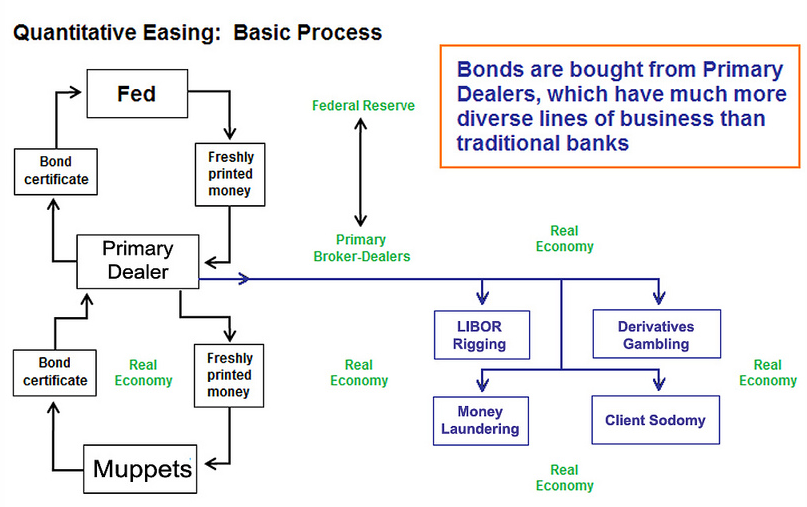
| Quantitative Easing Benefits the Elite … And Hurts the American Economy Posted: 13 Dec 2012 10:30 PM PST Quantitatitve Easing Is Not "Liberal" EconomicsThe Fed has just announced its fourth round of "quantitative easing". While the mainstream financial press pretends that quantitative easing is a "liberal" economic policy, nothing could be further from the truth. As we've repeatedly explained, quantitative easing is a bailout for the super-rich, at the expense of the little guy. It increases inequality and fails to stimulate the economy. (And it destroys the savings of retirees.) Indeed, Fed boss Ben Bernanke knew 24 years ago that quantitative easing doesn't help. Forbes' Lawrence Hunter explains:
Indeed, the Fed:
Hunter continues:
There are much better ways to stimulate the economy, but the Fed is only interested in maintaining the status quo for its owners. And see this. |
| Honest Trailer: Lord of the Rings Posted: 13 Dec 2012 03:00 PM PST |
| Posted: 13 Dec 2012 01:30 PM PST My afternoon train reads:
What are you reading?
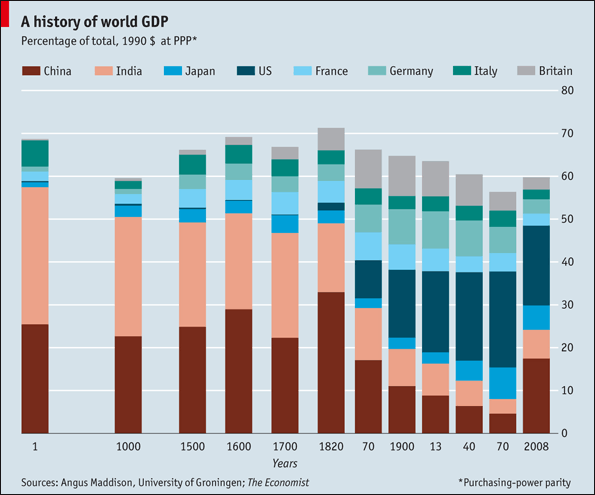
2,000 years in a single graphic
|
| Posted: 13 Dec 2012 11:30 AM PST
|
| EU agrees on banking supervision Posted: 13 Dec 2012 11:00 AM PST More calls for the Australian RBA to cut interest rates, this time from the CEO of Westpac, Gail Kelly, who cites low consumer and business confidence. However, the A$ continues to strengthen, currently A$1.0555 against the US$; A Chinese airplane flew over the disputed islands in the South China seas, with Japanese defence forces scrambling aircraft to intercept it. This game is getting dangerous. Apparently, it was the 1st violation of Japanese airspace since 1958. The action will help Mr Abe, who has proposed that Japan takes a firmer line with China (source FT); The EZ has agreed to disburse E49.1bn of aid to Greece in 4 tranches, with E34.4bn to be dispersed in December. E16bn will go to recapping Greek banks. In addition, further assistance will be provided to Greece if it achieves a primary surplus next year. Greek Q3 unemployment rose to 24.8%, up from 23.6% in Q2; The head of the centre-left Italian party wants Mr Monti to continue to be involved in the government after the elections. In addition, Mr Bersani, the head of the PD stated that his party would be willing to cede more control over the Italian budget to the EU, if the EU enacted anti-recessionary policies; The IFO institute forecasts that German GDP will decline by -0.4% in Q4, Q/Q; Fitch reports that the 2013 outlook for French banks is negative. France is likely to be the real problem next year; The EU has agreed on the ECB supervising EU banks which have assets of E30bn and over and, in any event, the largest 3 banks of each country in the EU. Mr Schaeuble believes that the banking supervisor will be established by March 2014. About 200 banks in the EU will be affected; US initial jobless claims came in at 343k, lower than the 369k expected and the revised 372k the previous week. Continuing claims totalled 3.198mn, slightly lower than the 3.210mn expected and the 3.221mn previously; US November retail sales rose by +0.3% M/M, lower than the +0.5% expected and the -0.3% in the previous month. Retail sales, ex auto and gas came in +0.7% higher M/M, above expectations of +0.4% and -0.3% in October; US November PPI came in at -0.8% M/M (+1.5% Y/Y, lower than the +1.8% Y/Y expected), lower than the -0.5% expected and -0.2% in October. Core PPI (ex food and energy) came in at +0.1% M/M (+2.2% Y/Y), in line with expectations and -0.2% in October; US October business inventories came in at +0.4% M/M, in line with expectations, though lower than the +0.7% in September; Outlook Asian markets closed higher, though European (ex Italy and Spain) and US markets are marginally lower The Euro is trading around US$1.3085, up on the day. The Yen is weaker, currently Yen 83.50 against the US$. Gold is trading at US$1697, with January Brent at US$107.59. Pretty lackluster day. Kiron Sarkar 13th December 2012 |
| Posted: 13 Dec 2012 10:29 AM PST |
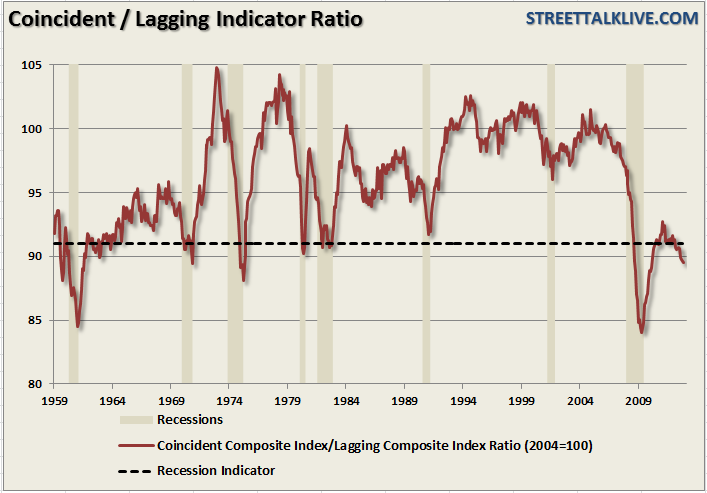
| Coincident to Lagging Economic Indicator Posted: 13 Dec 2012 09:33 AM PST click for larger graphic
Whenever we are near fully invested, we begin to look for the drivers that have the potential to derail the current portfolio posture. Earnings were the prime worry last month. Now, the concern is an eventual recession coming sooner rather than later. Towards that concern, Albert Edwards of Soc Gen points us to John Hussman who points us to Lance Roberts, who is looking at the Coincident to Lagging Economic Indicators (above) . Dennis Gartman has called this the “single best recession forecaster” there is. While I don’t believe that a recession is a sure thing, I also suspect (fear?) that it is a greater possibility than most Non-Rosenberg economists are forecasting. That is the nature of the art of investing – it requires probabalistic decision-making using imperfect information about an inherently unknowable future. |
| Must Read: Mervyn King’s “Unpublished” Speech Posted: 13 Dec 2012 08:28 AM PST For some reason, this week’s Mervyn King speech at the Economic Club of NY remains unpublished by the Bank of England. They apparently are not as transparent as the US Central Bank, who seems to publish every Fed Governor Speech the moment they begin to speak. While we appreciate Sir Mervyn King’s eloquence and arguments, we are perplexed by the lack of pu8blication of what was to all other indications a public speech made to a room of journalists and market participants. Well, that is not how we roll here in the colonies. As a a public service, and a continuation of the 236 year struggle to free ourselves from some of the odder rulings of British Society, we present to you Sir King’s complete and unedited speech in text form so it is Google searchable. Sure, we have a special relationship with England, but major policy speeches given here by elected or appointed government officials are usually considered public domain works. (Note that the The Economic Club of New York finally posted a PDF of the speech here).
|
| Mervyn King Speech at Economic Club of NY Posted: 13 Dec 2012 08:14 AM PST The Economic Club of New York
Introduction Roger Ferguson Well, good afternoon. Good afternoon. I'm Roger Ferguson. I'm the Chairman of the Economic Club of New York and I'd like to welcome you to this, our 427th meeting of the club. As those of you who are members know, the Economic Club of New York is the nation's leading nonpartisan forum for economic policy speeches. Since we were founded 105 years ago, we've been honored to have more than 1,000 guest speakers appear before this club. And they have all established a strong tradition of excellence, a tradition that I know will be more than upheld today. I'd like to begin first and foremost by recognizing the 174 members of our Centennial Society who have contributed their support to the club. That support is very important to us. And so I thank all of you for ensuring that the club is able to continue to fulfill its mission. I'd also like to welcome the students who have joined us today and thanks to our members who have supported those students. Today we have students from the NYU Stern School of Business, the Columbia University School of International and Public Affairs, and Fordham University. So welcome to all of the students. We're glad that you are here. And now it is my great pleasure to introduce our speaker, Sir Mervyn King. He is the Governor of the Bank of England and Chairman of its Monetary Policy Committee and the Financial Policy Committee. Sir Mervyn's service to the Bank of England extends back to 1990 when he became a non-executive director. From there he became Chief Economist and Executive Director and then Deputy Governor, then he was appointed Governor in 2003. Prior to his Bank of England service, Sir Mervyn taught at the London School of Economics, Harvard, MIT, Cambridge, and the University of Birmingham. He studied at Kings College, Cambridge and was a Kennedy Scholar at Harvard. Sir Mervyn, we're delighted to have you with us and we look forward to hearing what you have to share with us today. The podium is yours. The Honorable Mervyn A. King Governor of the Bank of England Roger, thank you. Ladies and gentlemen, good afternoon. It is a real honor to be invited to speak to this great club of yours especially in front of such a distinguished audience today. And it's a particular pleasure to be introduced by Roger because we were Deputy Central Bank Governors together and it's deputies who make the world go round. But particularly I will never forget in those dark and terrible moments after the attacks on New York in September 2011 Roger and I negotiated a swap arrangement which enabled the financial system to continue operating solely based on trust. And if that demonstrated nothing, it showed two things. One was that Central Bank cooperation is alive and well, and secondly that the world can exist without lawyers. But the most important thing I want to say about Roger is that I know that my pension is safe with Roger in charge. Thirty years ago Ben Bernanke and I had adjoining offices at MIT. We never imagined that thirty years later we would be colleagues as Central Bank governors, and even if we had, we would never have believed that the industrialized world would have faced an economic and financial crisis on a par with the problems seen in the 1930s. As young men we believed that economics, whether it was Keynesian economics or Monetarist economics, meant that those problems were in the past. Well, we were wrong. But to be fair, the worse problems of the 1930s were avoided this time around because of the stimulatory policies injected into the world economy by central banks and governments around the world although it is fair to say that a recovery of a durable kind is proving elusive. So what can and what should be done? I want to say a few words about my own economy and then to say a few words about the contrast between the U.K. and the United States which I think is revealing, and then to finish with some words about the challenges facing the world economy which if anything in my judgment are more important than those facing individual countries alone. The United Kingdom was hit very badly by the financial crisis. Total GDP fell by six percent between the peak at the beginning of 2008 and the trough in the second quarter of 2009. And output still remains about three percent below the peak level and is more than 15 percent below the level that output would have reached had the long run average growth rate merely continued. And on top of that the inflation rate has been well above our two percent target for over three years. And in the wake of the financial crisis the budget deficit reached a level of 11 percent of GDP, a good part of that being structural. So we had serious problems to contend with when trying to put in place an economic recovery program in 2009-2010. And it was very clear at that point that the U.K. needed a major re-balancing of our economy to shift spending away from consumption, both private and public and towards net exports, whether exports or production, to compete with imports. And the strategy adopted in 2007 had two main pillars. The first was to put in place a credible medium-term plan for fiscal consolidation that would eliminate the structural budget deficit as it appeared at the time over the lifetime of a parliament, five years, but with the rider that the automatic stabilizers would be allowed to operate meaning that if economic growth turned out to be weaker than the central path that was expected then obviously revenues would fall, expenditures would be higher, and the deficit would take the strain. But that credible medium-term fiscal consolidation plan was central to the U.K. recovery objective. And at the time, at the spring of 2010, ten-year interest rates on government loans were exactly the same at four percent a year in the U.K., Spain, and Italy. Today of course the ten-year borrowing rates are very different. Ours has fallen markedly and the spread against German and U.S. rates has come in a great deal. Well, that was the first pillar. The second pillar was that monetary policy would provide the vehicle for accommodating the stimulus to the economy. Fiscal policy would undoubtedly be a headwind in terms of the movement of total demand, but monetary policy would be accommodative and more importantly would accommodate the sharp fall in the Sterling exchange rate which had already taken place between the end of 2007 and the beginning of 2009. That was a 25 percent fall in the average effective exchange rate of Sterling against other currencies, a very large fall, the biggest since the second World War. And the role of monetary policy was to make sure that that gain in competitiveness was retained by ensuring that domestically-generated inflation would remain stable. Now these two pillars were thought to be consistent with a gradual recovery of the economy. But what happened was that we didn't get a gradual recovery of the economy. We saw output being broadly flat over the past two and a half years. It's been a zig-zag pattern. In Britain this year we've had the excitement of the Olympic Games and the Queen's Diamond Jubilee, events which you haven't been blessed with. But it's created a zig-zag pattern of quarterly growth rates being up and then down. But look through that and what you see is a picture of broadly flat output. So we have not seen even the recovery that you have seen in the United States. So why is that? What in a sense has happened that was unexpected two and a half years ago? Well, one factor has been a very sharp pickup in world energy and commodity prices that over the past two years or so meant that although domestically-generated inflation was indeed held down at stable levels, that CPI inflation rose as the impact of the depreciation of Sterling, higher world energy and commodity prices fed through, and in fact inflation reached over five percent about 15 months ago. And that led to the longest squeeze in real take-home pay since the 1920s. And inevitably that suppressed the recovery in consumer spending. But an even more important factor has been the intensification of the problems in the Euro area. They picked up in the summer of 2011 and they've impacted on the U.K. in three ways. First obviously a slowing in our exports to the Euro area. Whereas the depreciation was very effective in stimulating exports of goods to the rest of the world, exports to the Euro area have now fallen back. But the problems go further than that because our major banks are significantly exposed to the Euro area. Not so much in terms of holdings of sovereign debt but in terms of exposures on loan books to the real economy in the Euro area periphery. And that means that when those problems become apparently more serious that investors around the world, whether U.S. money market funds or insurance companies or anyone else providing finance to our banking system, the interest rates at which they're willing to lend to our banks go up and our funding costs, bank funding costs in the U.K. rose after the middle of 2011, and those higher funding costs inevitably feed through to higher interest rates charged to U.K. domestic borrowers whether households or companies. And the third consequence of problems in the Euro area, probably the most significant of all, is the uncertainty generated by it. It's very hard to know what is going to happen in the Euro area and extremely difficult to judge what will happen over a five or ten-year horizon often so relevant for business investment decisions. And what I've called a black cloud of uncertainty has drifted across the channel from the continent and covered our business sector with uncertainty that has diminished what would otherwise have been I think a recovery in investment spending. So these three factors have been a major impact on the U.K. and have led to, as I said, flat output rather than a recovery. So what now? Well, the first factor, the squeeze on real take-home pay, should diminish. It's hard to see why a central view would be that we would see a repeat of further large increases in world energy and commodity prices. Of course it could happen. Certainly I don't think I'm suggesting that we'll see the rises that did take place go into reverse, but whether we will see further sharp rises is perhaps not a central view and that may stimulate then some pickup in consumer spending. But the problems in the Euro area do not seem capable of easy resolution. So what can the Bank of England do in the face of this? Well, there are three things that we're doing. One, and very parallel to what the Fed is doing, is we have engaged in a significant program of asset purchases. We do this with a very explicit aim of trying to prevent what would otherwise be a damaging contraction in the money supply, in the broad money supply. So we are boosting initially the narrow money supply, that has a one for one impact onto the broad money supply, in order to ensure that we don't see the kind of contraction in the money supply that characterized the United States in the 1930s and does characterize Greece today. That asset purchase program of 375 billion Pounds is approximately one-quarter of an annual nominal GDP flow, a lot of money. And broad money is now expanding at just over five percent a year. And I think we'll see the impact of that on demand later in 2013. The second action that the bank has taken to provide a breathing space before these broad macroeconomic factors feed through is to introduce what we called a funding-for-lending scheme, a special scheme started on the first of August under which the Bank of England with a guarantee of the government, because this is a quasi-fiscal action, would provide four-year finance to our banks to enable them to increase lending to the real economy, or at the very least to contract lending to the real economy by less than they would otherwise have done. We will lend to banks according to how much they are expanding their own net lending to the real economy. And the more they expand their net lending, the lower the interest rate which we will charge on loans to them. There's a very powerful financial incentive built into this funding-for- lending scheme to persuade banks to expand their lending. And that too we are confident will feed through particularly to the mortgage market during 2013. And the final factor is to look once again at the health of our banking system. Back in the autumn of 2008 the United Kingdom did, I think, lead the way in arguing that the problems facing the financial system were not those of liquidity, of course there were liquidity problems, but they were symptoms of a wider problem of solvency. The banks simply didn't have enough capital. We re-capitalized our banking system, the United States did likewise. We probably didn't do enough and go as far as we should. And we think that given the concerns about the Euro area, our regulators, currently the FSA, shortly to be once again the Bank of England, have calculated the buffers of capital that banks need to provide a buffer against the stresses that could arise in the Euro area. And our concern as expressed in our new Financial Policy Committee at the Bank of England, so called a macro-prudential policy committee, is that these levels of capital at present are simply overstated. Overstated for three reasons. One is that our banks have not taken adequate account of expected losses on their loan books particularly in respect of commercial property. Second and highly topical particularly in New York is that the cost of regulatory redress is much higher than had been expected and our banks need to make greater provisions for the cost of regulatory redress, whether in the form of fines or compensation to customers. And thirdly that the risk weights that some of our banks are using are inadequately insufficiently prudent. And we've recommended to the FSA that they immediately ensure that banks examine their balance sheets and come up with an estimate of how much their current capital is overstated because of these three reasons, and that they then either issue new capital or raise contingent capital or otherwise restructure their exposures without diminishing their lending to the real economy to ensure that they have the buffers which the FSA believe to be necessary in order to meet the potential stresses from the Euro area. These problems are all manageable. There's nothing insuperable about the need for our banks to raise somewhat more capital. But manageable though they are, they have to be done. There is behind all this a problem which all central banks are facing. I think most industrial countries' central banks have pursued broadly the same strategy here of trying to ensure their banking systems are adequately capitalized, of lowering interest rates to zero, and of expanding their balance sheets. But the problem that we all face is what I have called the paradox of policy. Namely that what seems to be the right thing to do in the short term to maintain support for aggregate demand is absolutely the opposite of what we know we need to do in the long term. The U.K. does need to see a slowing of consumer spending and government spending and a switch to net exports and business investment. We need to raise our national saving ratio. We need to reduce our trade deficit. We need to reduce our overall debt levels. In the short run a headlong rush to achieve these objectives would lead to a weaker economy but in the long run we need to make these adjustments. And the big challenge facing monetary policy is to work out at what point it is sensible to switch policy from focusing on the short term to supporting the long run adjustment that is needed because we in the U.K., and I believe the world economy more generally, needs to move to a new equilibrium position. Let me briefly mention three differences between the U.K. and the U.S. which illustrate not so much the differences of policy response that we've engaged in because in many ways they are very similar, but actually illustrate differences in the nature of the economies and the problems thrown up by the crisis. The first difference is simply the size of the banking system. On the eve of the financial crisis, the total assets of banks in the United States barely touched 100 percent of annual GDP. In the U.K. the assets of our banks were over 500 percent of GDP, almost at the levels of Switzerland and Ireland, if not the heady heights of Iceland. But nevertheless the consequence of that was that first the impact on the public finances of the need to recapitalize our banks and deal with the consequences of the banking crisis were more severe. And secondly, and this is perhaps the most important part, the impetus from de-leveraging of our banking system bore more heavily on the willingness of our banking system to supply credit to the domestic economy. Now we are engaging in a serious attempt in the U.K., and I think internationally, to rid the world of the problem of "too important to fail," what some call "too big to fail." It is very important that we deal with this. And as you know we have not gone down the route of the Volcker rule. We certainly don't have the energy to write regulation of the same length as Dodd-Frank. But we are intent on putting in place a ring fence around those banking activities which are absolutely crucial to the operation of our domestic economy, retail deposits, the payment system, and finance for small business. And those reforms which were recommended by our Independent Commission on Banking will be introduced in legislation within a few months. And I'll be happy to answer questions on that after the talk, but let me for the moment move on to the second difference between the U.K. and the U.S. which is the housing market. And here of course the interesting fact is that your problems in the housing market were much worse than ours. Before the crisis both countries saw a rapid rise of house prices which went to record levels relative to household incomes. My own view is that the cause of this was the secular decline in long-term real interest rates which had the inevitable consequence that all asset prices relative to flows of income rose. And that meant that after the crisis we haven't seen the fall in house prices that was experienced here of about a third. Ours was only a fall of 10 to 15 percent. And we don't have a stock of unsold housing that had to be worked through for the housing market to recover. And we see absolutely minimal levels of defaults on mortgages and housing repossessions. Now I don't claim this is a result of virtue in the U.K. but I do think it was an inadvertent result of our very strict planning laws, but it has been a valuable antidote because we haven't seen the large unemployment that's occurred in a number of countries that follow the sharp contraction of the construction sector. And of course the third main difference is that the United Kingdom is a much more open economy than that of the United States. We're much more exposed to international trade and we are much more exposed to the Euro area. And that has meant that although we have been successful in keeping domestically-generated inflation under control, wage inflation has been two percent a year for some time now, nevertheless CPI inflation has risen and we could only wish that we had experienced your experience with the movement of natural gas prices and domestic energy prices. Indeed had the U.K. experienced the U.S. pattern for domestic energy prices, the average level of real household take-home pay today would be one and a half percent higher than it is with a consequential impact on consumer spending. That's one of the reasons why our recovery has been slower. Now those differences I think are interesting but they, to my judgment, pale in significance in contrast to the challenges which the world economy as a whole faces. Both your economy and mine need to re-balance. But the need to re-balance is not confined to those countries which previously had large trade deficits. Indeed by the laws of arithmetic if we have to re-balance, there must be some other countries out there also that have to re-balance. And this contrast between the surplus and deficit countries is a problem overshadowing us all. It's not a new problem. It was a problem discussed at length at Bretton Woods in 1944. No solution was found to it then. And we haven't found a solution to it since. The nearest we came was after the collapse of the Bretton Woods fixed exchange rate system when the industrialized countries of the world, primarily the G7, put in place a regime under which domestic monetary policy would focus on price stability and the convention was that unless there was unanimous agreement on exchange rate intervention, exchange rates would float and move as they would in order to eliminate the buildup of imbalances. That came to an end with the rise of some of the emerging market economies and their entry into the world trading system combined with a wish to earn export surpluses as part of their strategy for development. Now back in the 1960s there was a British member of parliament who ran on the slogan, "I want to see a world where every country can have a balance of trade surplus." (Laughter) And believe it or not, since he was affiliated to one of the two major parties, he was elected. But sadly that political deceit doesn't help us today. The pressures on deficit countries are inexorable because those are the countries that have built up debt and those are the countries that are having to adjust. The surplus countries are under no such pressure to do so and many of them show great reluctance to expand domestic spending to allow the deficit countries to re-balance. Nowhere is this seen more vividly than in the Euro area where the surpluses in some parts of the Euro area are the mirror image of the deficits in other parts. And this is a problem which has to be tackled. The G20 in 2009 came together at the London Summit and agreed the easy part which was stimulatory policies where every country could agree. But sadly the G20 has gone backward since then and there has been no agreement on the need for working together to achieve some element of re-balancing the world economy. Again these challenges are manageable but manageable challenges are only managed if action is taken, and there is a need to do this today. Otherwise my concern is that in 2013 what we will see is the growth of actively managed exchange rates as an alternative to the use of domestic monetary policy. With interest rates at very low levels, with balance sheets having expanded a great deal, and with the inability of monetary policy indefinitely to postpone the adjustment that's required to bring about the re-balancing, some other mechanism will be needed. And you can see month by month the addition of the number of countries who feel that active exchange rate management, always of course to push their exchange rate down, is growing. Finally, we face a broader challenge, a challenge to defend the market economy in the face of concerns amongst so many who suffered during the financial crisis. This was expressed memorably by William McChesney Martin when he spoke to this club in 1957, the Golden Anniversary of the club at the time. And he too talked about the need to support the legitimacy of a market economy. And I would add to that the need to slow the march of special interests and the growth of lobbying. All of these things are sustaining the anger amongst many ordinary people who feel that they are the people who have borne the cost of the financial crisis but they didn't benefit from the upturn beforehand. And to quote Martin, he wrote in 1957, "Men begin to question whether the merriment was worth the misery especially when the misery was worst among the millions who had never got in on the merrymaking in the first place." We need to remember those words. We need to ensure that whatever else we do a market economy is seemed to be perceived by opportunities and a sense of fairness. No country has done more to stimulate economic thinking about how we get out of this crisis than the United States. As Roger said, I came to the United States forty years ago as a Kennedy Scholar. And I come again here today as Governor of the Bank of England to pay tribute to the academic work that's done in the United States, to the financial community that's been leading the way out of our current predicament, and especially to the Federal Reserve and my colleagues in the Federal Reserve who have done much of the heavy lifting in getting us out of this crisis. As a tribute to President Kennedy, the British Prime Minister Harold Macmillan said of the fallen president, "His eyes were on the horizon but his feet were on the ground." There can't be any better inspiration to a central banker today than those words. Thank you. QUESTION AND ANSWER PERIOD ROGER FERGUSON: Sir Mervyn, thank you very much for those inspirational and insightful words. Now as is our custom Sir Mervyn will be questioned by two of our members. Doing the duty today will be Glenn Hubbard who is the Dean of the Business School at Columbia University and the club's former chairman. And then Abby Joseph Cohen, Senior Investment Strategist at Goldman Sachs and a trustee of the club. If any of you in the audience should have any questions, you can email them to questions@econclubny.org and our president Jan Hopkins will read them. Abby, the first question is yours. ABBY JOSEPH COHEN: Thank you. And Sir Mervyn, let me thank you again on behalf of the members here and our guests for what I thought was an extraordinary presentation done in a very short period of time. So thank you. It was a command performance. (Applause) In your prepared remarks you spent a good deal of time reviewing the macroeconomic environment in the U.K. And one of the topics you touched on was the relationship between the U.K. economy and that of the E.U. with the E.U. presenting, shall we say, several challenges both in terms of aggregate demand but also in terms of some of the ongoing regulatory issues. And because you challenged your questioners to do so, let me ask you a question probing you a little bit more for some detail. Just over the last few hours there was a joint report issued by the U.S. FDIC and your colleagues at the Bank of England talking about how to handle systemically important financial institutions, in this case the G-SIFIs, the global ones. And so many of them are in fact in the United States and the U.K. And I know I for one was heartened by the idea that two important regulatory bodies will be working together and discussing the right way forward. Yet there is another set of regulatory bodies that has not yet been involved perhaps in the same way. If we look for example at China or if we look at the E.U., there are some questions that get raised. And among them would be whether the banks that are systemically important in other parts of the world could be or should be allowed to operate in other nations following a different set of regulatory standards. THE HONORABLE MERVYN A. KING: Well, let me start with an anecdote about the height of the crisis when there was a G7 meeting in Tokyo, and we all flew over for a meeting that lasted about three hours. And we had to stay overnight so the central bank governors had dinner. And I said, well, wouldn't it be a good idea if we had a discussion over dinner, make some use of the time in Tokyo. And they said, good idea Mervyn, what question do you suggest? And I said, well, why don't we talk about what would happen if one morning we went into the office and say Goldman Sachs rang us up and said, terribly sorry chaps, things have gone badly wrong, we're bust. What would we do around the world in dealing with that? And everyone said you must be joking. This is far too difficult a question, let's just enjoy a good dinner. (Laughter). Well, I'm glad to say that actually, particularly between the U.K. and the United States the community is now taking this question of "too important to fail" very seriously and trying to ensure that all major institutions, banks or near-banks, have resolution plans so that the regulators around the world can work together within their respective national legal systems to resolve large banks. And the key aim of this is to ensure the people who lend to such institutions know that they're not lending to the government with a guaranteed loan. They're actually taking a genuine financial risk because that debt could be baled in. And we have made enormous progress. As I said the big challenge is that I don't think it's practical to think that we will end up with a common legal framework which would be binding, but what is relevant is that we can ensure that we get to the point where for example if at the holding company level there is enough bale-inable debt, then it's possible for groups to be resolved. And what there is, there's no doubt a lot of cooperation between Bank of England and the FDIC and also the Bank of England and the Fed about how we would handle problems of cross-border institutions which are large in size. I think one thing that, you know the U.K. had a difficult experience in this crisis because we had absolutely no resolution framework at all, even for small banks. But we then introduced a resolution framework which will work well for U.K. banks but will not work easily for cross-border banks and we have some large ones and you have some large ones and we want them to be able to operate in international markets. But to do that we need a framework whereby these banks can be resolved, and we are determined to get to that point. And rather to my surprise I think we've made much more progress than I might have expected. So I think we're well on the way and that's a key part of the approach. GLENN HUBBARD: Let me join, first join Abby in thanking you, Mervyn, for those excellent remarks. I also wanted to take you to an international comparison but bring you to North America. As you noted in your remarks, despite the monetary easing from the Bank of England, the U.K. economy I think was flat in your words. What more, if anything, could the Bank of England do? And here I wanted to know what you think, if there would be any gain in following the approach in Canada or in the United States of specifying how long interest rates would remain low? And if you disagree with that, why? THE HONORABLE MERVYN A. KING: Well, we don't believe in the Bank of England that we have a crystal ball which enables us to foretell the future. So we simply do not know what we will be deciding six months, twelve months, two years from now. What is important I think is to have sufficient transparency about how we will react to events as they unfold. So we certainly don't want to leave vast uncertainty about our future actions. But instead of saying interest rates will be low at a certain point in time, what we would rather say is we'd rather talk about our actions in a way that people are confident that they understand how we might react to events as they unfold. And I think the proof of the success of that is that if you look at market interest rates, there's actually rather little difference in terms of what markets expect the yield curve to be looking ahead between those central banks that are willing to talk more openly about what they will do and those banks who don't talk about the future but talk about how they would respond to events as they unfold. And of course the other reason for doing that is our committee structure in the Bank of England, the Monetary Policy Committee comprises nine individuals each of whom is individually accountable for their actions, appears before parliament to explain their actions, and has one vote. And I only have one vote. And I have been in a minority on three or four occasions since I became governor. So I don't think it's actually easy for us to pretend how the committee will behave in two or three year's time. What we should be doing is to say, look, let's be honest about it, no one knows what the future holds. What we have to do is to give the impression that we have a very clear set of objectives. We have instruments to meet those objectives. What we will actually choose to do at any particular date in the future will depend on the conditions at the time. ABBY JOSEPH COHEN: Sir Mervyn, back to the economic outlook in the U.K. One of the things that you stressed during your presentation was the importance of trade for the U.K. And yet over the last 12 months or so the trade numbers have deteriorated somewhat. The aggregate GDP numbers have not looked particularly good and the productivity numbers have been unfortunately moving lower. Yet there seems to be a bright spot in terms of the efficacy of the FLS, the scheme to encourage and incentivize bank lending, and I assume a good deal of that bank lending for domestic purposes. Can you allow this American audience a brief description of how that program works and why you think it is being effective? THE HONORABLE MERVYN A. KING: Yes. I mean the backdrop is as you said that we've had broadly flat output now for two years. The export figures have actually been good to the rest of the world but not to the Euro area. And we've also seen a big loss in terms of exports of financial services. I don't myself want to put enormous weight on the published data for trade so far that are always being revised and the number of occasions when people, at least in Britain, say if only we'd known three years ago what the revised data say now, we might have done something very different. So bearing that in mind does seem to be extremely important. But we were very struck from the middle of 2011 as the problems in the Euro area built up, that our bank funding costs rose too, and that's because our banks are exposed to the Euro area. So we felt that we had to do something to create a breathing space before we might see the impact of easing monetary policy feed through. So we created a scheme, the funding-for-lending scheme, the FLS, under which we said the Bank of England would be willing to lend to banks an amount equal to the net increase in their lending to the real economy plus five percent, of their pre-existing stock of loans to the real economy. So we calculated their lending to the real economy last August, the first, we'll lend them five percent of that without strings, and plus any increase in lending between then and the end of 2013. So a big incentive to do it over 2013. And the interest rate which we charge on those loans goes down the more they expand their lending. We had to calibrate this very carefully to give incentives to two groups of banks. First those banks that are already expanding lending and we want them to expand lending even more. And secondly those banks who are contracting lending because of the state of their balance sheet, typically the state-owned banks, and we want them to have an incentive to contract their lending by less than they would otherwise have done. And that explains the actual calibration of the scheme. But we've been pleased by the take-up. We think this won't feed through to lending activity until 2013. But what it has already done irrespective of how much money banks borrow from us, the existence of this scheme has led to a sharp fall in bank funding costs already. So that is already being seen. So I wouldn't measure the impact of this just by how much money banks borrow from us, but what has happened to bank funding costs. And I think that is another factor that leads me to think that, you know, who knows what the future holds, but a reasonable central view would mean that we would expect to see some pickup in lending and investment. We would expect to see the squeeze on consumer spending ease somewhat. And we would hope that they might find some way of making the conditions in the Euro area more conducive to an expansion of trade within Europe. ROGER FERGUSON: Why don't we have Jan do a question… JAN HOPKINS: If the U.S…this is a question from the floor, if the U.S. goes over the fiscal cliff, will it tip the U.K. into a triple dip recession? THE HONORABLE MERVYN A. KING: We have great confidence that one way or another…(Laughter)…one way or another the United States will find a way, if not of avoiding going over the cliff, at least hanging on by the fingertips and not falling down on the other side. And I've always been impressed by the energy and dynamism associated with this country. I'm confident in the end you'll find a way of doing it. GLENN HUBBARD: Well, I'm never so sure with the Congress, Mervyn, whether either the eyes are on the horizon or the feet on the ground, but I take your answer confidently. I wanted to ask you about the LIBOR scandals. In the wake of the alleged manipulation of LIBOR, how difficult will it be both to design and regulate a replacement for LIBOR? THE HONORABLE MERVYN A. KING: Well, there are two steps in the replacement, you used the word replacement…the modification I think of LIBOR. The first one is to make sure that there are some rules and regulations around the way in which reporting banks do submit their quotes and the rates which they claim to be relevant to their own ability to borrow. And in the U.K. Martin Wheatley produced a report on this that's already being implemented. It means the market will, for the first time, be a regulated activity, the LIBOR quotes. And I think in the short run that will do a great deal. The real question I think in the longer term is less obvious. The first thing that clearly has to be done is that if there is to be a series of activities using these reported rates, that we know that there will be times, we don't know when it will happen, but we know there will be times when markets will be so thin, liquidity will dry up, that it will simply be impossible for people honestly to report quotes for LIBOR. It just won't exist. That's really what happened in September 2007 and September 2008. In those situations there has to be a component of the legal contract that defines what the reported rate is in that set of circumstances and a rule which specifies when those circumstances are deemed to have kicked in. What's also, and I think the central banking community which is working on this, I mean Bill and his colleagues and I have been, we've been setting up working parties in Basel to think this through, and I think we would favor some very clear statement of the principles that should guide the construction of any of these reported rates. What we think will be wrong, though the press always seems to want this to be the case, ex-post at least, is that we in some sense should take responsibility for saying what the rate the people should use is. And the people have these reported rates for a wide variety of transactions, some of which might quite adequately be catered for by linking the transactions to central bank overnight rates, others of which that would not be adequate to give the hedging capacity that people transacting in derivatives markets want. Well, they should choose the rate that suits them. It shouldn't be for us to say what the rate is. But I suspect that to maintain the integrity of markets, there will need to be some set of principles and some method of saying what reported rates have met those principles and then the market can choose from that according to their preferences and their wish for particular transactions. Certainly I don't think central banks want to get in the business of designating the rates that people should use. ROGER FERGUSON: Abby, do you have one more? ABBY JOSEPH COHEN: I do have one more if you don't mind. THE HONORABLE MERVYN A. KING: You've probably got several more. ABBY JOSEPH COHEN: Perhaps. Sir Mervyn, since the crisis there has been a very dramatic improvement in the health of the U.K. banking system. And so, for example, bank leverage has declined very sharply from 55 to 25. Tier 1 capital has risen from 8 to 13 percent. Yet we've talked about the fact that the banks are improving their balance sheets yet they're not using it to lend very much. And the FLS program that we talked about in the last question is really aimed to offset that. If you were to contrast the situation in the U.K. versus the U.S. where we've had another outlet as well and that is very robust public debt markets where larger companies have been able to get whatever financing they need even if the banks were not interested in lending. What sort of facilities have U.K. companies been able to avail themselves of in terms of the public markets? THE HONORABLE MERVYN A. KING: Very many. I think a very interesting point is that in the U.K. people often focus too much probably on the banking system as a source of finance. It is crucial in two markets, the market for small business finance and for mortgage finance where we don't have, I'm glad to say, a Fannie Mae or Freddie Mac, so I think that's a good position to be, but it is one where the banking system is critical to the functioning of the mortgage market. Those are the areas where it matters. For larger companies with access to thenbond market or the equity market, they have really hardly been affected. They've built up quite large piles of cash and they are issuing almost at record levels in both the bond and equity markets. And it is very interesting that in going through this financial crisis these markets have functioned extremely well all the way through. Occasional liquidity problems but by and large these markets have functioned extremely well. This was a problem in large part of bank solvency and we needed to get through that and that does take a bit of time and a lot of determination on the part of governments, central banks, and regulators. But I think we are well on the way and I think the funding-for-lending scheme will do a great deal to help the two markets I highlighted, the mortgage market and small business finance, but the bond and equity markets are certainly doing their bit for large U.K. companies. ROGER FERGUSON: Glenn will have the last question. GLENN HUBBARD: The Bank of England will soon shift from your stewardship to that of Mark Carney. What key economic and organizational challenges do you think lie ahead for Mr. Carney? THE HONORABLE MERVYN A. KING: Well, I'm not sure if the challenges are any greater than the ones we have now. Over the past two and a half years we have created the Financial Policy Committee. We have put in place the framework for the Prudential Regulation Authority. It will move to the Bank of England early in the new year. And all the work of the bank really will be decided by one of three committees, the Monetary Policy Committee, the Financial Policy Committee, and the Prudential Regulation Authority. We've already decided that there will be a new Chief Operating Officer of the bank to relieve the governor of the burden of managing much of the bank. That is something that I would have wanted to do myself a year and a half ago but frankly I knew that if I had found a good candidate, say six months down the road, I could have persuaded this person that the Bank of England was absolutely the place to come and work as a COO. And they would have looked me in the eye and said, so who is going to be your successor then? And I couldn't have answered it. Now we know who my successor is and I'm very confident we've got a great COO as well as a great governor. My wife, when she saw the news on television, she said to me, you know Mervyn, they'll miss you. Six months down the road they'll start to miss you. And then she looked at the TV screen and said, he's very young. He's very good looking. He's immensely charming. And he's very charismatic. I think he'll do a great job and they won't miss me at all. ROGER FERGUSON: Well, Mervyn, thank you very much. Your modesty at the end I will say is completely unfounded. In my eyes you're young, you're charming, and you're charismatic. And you're always welcome to come back at some point. Let me also thank Glenn. Let me thank Abby. And let me thank all of you for your questions. Before lunch is served, let me just say that 2012 has been a very good year for the club, 2013 promises to be equally delightful as well. We'll have a talk by our own vice chairman who is also the vice chairman of the FOMC, Bill Dudley, the President of the New York Federal Reserve, and a presentation of the Economic Club Leadership Award, this time to one of our members. That will be announced later. In the meantime, let me thank all of you. Let me wish you a happy holiday season and a safe and prosperous end to the year. And we look forward to seeing you at our programs next year. Thank you very much. Source: |
| Ritholtz: No Uncertainty on Fiscal Accord Posted: 13 Dec 2012 08:00 AM PST Barry Ritholtz, chief executive officer of FusionIQ and author of the “Big Picture” blog, talks about Federal Reserve monetary policy, fiscal talks and the U.S. economic outlook. Ritholtz speaks with Tom Keene, Sara Eisen and Mchael McKee on Bloomberg Television’s “Surveillance.”
|
| Posted: 13 Dec 2012 06:48 AM PST Retail Sales in Nov, a quite disruptive month to say the least in terms of the dense, large economy of the Northeast, rose .3% headline and was flat ex auto’s vs expectations of up .5% and flat. However, after taking out the 4% drop in gasoline sales, sales were up .8% m/o/m after a .5% drop in Oct. The core rate of sales which take out gas, autos and building materials were up .5%, a touch better than the estimate of up .3%. On the hurricane, the census bureau said they were not able to isolate the effect but said they “did receive indications from co’s that the hurricane had both positive and negative effects on retail sales data. Some firms reported a drop in sales due to permanent or temporary store closures and stores having reduced business due to damage, fewer customers, and/or lack of employees. On the other hand, some firms reported sales increases due to significant sales of supplies for the affected areas and evacuees purchasing retail and food services in different geographic locales.” Bottom line, because of the hurricane, we may have to wait until the Dec retail sales data to get a more complete view of the state of consumer spending during the holiday season. Separately, Initial Jobless Claims totaled 343k, well below expectations of 26k and down from 372k last week. It’s near the lowest since early ’08 but the Labor Dept is cautioning that the seasonal adjustments are more difficult this time of the year because of planned layoffs that some industries have. Continuing Claims fell by 23k while Extended Benefits rose a large 188k as we approach the expiration of many extended benefits. Bottom line, I’d like to say how bullish the Claims # is with the large drop but the Labor Dept seems to want us to average out the upcoming weeks into yr end to get a more clear trend with a smoothing of the seasonals. |
| Posted: 13 Dec 2012 06:45 AM PST My morning reads:
What are you reading?
The Mighty Consumer Is on the Ropes |


| You are subscribed to email updates from The Big Picture To stop receiving these emails, you may unsubscribe now. | Email delivery powered by Google |
| Google Inc., 20 West Kinzie, Chicago IL USA 60610 | |



0 comments:
Post a Comment