


The Big Picture |

- Sequestration Debate Misses the REAL Issue
- This Year’s Subsidy to Wall Street = This Year’s Sequester Cuts
- 10 Thursday PM Reads
- Sequester 101
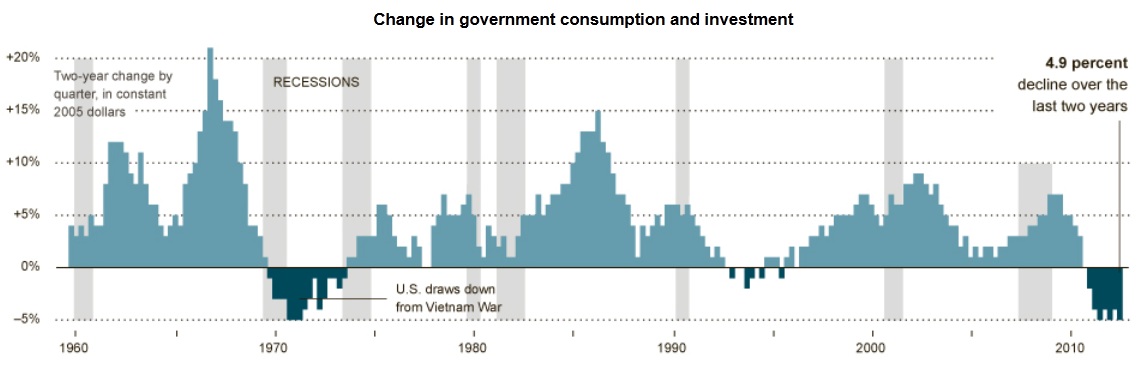
- Change in Government Consumption and Investment
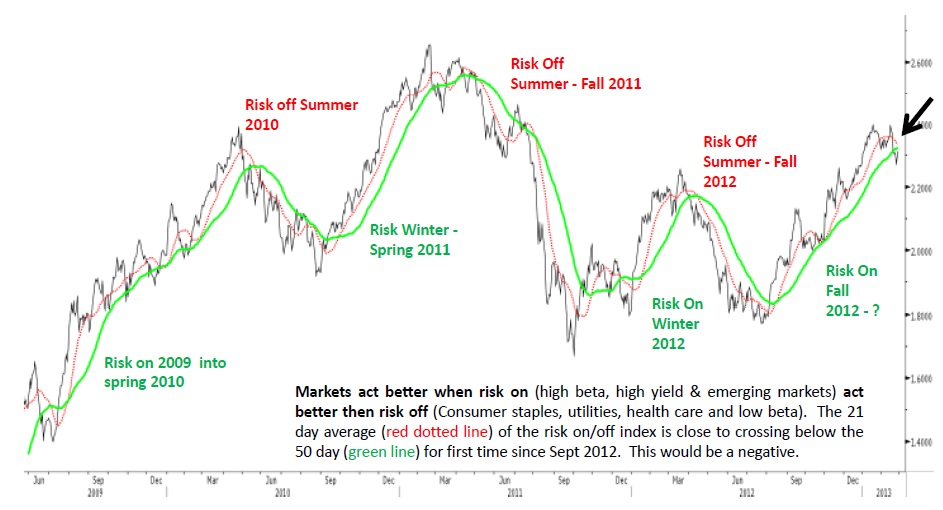
- Risk On, Risk Off Index
- 10 Thursday AM Reads
- January New Home Sales Bullet Points: The Reality
- Markets or Media: Which is More Irrational?
- Mitigating the Theft of U.S. Trade Secrets
| Sequestration Debate Misses the REAL Issue Posted: 28 Feb 2013 10:30 PM PST Waste and Fraud Are the Real Causes of the DeficitWith sequestration set to go into effect in a few days, everyone is talking about it (via Google trends): Sequestration means across-the-board cuts in government spending, split 50%-50% between the military and domestic spending. As this post will show, the hypocrisy surrounding the sequestration debate is stunning. For example, president Obama says that sequestration is the GOP's fault. But Bob Woodward and YouTube reveal that Obama supported sequestration from day one. And Dems obviously want to slash military spending and protect domestic programs, while the GOP wants to slash entitlements and leave military spending as is. But the whole sequestration debate misses the bigger picture: Tremendous savings can be wrung out of both military and domestic spending without reducing services to either. Military Wasting Bucketloads of Money on Non-Defense CostsBusinessWeek and Bloomberg point out that we could slash military spending without harming our national security. Specifically, we could slash boondoggles that even the generals don't want:
BusinessWeek also notes that redundancy wastes a lot of money:
BusinessWeek provides a list of cost-cutting measures which will not undermine national security. American Conservative does the same. So why doesn't Congress trim the fat? Because politicians want to bring home the pork. As BusinessWeek notes:
American Conservative reports:
Of course, this just scratches the surface. In reality, the military wastes and "loses" (cough) trillions of dollars. See this, this, this, this, this, this, this, this, this, this and this. The Secretary of Defense acknowledged in May 2012 that the DOD "is the only major federal agency that cannot pass an audit today." The Pentagon will not be ready for an audit for another five years, according to Panetta. Republican Senator Tom Coburn also notes that the Department of Defense can reduce $67.9 billion over 10 years by eliminating the non-defense programs that have found their way into the budget for the Department of Defense. And Coburn documents abusive wastes of taxpayer dollars, including:
In addition, the defense department spends huge sums securing our access to oil. In 1991, the Government Accountability Office estimated that – between 1980 and 1990 – the US spent $366 billion to defend oil supplies in the Middle East. America was not fighting any major wars – in the Middle East or elsewhere – at the time. George W. Bush, John McCain, Sarah Palin, a high-level National Security Council officer, Alan Greenspan and others all say that the Iraq war was really about oil. Nobel prize winning economist Joe Stiglitz says that we'll end up spending $3-5 trillion spent on the Iraq war alone. See this, this and this. Indeed, most of our wars are fought for petroleum resources. Security experts – including both hawks and doves – agree that waging war against Iraq and in other Middle Eastern countries weakens national security and increases terrorism. See this, this, this, this, this, this, this and this. So why is our defense spending so high? Because war and defense spending – as President Eisenhower warned so long ago – is a feature, not a bug … which makes the rich even richer. American Conservative reports:
Any lingering doubts about whether we can cut defense costs without undermining our national security can be dispatched with a few facts:
Government Squandering Taxpayer Money on Unnecessary Domestic ExpensesAll of the top independent economists and financial experts (and many bankers) say that we've got to break up the big banks to save the economy. Instead, the government has thrown trillions at the big banks to artificially make them appear profitable. The bailouts are continuing non-stop … to this very day (and see this). Indeed, the government chose the big banks over Main Street, the average American … or the economy as a whole. And see this and this. As such, the government has sucked trillions out of the real economy by pushing policies which destroy jobs (sorry … Obama doesn't care), redistributed wealth upwards from the broad economy to a handful of the very richest (which trashes the economy .. and Obama is even worse than Bush), and destroyed savers and Main Street. In other words, we have thrown many trillions of dollars at the banks, and then sucked trillions more out of the real economy. As we noted recently:
Given the above – and the fact that we no longer prosecute the big white collar criminals – we no longer have a free market economy … we have fascism, communist style socialism, kleptocracy, oligarchy or banana republic style corruption. As such, the machinery of capitalism – which could generate enough prosperity to dig us out of this budget deficit – has been broken. Indeed, fraud caused the Great Depression and the current financial crisis. The government could easily close the budget deficit by clawing back bonuses and ill-gotten gains from every Wall Streeter who committed fraud. Moreover, the government has encouraged American companies to move their facilities, resources and paychecks abroad. And some of the biggest companies in America have a negative tax rate… that is, not only do they pay no taxes, but they actually get tax refunds. If we want to stop the budget deficit from spiraling out of control, we should stop the "giant sucking sound" which is shipping prosperity abroad. (And a large percentage of the bailouts went to foreign banks (and see this). And so did a huge portion of the money from quantitative easing. More here and here.) Finally, the current banking system is set up so that the government has to pay trillions of dollars in unnecessary interest costs to the big banks to "create money" and expand the money supply. To understand this crazy system, read this. The Bottom LineThe bottom line is that the entire "sequestration" debate misses the real issues and the true sources of our budget deficit:
Note: Time Magazine noted last December in an article entitled "The Best Way to Cut Government Spending: Get Really Tough on Fraud":
|
| This Year’s Subsidy to Wall Street = This Year’s Sequester Cuts Posted: 28 Feb 2013 05:00 PM PST Guest post by Eric Zuesse. Investigative historian Eric Zuesse is the author, most recently, of They're Not Even Close: The Democratic vs. Republican Economic Records, 1910-2010. ~~~ Since we've bailed out the 10 largest banks $83 billion this year alone, should they give it back to us by paying into the U.S. Treasury the amount of this year's sequester? After all, it's the same amount. On February 20th, Bloomberg News editors headlined, "Why Should Taxpayers Give Big Banks $83 Billion a Year?" and issued the first-ever thorough and current analysis of the taxpayer-subsidy to the Wall Street mega-banks. They found that this subsidy is $83 billion this year, but they made no note of the fact that this amount is only $2 billion less than this year's sequester cuts are estimated to be, so that all that would need to be done, in order to avoid those cuts, would be to have those mega-banks that we bail out every year forego their subsidy from taxpayers, for just one year. Unfortunately, this would be easier said than done. That $83 billion subsidy this year is, according to Bloomberg's, also approximately the amount of profits that those banks are "earning" this year. So, if the mega-banks wouldn't refund it out of what we gave them last year, then they could just refund it by paying to us – who, after all, bailed out their stockholders enormously in 2009 – the "profits" that they made this year. The editors at Bloomberg News (hardly a bunch of populists) calculated this $83 billion figure based upon their analysis of the figures in a sadly ignored but rigorous study that had been done by IMF economists, a study that had been issued months back, in May 2012, and which was titled "Quantifying Structural Subsidy Values for Systemically Important Financial Institutions." As Bloomberg's editors summarized the reason for this ongoing federal subsidy: "The banks that are potentially the most dangerous can borrow at lower rates, because creditors perceive them as too big to fail," due to the special Government backing for too-big-to-fail (TBTF) institutions. The taxpayer-funded annual subsidy to these TBTF banks has never before been calculated as to its actual annual dollar-value, but this rigorous IMF study finally provided the means for doing that. Bloomberg's summarizes: "What if we told you that, by our calculations, the largest U.S. banks aren't really profitable at all? What if the billions of dollars they allegedly earn for their shareholders were almost entirely a gift from U.S. taxpayers?" "The top five banks – JP Morgan, Bank of America Corp., Citigroup Inc., Wells Fargo & Co. and Goldman Sachs Group Inc. – account for $64 billion of the total subsidy, an amount roughly equal to their typical annual profits."
This $83 billion, in other words, is the current value of the annual subsidy received by America's 10 mega-banks, from our Government's special treatment of them as "Systemically Important Financial Institutions" (i.e., fully guaranteed by U.S. taxpayers, irrespective of the normal $250,000-per-account limit in savings and checking accounts), or TBTF institutions, which the other 7,053 (out of the total 7,063 FDIC-insured) banks are not – other banks can fail without destroying the U.S. economy. In a certain sense, these are the banks where the super-rich can enjoy FDIC protection without that $250,000-per-account limit, and can even gamble under the protection of that comforting umbrella. The Dallas Federal Reserve has issued a superb study showing that even at the peak of the crash, when the highest percentage of loans were in arrears, which had occurred around January 2010, only around 3% of loans were in arrears at banks that had "less than $1 billion" in assets, whereas banks that had "over $250 billion" (and only 12 banks are in that august category) were experiencing around 12% of loans in arrears. The following chart on page 7 of the Dallas Fed's study showed that the 2008 crash was virtually entirely a Wall Street (or mega-bank) phenomenon:
The big-ten banks are the ones that benefited from that $83 billion handout this year, and, as was noted, they did so because they are TBTF. Because these banks (basically the top line there) are TBTF, their top executives can have them engage in, essentially, high-risk gambling (such as "no-doc" or "liars" loans) with the vast sums that are under their command, since the people who buy stock in these banks know in advance that if these high-risk bets fail, then U.S. taxpayers (we) will eat their losses. Consequently, the only incentive for CEOs of these banks is to increase their bank's size even more, so as to increase their bonuses even bigger, since these executives don't really need to worry about risk (except as a PR issue, perhaps, but they hire PR people – including politicians – to deal with that). When Wall Street got bailed out to the tune of trillions of dollars by the U.S. Treasury, and the Federal Reserve (and with Fannie Mae, and Freddie Mac serving as a conduit between them and Wall Street), this left very little remaining for the Government to spend on the rest of the economy, such as infrastructure and education (the kinds of things that we supposedly pay taxes for), which might be why the recovery has been so slow, from the 2008 crash that was caused by Wall Street's federally-insured gambling with the trillions that they control of everybody else's money. If so, then this sequester is a result of Wall Street's failed bets: instead of cutting back on the subsidy to Wall Street, the politicians in Washington have chosen to cut back on government services to the public. Politicians like Barack Obama and his team, and the George W. Bush team before them, and all of the supporters of TBTF in Congress, made the basic choice to subsidize the mega-banks instead of the needy or the deserving, and this is also why the "Top 1% Got 93% of Income Growth as Rich-Poor Gap Widened" under Obama. It really is a plutocracy; that's precisely the way today's USA is functioning – no doubt about it. There were other possible ways of dealing with the 2008 crash than to continue to throw trillions of dollars at Wall Street, but that is what "our" Government did, and continues to do, because, essentially, this is what the super-rich pay them to do. Bloomberg's $83 billion/year finding here is so vast that it suggests that the U.S. is a crony-capitalism, hardly an authentic capitalism. The "cronies" are these giant Wall Street firms and their "counterparties" (namely, each other, plus Fannie & Freddie and the government officials and lobbyists, who all serve Wall Street), and also the stockholders and bondholders in these huge financial institutions: the mega-banks that would otherwise be "cleaned out" but for the TBTF backing they receive from U.S. taxpayers. We're getting reamed by Wall Street and K Street, and this is the first estimate of the actual circumference of that reaming. The Dallas Fed's study says that this reaming must stop, and that, despite what the Federal Reserve itself says, the mega-banks must be broken up. The easiest way to do that might be for Congress to pass a law that prohibits the largest ten banks from participating in the FDIC. That would transform the entire financial system, but Wall Street would hate it because it would yank their honey-pot. Because Wall Street's Mayor Michael Bloomberg made his roughly $20 billion fortune by serving the mega-banks, this editorial from Bloomberg News constituted remarkable news, in and of itself. One other study of "Valuation in Systemic Risk at U.S. Banks During 1974-2010" found that the taxpayer-subsidy was $300 billion in 2008 but supposedly near zero after 2009. Matt Levine linked to that study on 7 May 2012 under the optimistic headline "Markets Are Telling Us That Too Big To Fail Is All Better." The editors at Bloomberg ignored that study. The financial expert Yves Smith, when I called to her attention that that study, which she had relied upon, zeroed-out the megabanks' systemic risk after 2009, wrote in reply, "I didn't realize they were doing this using bank equity volatility as the proxy. He did not make clear how he was going to do about it in the talk. Methodologically, that's crap." So, Bloomberg's editors have issued the only reliable study that has ever been done on the size of this important subsidy. Bloomberg's editors were courageous to do this, and they are already getting flak for having done it. On February 24th, they issued a follow-up, "Remember That $83 Billion Bank Subsidy? We Weren't Kidding," and explained in more detail how they had calculated this $83 billion sum. They explained why the $83 billion estimate was far likelier an underestimate than an overestimate. Anyway, this subsidy is a major problem, probably at least as big as the sequester, which it might have helped to cause. On February 28th, Yves Smith posted at her "Naked Capitalism" website, "Occupy the SEC, Frustrated With Regulatory Defiance of Volcker Rule Implementation Requirements, Sues Fed, SEC, CFTC, FDIC and Treasury," and she linked to a new legal filing in the Eastern District of New York "over the failure of the relevant financial regulators to issue a Final Rulemaking as stipulated in Dodd Frank." She summarized what the evidence clearly showed: "Not only are the[y] out of compliance [with the Dodd-Frank Act's Volcker Rule provision for these regulators to draft rules restricting the mega-banks from gambling with investors' money], they [the regulatory agencies over the mega-banks] appear to have no intent of finalizing the Volcker Rule." She went on to say: "Much of the public still fails to understand the degree to which the ruling classes no longer represent their interests. Oh, they may resent the banks, and they may also hate Congress, but most people deeply need to believe they live in a system that is fair and where business and political leaders (some if not all) still deserve respect and admiration." Comment by Washington's Blog: President Obama says that sequestration is the GOP's fault. But Bob Woodward and YouTube reveal that Obama supported sequestration from day one. Read potential solutions to the sequestration debate.
|
| Posted: 28 Feb 2013 01:30 PM PST My afternoon train reading:
Whatchu talking ’bout Willis?
Sluggish economy may signal correction |
| Posted: 28 Feb 2013 01:13 PM PST |
| Change in Government Consumption and Investment Posted: 28 Feb 2013 11:30 AM PST |
| Posted: 28 Feb 2013 08:53 AM PST Click to enlarge
Fascinating chart from my partner Kevin Lane – he works on the Institutional side and is the creator of the algos that drive FusionIQ. Kev created a RiskOn/Risk Off chart by plotting High Beta, High Yield and Emerging Markets versus Consumer Staples, Health Care and Low Beta names. When risk appetites are higher, it is reflected in the ratio moving higher. When fear levels rise, and sector rotation switches to the defensive names, and the ratio heads lower. We do regular conference calls with subscribers of FusionIQ, and this is one of the charts we discussed on our call last night. You can download the full slideset here.
Source: |
| Posted: 28 Feb 2013 06:46 AM PST My morning reads:
What are you reading?
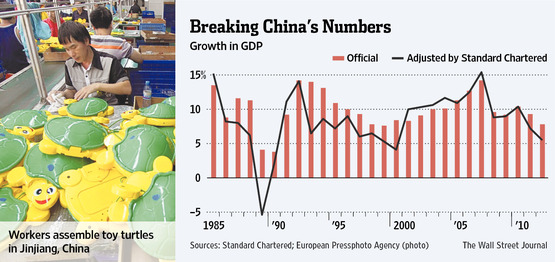
Hidden Risks of a Hard Landing in China |
| January New Home Sales Bullet Points: The Reality Posted: 28 Feb 2013 05:30 AM PST “Will have client detail report out later that clearly shows that stimulus and headlines have once sharply overstated this data set. Bottom line, this morning’s headline number of 437k was juiced by an unacknowledged short term-event…the year-end cap gains changes. We saw this same thing happen in CA Existing Sales for in Jan…”the cap gains effect ” has been boosting sales volume since Sept but ultimately will lead to a hangover near-term. In short, in January ALL of the 4k MoM increase in New Home Sales came from the “Western Region” greatly supporting the cap-gains theory. So does the fact that the Northeast — a higher end region — saw a 1k jump in sales (which is 50% due to such low volume in that region) and the South and MidWest regions showed zero sales gains, as there are so few houses there that would be hit with cap gains. Lastly, in this morning’s “surprise” consumer confidence beat the subset housing data showed the expectations to buy a new home in the next 6 months dropped to near a 3 year now. When a single region outperforms and is responsible for mostly all the gains or losses in a monthly data series go digging because something is not right. And paying attention to headline seasonally adjusted annualized numbers can lead to confusion and malinvestment. The real story always lies beneath the headlines as bulleted below. 1) The Jan New Home Sales headline SAAR blow out of 437k is a case of seasonally adjusting stimulus. This sets up for disappointment near-term. 2) Jan 2013 New Home sales higher by 3k to 4k NSA (can’t tell exact amount due to Census Bureau rounding) sales. Most — if not all — of this increase is due to homeowners that sold their houses for cap gains and rebought in Jan. We saw this in the CA and national resale numbers for Jan as well. The cap gains effect also supported New and Existing Home Sales in ALL of Q4, which means there is a pull forward effect in play, which always ends with a hangover. Some cap gains sellers will probably rebuy in Feb as well. Think about this…the entirety of this morning’s MoM gain in Jan New Home Sales was on 3k to 4k houses, or 1% of the volume of Existing Home Sales sold in January. Bottom line, it’s a rounding error to macro housing and GDP that means nothing until cap gains credit sellers get done rebuying, which will happen soon. Feb cap gains incremental buyer volume will probably be halved. 3) The FULL 4k MoM gain in New Home Sales came from the Western Region supporting the theory it was mostly cap gains sellers/rebuyers who will not be there for long. 4) Dec 12 sales revised higher by ONE THOUSAND sales to 27k NSA. But Nov revised LOWER by one thousand sales to 29k. So, net-net wash. With sales only in the mid-to-high 20k’s per month a couple of thousand sales in a trough month can produce some pretty amazing headlines when you annualize the number and then throw on top some seasonal adjustment hot sauce. Just like they did in 2010 during the homebuyer tax credit period when “record high” sales were going through and everybody then thought we were in a “durable” housing market recovery with “escape velocity”. Shortly thereafter, Existing Sales took a 30% MoM collapse on the tax credit sunset and everybody all at once realized that massive stimulus really does “activate” certain demand cohorts all at once, steals from the future, and leads to severe disappointment when the stimulus is removed.
Best Regards,
Mark Hanson
|
| Markets or Media: Which is More Irrational? Posted: 28 Feb 2013 04:26 AM PST The dreaded sequestration is upon us! The world is ending! Run away! — and Markets scream higher. Something appears to be wrong with this picture — and this morning, we are going to discuss which of these two organizations is incorrect. Let’s begin by noting both of these entities are self organizing collections of humans. Irrationality is built into their essence. We cannot get away from that factor, at least not until the singularity arrives, and humans can have their irrationality (and humanity) programmed out of them. For now, let’s simply admit that this is an inherent function of the breed. It cannot be avoided in organizations of Humans. Second, consider the motivations (to anthropomorphize this) of each entity. There in lay the clues as to which is more or less rational. Markets exist as a place where capital, investors and investments intersect in the form of securities. It is where the buying and selling of debt and equity occurs. Those with capital can invest in or lend to those who can put it to better potential long-term use, be they start ups or existing companies or governments. Media is a business form that creates content, which then attracts an audience. Media then monetizes that primarily by selling access to this audience to its advertisers. Neither of these entities is any stranger to irrationality. While noth have a profit motive, they each go about pursuing it in very different ways. At Market tops and bottoms, the collective pricing of its wares becomes absurd. In 1982, stocks traded at an 8 P/E. In 2000, they traded at 32 P/E. On the eve of crisis in October 2007, stocks were priced as if all was fine. In March 2009, stocks were priced as if governments and the Federal Reserve were going to do nothing. History teaches us that the human elements of markets all too regularly spiral into spasms of mass delusion. Media has a somewhat differing approach to embracing irrationality — with a different level of background foolishness. Hype is the watchword, and the media can take a relatively modest issue and blow it up far beyond reasonable proportions. Think back to Y2K as an example of relentless media silliness and fear mongering. The world was going to come to a stop on December 31st, 1999 when the clocks rolled over. (Nothing happened). This past December, the Fiscal Cliff was going to be yet another disaster. Again, you should have ignored the hype. And now, we have the sequester. It is front page story, lead item on every TV show. Yes, Sequester is likely to shave at least 0.5% off of our total GDP. It reflects the congenital dysfunction in Washington, DC. I don’t want to suggest this is a good thing — it is, as the comic below suggests, a self-inflicted wound. But it is not all that much of a stretch to read the actions of the market as suggesting its not all that. With Markets, the irrational behavior is a bug. Smarter, more experienced investors are aware of this all-too-human behavior. It creates opportunities, but is wildly disruptive. When markets become irrational, a majority of its participants suffer. Entire schools of thought have arisen to study irrational behavior of financial actors (i.e., Behavioral Economics and Neurofinance). It is not considered an advantage when markets spiral into their regular fits of irrationality. With Media, irrational behavior is a feature, not a bug. The goal is to attract a large audience that can be monetized with adverts. Hence, there is an incentive to emphasize the outrageous, the ridiculous, to create buzz and hype. An entire subspecialty dedicated to studying memes and viral events has arisen to capitalize on this. It is considered an advantage when media spirals into their regular fits of hype. From a business perspective, “Irrationality” to organizations that sell audiences to advertisers, is quite a rational behavior. Washington D.C. is the perfect foil for Media. It creates a a false narrative that plays right into their sweet spot. There are the classic elements of narrative conflict: Great stakes, villains and heroes, dramatic personalities, risk and redemption. As previously discussed, the media narrative about the 2012 presidential election — the horse race that was too close to call — was wildly wrong. But it sold boatloads of papers and advertising. It also scared some people into them into some poorly considered decisions. Over the years, I have tried to emphasize how dangerous a compelling narrative can be to investors. This is where the media narrative becomes so dangerous. I don’t want to suggest either is monolithic. Markets consist of buyers and sellers. Media has a spectrum of opinions. Markets produce an investment opinion by the preponderance of actions of its participants. Some press practitioners actually got these things right, and were proven by time to possess insight. But what we are referring to here is the overall actions, the collective impressions each creates. Between the two entities, which are you more likely to believe — the one whose job it is to match buyers and sellers, or the one who is trying to deliver an audience to advertisers?
|
| Mitigating the Theft of U.S. Trade Secrets Posted: 28 Feb 2013 03:00 AM PST |



| You are subscribed to email updates from The Big Picture To stop receiving these emails, you may unsubscribe now. | Email delivery powered by Google |
| Google Inc., 20 West Kinzie, Chicago IL USA 60610 | |



0 comments:
Post a Comment