.

{2} GoogleTranslate (H)

English French German Spanish Italian Dutch Russian Portuguese Japanese Korean Arabic Chinese Simplified

Our New Stuff

{3} up AdBrite + eToro

Your Ad Here

Friday, March 8, 2013

The Big Picture

The Big Picture


Open Thread: Federal Reserve

Posted: 07 Mar 2013 04:43 PM PST

Tonite, let’s have a little fun with our subject, being the Fed:

How much is the Fed driving markets?

What about the Economy — how much impact is the FOMC having on auto purchases? Home sales & refis? GDP?

~~~

What say ye?

Trend & Technicals: “The Pain Trade is Higher”

Posted: 07 Mar 2013 03:23 PM PST

Chris Verrone, head of technical analysis at Strategas Research Partners, talks about the outlook for the U.S. stock market and investment strategy. Verrone said the Standard & Poor's 500 Index may climb past its all-time high by June, following the Dow Jones Industrial Average in setting a new record this year. He speaks with Tom Keene and Michael McKee on Bloomberg Radio's "Surveillance."


Source: Bloomberg, March 6 2013

10 Thursday PM Reads

Posted: 07 Mar 2013 01:30 PM PST

My afternoon train reads:

If you make the same forecast repeatedly for 15 years, you will eventually be right: Dow 36,000 Is Attainable Again (Bloomberg
• Why analysts should not be investors, Andy Zaky edition (Reuters)
• What to do now if you're mostly in cash (MarketWatch) but see Wrong question. (The Reformed Broker)
• More to Dow's Rally Than Just the Fed (WSJ)
• When the Corporate Elite Supported Raising Taxes (Echoes)
• Why 401k Investors Chase Performance – and How to Prevent It (Fiduciary News) see also 401Ks are a disaster (USA Today)
• Investors Seek Ways to Profit From Global Warming (Businessweek)
To Hell with Reg FD! Bank of America Investors Grill CFO At Dinner (The Street)
• How Disney Bought Lucasfilm—and Its Plans for ‘Star Wars’ (Businessweek)
• A Day in the Life of a Freelance Journalist—2013 (Natethayer)

What are you reading?


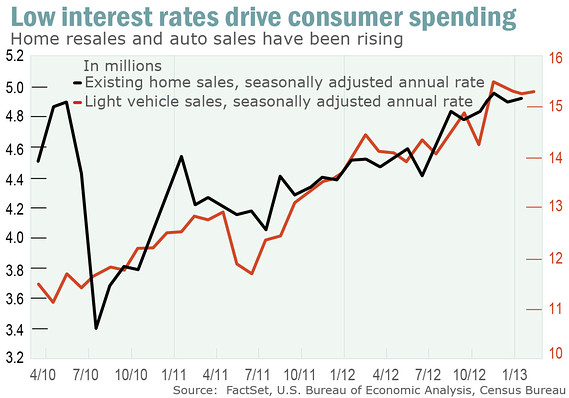
Low Interest Rates Drive Consumer Spending

Source: MarketWatch

U.S. Business Cycle: Yo-Yo Years

Posted: 07 Mar 2013 11:45 AM PST

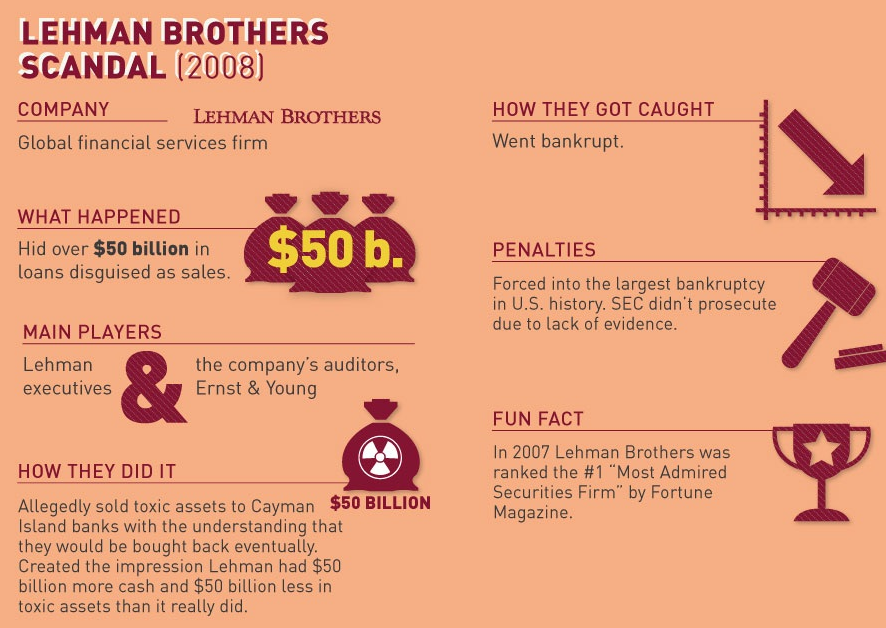
10 Worst Corporate Accounting Scandals

Posted: 07 Mar 2013 11:30 AM PST

click for all 10 scandals

Via AD.org


Full graphic after the jump


Source: Accounting-Degree.org

Achuthan: U.S. Recession Began Middle of 2012

Posted: 07 Mar 2013 11:16 AM PST

Lakshman Achuthan, co-founder of the Economic Cycle Research Institute, talks about the U.S. economy. Achuthan speaks with Tom Keene and Sara Eisen on Bloomberg Television’s “Surveillance.” John Silvia, chief economist at Wells Fargo Securities LLC, also speaks.


Source: Bloomberg, March 7 2013

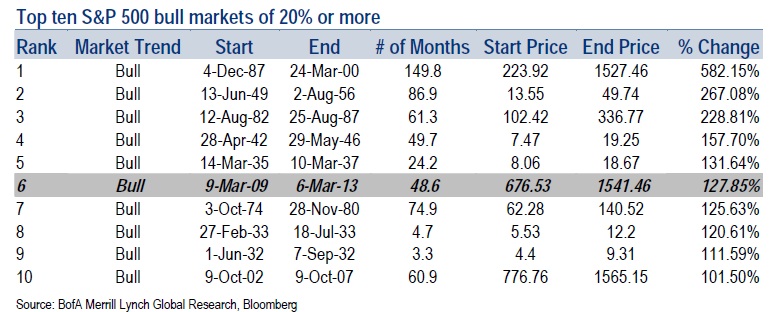
Current Market Rally is 6th Best Since 1929

Posted: 07 Mar 2013 08:30 AM PST

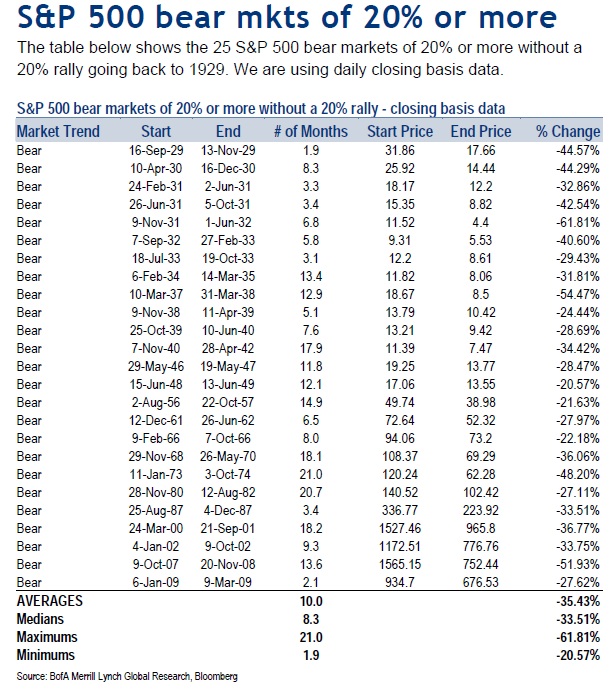
The S&P 500 rally dating back to March 2009 is the 6th best rally since 1929:


click for larger tables

Source: Merrill Lynch


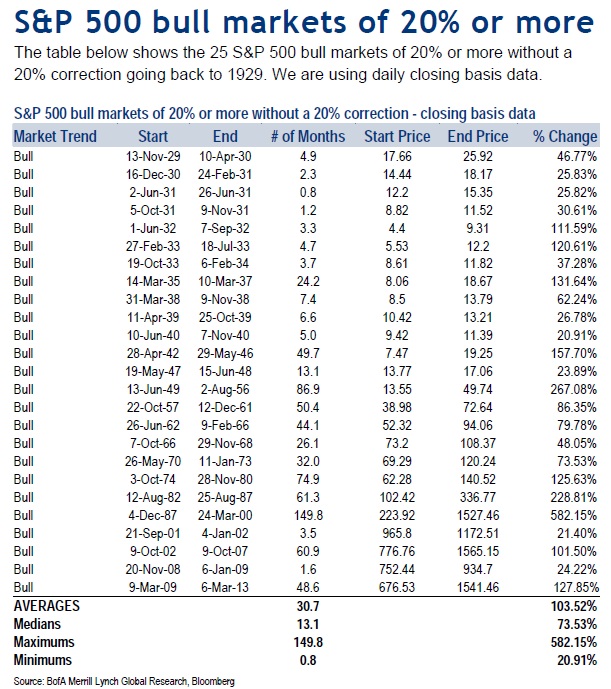
Full tables of past Bull and Bear markets after the jump . . .


S&P 500 Bull; & Bear Markets of 20% or More:


Big Bulls


Big Bears


Source:
The S&P 500 rally from Mar 09 is the 6th best rally since 1929
March 7, 2013
Merrill Lynch

10 Thursday AM Reads

Posted: 07 Mar 2013 07:00 AM PST

My morning reads:

• Jobless Claims in U.S. Unexpectedly Fall to a Six-Week Low (Bloomberg) but see With Positions to Fill, Employers Wait for Perfection (NYT)
• Is that a buy from the Coppock indicator? (FT Alphaville)
• Holder says some banks are 'too large' (FT.com) see also Too-Big-to-Fail Banks Limit Prosecutor Options, Holder Says (Bloomberg)
• With Legal Reserves Low, Bank of America Faces a Big Lawsuit (DealBook)
• Citizens in Europe are rejecting austerity policies as deeply misguided (theguardian) see also We've reduced the deficit and hurt the short-term economy (Wonkblog)
• New robots in the workplace: Job creators or job terminators? (The Washington Post)
• Fallout from ‘Untouchables’ Documentary: Another Wall Street Whistleblower Gets Reamed (Taibblog)
• ComScore:  iPhone Taking Share From Android in U.S. Smartphone Market (comScore)
• The father of all men is 340,000 years old (NewScientist)
• How to predict the progress of technology (MIT news)

What are you reading?


Bad-News Bears Crash the Party

Source: WSJ

Is There a Rental Supply Glut?

Posted: 07 Mar 2013 05:30 AM PST

Mark Hanson:

Summary…”If you buy it, they may not rent it…at the price you thought or need”

A side of the “flood of investors sucking up all the supply” story that nobody is talking about…weakening rental demand. Phoenix cap rates projected to be between 1.75% and 4% at present (unless you do all the maintenance yourself). With caps this low, one may as well buy INTC or lever up 10 year notes at 1.9% and take far less risk than buying the tail end of a Twist-induced housing market short squeeze on the verge of a ‘consolidation’.

Weak national rental demand — relative to the flood of rental single family and multi-unit supply coming on line – is a potential 2013 US housing market theme that will take it’s toll on landlords, REITs, institution investors, house prices, price/rent ratios, relative affordability, loan default & mod redefault rates (as the millions on the default fence or in high leverage mods decide it’s better to de-lever and rent), and ultimately the full blown housing recovery thesis now fully factored into every macro economic and investment models out a decade into the future.

Do you remember looking at ‘opportunity fund’ capital raising slide decks a couple of years ago? A central thesis to the ‘buy and rent’ trade was not only historic low rates forever but millions upon millions more foreclosures for the next several years and all of those former homeowners needing a place to rent. On the rates side, they nailed it. But on the rental demand side, the exact opposite happened. As every insti and private investor domestic and foreign was buying up all low-end and distressed house in the country the banks and government made 8 million loan mods and workouts turning homeowners into renters of their own home. And they made it virtually illegal to foreclose too boot. As foreclosures hit a pre-crisis low in 2012 rental demand has been by and large dictated by good ol macro economic factors such as jobs, income, tax rates, energy costs etc, none of which are screaming in the direction of more demand and higher rents.

So, in short the “buy and rent” trade has turned into one in which you have to fight the government for the demand, which is something nobody factored into the ‘investment’. On the contrary, most have stable and linear 3% to 4% annualized rent increase factored in. If rents drop 15% in the first half of 2013 (from the back half of 2012), which is a number I simply picked from my model range of -5% to -25%, everything changes literally overnight. The present lack of ‘for sale’ supply could easily turn into supply wave quickly reversing the past years’ upward house price trajectory. Some will say, ‘that’s great, the market is starved for supply’. Yes, it’s starved for specific lower-end and/or distressed ‘investor’ supply. It’s extremely questionable that if a wave of rehabbed former investor rentals were to hit the market as resales whether first-timer and repeat organic (or investor) demand would be there in kind. Some will then think of all the stories you read daily of ’40 offers on every house and organic buyers not being able to buy’. This is happening. But from most all the Realtors I talk to, it’s the same 37 investors bidding cash pushing out the 3 organic bidders that need loans in order to buy. So bottom line, a wave of rehabbed resales from panicked investors shuttering supply could quite possibly be met with meager first-timer and organic demand.

In media and sell side housing market reports that refer to the investor landlord/renter nation ‘movement’ everybody takes for granted ‘if they buy it, it will automatically rent at market rates’. In fact, most never even talk about the rental demand side of the equation because they assume it’s a ‘given’. But that’s not the case, at least in Phoenix. There is so much rental supply on the market — and coming on line — that landlords are in full blown price cutting wars. Moreover, aggressive landlords have loosened rental guidelines to accept virtually anybody with a cashiers check and heartbeat.

Bottom line: A flood of institutional and private investor landlord buyers have shredded the inventory in Phoenix, Las Vegas, CA and several other of the more legacy distressed regions around the nation. For quite some time there have been bidding wars with investors paying 10% to 20% over “appraised value” looking at cash-flow yield as the primary metric and real ‘value’ way down the list of factors. But the story has taken a major left turn at least in Phoenix, which is the first market I am studying closely. In short, as rental supply reaches record highs, rental demand is falling pervasively. This, while Phoenix house sales demand have been negative on a YoY basis for several months now with January down double-digits.

  • “Help! I have a rental that nobody wants to rent! Well, at least at the price I want to charge”
  • “Help! We have a 200 housing start community in the Phoenix area and potential buyers can rent one of a 100 houses just like the ones we are building right across the highway”
  • “Help! We have owned 300 houses in Phoenix for a year and a half, cap rates are half of what we had modeled, and rents are dropping. Humm, maybe it’s time to sell half”
  • “Help! Honey, we spent the last two weeks looking at rentals and there is so much to chose from I can’t make up my mind! Ok then, let’s go low ball them”
  • “Help! Legacy loan defaults and Modification redefaults in AZ have suddenly started rising again. Perhaps this has something to do with the plethora of rehabbed single family houses available for rent in the region. I guess we have to start ratcheting up loan loss reserves this quarter”.
  • “Help! BlackOchPersTress fund just called and wants to list 200 single family houses for sale!”

I think there is a strong chance that we could all of a sudden see for-sale inventory levels rising sharply and prices dropping in the ultimate whip-saw event this spring/summer that ‘nobody saw coming’. Throughout history investor and first-time buyer demand has been known to ‘vanish’ literally overnight. Legacy distressed markets markets like Phoenix all around the country have been supported by these cohorts for years. And with over TWO-THIRDS OF all mortgage’d households in Phoenix unable to sell and rebuy (due to epidemic negative and effective negative equity, credit, or income problems) the repeat buyer cohort will not be able to catch this market as it drops.

Recent, First-Hand Phoenix Rental Market Experience

I have some friends in the Phoenix “skirts”, Chandler, AZ to be exact. Chandler AZ (like Gilbert and Mesa) is a burb of Phoenix known for overbuilding, foreclosures, a ton of single family houses etc. But it’s also known for it’s family bias, decent schools etc. Areas like this are where investors have swarmed to buy and rent single family houses. Reports typically generalize the Phoenix outskirts as “Phoenix”.

My friends recently had a third kid and needed a new house so went out looking last summer. They are significantly underwater in their present house but their Realtor promised them it would be no problem to rent out their house after they bought the new one. So, they went housing shopping beginning in July. Every house they liked there were multiple offers, most all from investors. They couldn’t get an offer even looked at for months because they were not a cash buyer…they had a contingency that the purchase price and appraised value had to jive… they could not pay 15% over appraised value like Blackrock does…they are NOT paying with other people’s money…you get my point here.

Finally, they found a “HUD” foreclosure (HUD resales generally have “no investor” provisions), were first to bid, and got the house. They moved in a few weeks ago. After they spent a bunch of money fixing up their old house they put it up for rent hoping to get someone in quickly because they technically can’t afford the new house without the rental income. The day they listed their old house for rent they considered their “move” complete. Little did they know the stress was just beginning.

“Still, no calls on our rental”

To set the stage properly their old house is “worth” about $120k. They initially put it up for rent at $1100/mo. After expenses and at a 90% occupancy rate this would equate to about a 5% cap rate. Not great, but not a killer. This is of course if they got $1100 a month. But they didn’t…not even close.

The first week the rental ad ran no calls came. So, they lowered their rental price by 10% the second week. Still, no calls. They lowered their price by 15% the third week and a couple of calls came but it was from people wanting to “make an offer”. This weekend they lowered the price by 20% — to $875 — and they got 2 calls. While $875 still works for them they are beginning to panic. Last week they talked to their Realtor extremely concerned about the lack of rental demand. He replied “the market has changed dramatically in the past 6 months. There is a flood of rental supply and not enough renters so there is a price cutting war by landlords just to get people in”. If they end up getting $800/mo that’s about a 2-cap.

Note, a 5-cap is a rate of return far too low for most insti investors, a 2-cap is a non-starter for all but the investors who have to deploy capital (typically other people’s capital) in order to get a paycheck. Anyway, my friend’s house is in the rental sweet spot, which makes this story even more pertinent to the rental investor community. That’s because as you go higher in house price/value rents don’t keep up, so cap rates fall.

Like everything else in the housing sector since even before the crash happened…a key piece of the story is being left out of all the sell side research and financial press “housing recovery” stories. In the case of Phoenix — and most likely most other heavily distressed regions turned ‘investor havens’ throughout the nation — it looks like the missing piece of the story is the lackluster demand for the mega-supply and nowhere remotely close to the rental returns investors had hoped for unless you bought the right property in a relatively small window that slammed shut in early 2012.

Rental Supply Glut will Promote Increase in Strategic Loan Defaults & Mod Redefaults

Another consequence of the surge in rental supply and drop in rental rates should be a rise in loan defaults and mod redefaults. In Phoenix for example over 60% of the mortgage’d population is underwater or effectively underwater, many living with high LTV and DTI mods. Many of these Zombie homeowners simply find it easier to pay their 2% to the bank or for a HAMP mod than to finally de-lever through foreclosure or short sale and move their families, change schools etc. However, if all of a sudden houses similar to theirs are popping up in the neighborhood for lease without the expense of taxes, insurance, and maintenance it will absolutely push borrowers on the default fence or struggling every month with high DTI mods out of their houses into rentals.

In closing…

I have believed for a long time that the activity in Phoenix — and regions with similar ‘investor activity around the nation — was a short squeeze…a trade…nothing “durable”…on the back of Twist and 1.5% 10s. This due to a variety of fundamental factors least of which is that over 60% of all mortgage’d homeowners in the region are underwater ‘Zombies’ (not enough equity to sell and rebuy) and at least a third of those who aren’t Zombies don’t have the credit or income necessary to sell and rebuy; and the mortgage mod bubble further preventing the all-important repeat buyer cohort from selling and rebuying.

I have also believed for a long time that the lack of foreclosures — and the mortgage mod/workout bubble — would ultimately be a killer for those hoping to rent houses to distressed borrowers. Of course, that’s because the banks and gov’t let all these potential borrowers rent their owns houses from them a 2% interest only for 5 years. And this is exactly how it’s playing out.

I will be going to Phoenix shortly in order to meet with several brokers and new-era “landlords” but until then I wanted to get this theme out to you.

Best Regards,

Mark Hanson

www.MHanson.com

Organic Organization Chart

Posted: 07 Mar 2013 05:00 AM PST

OrgOrgChart Autodesk Research

The OrgOrgChart (Organic Organization Chart) project looks at the evolution of a company’s structure over time. A snapshot of the Autodesk organizational hierarchy was taken each day between May 2007 and June 2011, a span of 1498 days.

Each day the entire hierarchy of the company is constructed as a tree with each employee represented by a circle, and a line connecting each employee with his or her manager. Larger circles represent managers with more employees working under them. The tree is then laid out using a force-directed layout algorithm.

From day to day, there are three types of changes that are possible:
- Employees join the company
- Employees leave the company
- Employees change managers

Instead of recomputing the full layout each day, we animate the transitions from one day to the next. In this version of the video, each second corresponds to approximately 1 week of activity.

If you have any questions, please contact me via email (http://www.autodeskresearch.com/peopl…) or on Twitter (@JustinMatejka).

You can view more details about the video on the project page:

http://www.autodeskresearch.com/proje…

World Is In a Recession (Go about your business as usual)

Posted: 07 Mar 2013 04:27 AM PST

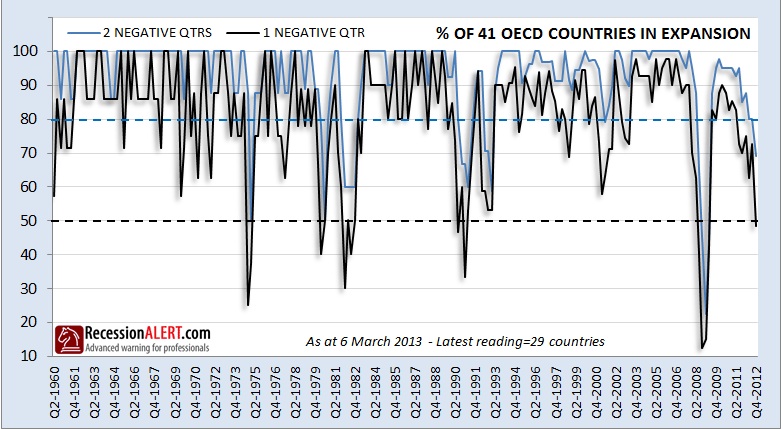
Click to enlarge

Source: RecessionAlert


My pal Lakshman Achuthan was just on Bloomberg TV, defending his 2013 (and 2012) recession call.

While I respectfully disagree, I understand his point: The current environment is a typical feeble post-credit crisis recover. Indeed, we are in a Fed driven economy, and but for their interventions, we in the USA would very likely already be in a recession. As I have have stated to  many times, but for the Fed, equity markets would likely be 20-30% lower (and I may be too optimistic with those numbers).

But the key takeaway, based on the chart above from Recession Alert, is that the rest of the world IS ALREADY IN a recession. Indeed, more than half of the 41 OECD member nations are in economic contractions — and have been since Q4 2012.

Here is the bizarre twist: As I will explain in this weekend’s WaPo column, this hardly matters for equities. In fact, markets correct before official recessions, primarily because contractions typically show up in earnings long before they do in the economic data . . .


An Infinite Amount of Money

Posted: 07 Mar 2013 03:00 AM PST

An Infinite Amount of Money
John Mauldin
March 6, 2013


An Infinite Amount of Money
Et Tu, Italy?
Moving, Argentina, and Sonoma


The three major blocs of the developed world are careening toward a debt-fueled denouement that will play out over years rather than in a single moment. And contrary to some opinion, there is no certain ending. There are multiple paths still available to Europe and especially the US, though admittedly none of them are bright and carefree. There are very few paths available to Japan, as they have skipped too far down the yellow brick road of debt. None of Japan's remaining paths have good endings. In the US, even as numerous voices declaim on the crisis that awaits if we don't act, there is seemingly no collective will to actually do anything as yet. Perhaps it will take… a crisis. In Europe, the peripheral countries can already be said to be in crisis.

This week we will look at the mindset that ignores warning signs, and reflect on a hard-to-believe comment from Mayor Bloomberg of New York. It is a teaching moment that does not bode well for my hopeful outcome in the US. Meanwhile in Europe, the risks have been heightened with the recent vote in Italy. We must remember that Italy is the world's third-largest issuer of bonds – its problems matter on the world stage. While it may all be molto divertente for those of us sitting on the sidelines, the potential consequences are anything but amusing.

An Infinite Amount of Money

I am often asked, "How can anyone not see the problems of growing debt in the US? Why can't we get a consensus to change?"

Part of the problem is that too many in power just don't see the impending crisis that you and I see, or at least they don't see the need to act now. That is changing – or so I thought until I read a most inexplicable statement by the billionaire entrepreneur mayor of NYC, Michael Bloomberg. This is the sort of thing that causes me to despair. Here we have a supposedly (well, relatively) fiscally conservative politician, someone who is no stranger to financial circles, giving us these off-the-cuff remarks last week, commenting on whether sequestration will affect the NYC budget:

"It depends on how long," Mr. Bloomberg said on his weekly WOR radio show with John Gambling. "If it lasts a few weeks, no. If it [lasts longer], yeah. We get 10 or 12 percent of our budget from the federal government, not all of that is going to be cut back, but there would be effects – not good effects. But in the context of, 'Is anything going to change tomorrow? Are we going to run out of money tomorrow?' I'm sure I'll get that question at the [next] press conference. No."

Furthermore, while saying the federal deficit does indeed need to be curtailed, Mr. Bloomberg argued the United States could owe "an infinite amount of money" and there is no specific amount that would cause the country to default.

"We are spending money we don't have," Mr. Bloomberg explained. "It's not like your household. In your household, people are saying, 'Oh, you can't spend money you don't have.' That is true for your household because nobody is going to lend you an infinite amount of money. When it comes to the United States federal government, people do seem willing to lend us an infinite amount of money.… Our debt is so big and so many people own it that it's preposterous to think that they would stop selling us more. It's the old story: If you owe the bank $50,000, you got a problem. If you owe the bank $50 million, they got a problem. And that's a problem for the lenders. They can't stop lending us more money." (Observer.com)

I am not sure what his understanding of the word infinite is, but I am pretty sure he is not using the word to mean "limitless or endless in space, extent, or size; impossible to measure or calculate." In the few times I have met him, he has seemed quite reasonable and in command of the English language. I think he was speaking in a metaphorical sense, as in, there is (to his mind) no practical limit. I certainly hope he was.

I am reminded of former Vice President Dick Cheney's comment that "deficits don't matter." He is right, if the deficit never grows past the rate of the growth of the country (nominal GDP). It might not be wise to approach that limit, but it would not necessarily be a disaster. And, to be charitable to Cheney, I'm sure it never occurred to him that the US could run a deficit close to 10% of GDP. Such a notion would have been preposterous to him. Unthinkable. The US government would pull back from anything even close to that. And that remained true – until it happened and we didn't pull back.

And that is the problem. Too many of our leaders do not yet think we have approached the limit – hey, we're not to infinite yet! The political and economic repercussions of restraining ourselves are just too difficult for some of us to resist pushing the limits a little further. Too many in the current administration appear to truly believe that even minor spending cuts (and I mean just cuts to the increase in spending, not actual cuts!) will bring about calamity.

Spending cuts will indeed reduce potential GDP in the short run. And for most politicians, the short run is the world they live in. But at some point, the short run gets longer, and as infinity approaches the bond markets get very antsy.

Greece protested against the austerity imposed on it. But what choice did it have? If it did not cut its budget, the rest of Europe would not fund the new debt the country needed. It is not a God-given right for Greeks to expect Germans (and the rest of Europe) to fund their lifestyle. So the bond markets simply stopped funding Greek debt. Unless the Greeks had agreed to austerity (known in some circles known as "reality"), the budget cuts would have been far larger, as Greece cannot print its own currency. The rest of Europe gave Greece money to avoid the potential debacle of a disorderly exit from the euro, but they did extract a price. The object of the process was to get Greece back to a place where it could fund itself with a smaller government budget. (More on that subject later.)

Austerity is not fun. Ask any teenager whose parents have set limits where previously there have been few or none. Tantrums ensue. It is kind of like the five stages of grief: denial, anger, bargaining, depression, and acceptance. Except that when you are talking about seriously over-indebted governments, the depression (pardon the pun) can last a lot longer than any other stage.

Bloomberg and those who think like him project our current experience into the far future. "Look at interest rates," they say; "they are telling us the markets are just fine with the levels of US debt and the deficit." And they are right; there are no bond-market issues now. But those of us with an eye on history know that is not unusual. Bond markets are typically sanguine right up until the BANG! moment. Then they are not. Bloomberg is right to say that there is no specific amount of debt that would cause the markets to cease funding us. Would that there were some convenient, unmistakable line we could see as we approached it. But the experience of over 250 debt crises over the past few hundred years tells us that there is no specific point when the markets lose confidence in a government's debt. When it happens, though, it is ferocious in its intensity.

That is why I and others are so deeply worried about Japan. The level of denial is majestic. The newly nominated governor of the Bank of Japan, Haruhiko Kuroda, has openly espoused the printing of money and monetization of debt. And Kikuo Iwata, one of the government's nominees for central bank deputy governor, said the Bank of Japan should buy longer-term bonds to help it achieve a two-percent inflation target.

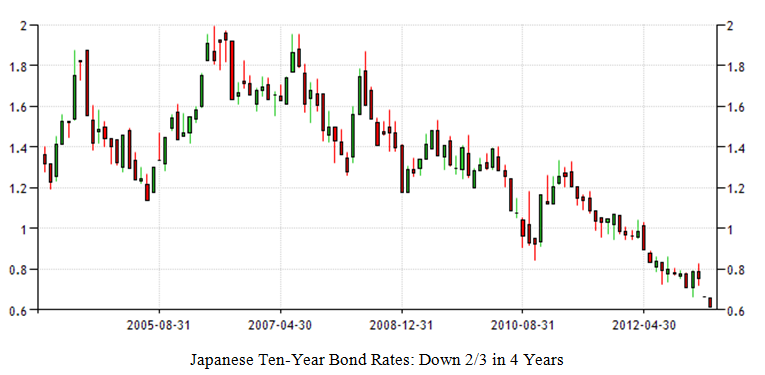
They both suggest that the monetization planned for 2014 under the old regime could be accelerated into the present. As if to reinforce the perception that Japan can borrow an infinite amount of money, the yield on Japan's ten-year bond has fallen to 0.585%, the lowest in a decade. If the bond market is so compliant in the face of imminent massive monetization, what could possibly go wrong? The amount of debt Japan has amassed has now topped one quadrillion yen. Not trillion with a "T" but quadrillion with a "Q," which coincidentally also begins the word "questionable." You can see for yourself how confident bond buyers are, in this chart:

Infinite means "without limit." If Japan can borrow such sums at a 240% debt-to-GDP ratio, the thinking surely goes, the US can borrow a few trillion more – or perhaps even an infinite number of trillions. And we have such a long way to go before we even get to a quadrillion!

I warned in Endgame two years ago that the markets could lose patience in 2014 if they do not see a serious attempt to curtail the US deficit. The recent gold standard for a bearish mindset, my friend Nouriel Roubini told me he thinks I am being too pessimistic – we can probably get through to 2015.

If we do indeed see some movement toward deficit reduction, then our date with destiny can be postponed for quite some time. If over time we can bring the deficit back to below nominal GDP, a true debt crisis can be averted. If pressed, I am sure Mayor Bloomberg would now express regret at using the words infinite and debt in the same sentence. I doubt he actually believes what he said; rather (I generously assume), he was trying to make the point that the current sequestration will not bring on a debt crisis.

Until we get enough leaders to press the point, leaders like Simpson and Bowles, et al., we will dig an ever-deeper hole for our children; and if we don't stop digging pretty soon, we will find ourselves in that hole. Past performance is not indicative of future results: it is not preposterous to think there might be limits.

Et Tu, Italy?

Only last year I was a mild-mannered euro skeptic. My default position was that the eurozone would break up, at least partially, due to economic strains and the unwillingness of nations like Germany to write checks and endure outright monetization. If Germany et al. relented, then I would have to change my position.

Germany has clearly gone along with monetization (while protesting all along the way). I now assume that the eurozone will somehow stay together unless and until we see a political event that creates an exit crisis for some country. The will of European leaders to keep the euro experiment alive at all costs is impressive. Now, the cost of a breakup is almost unfathomable. A breakup is not impossible, but oh dear gods, what a cost. It is now probably cheaper just to continue to bump along, forcing austerity where one can. That is certainly the default political position in most of Europe.

For now, "austerity" is a bad word. It has been openly forsaken in France and Spain. There are massive demonstrations in Portugal. Greece has gone about as far as it can politically for the time being. The Dutch government finally conceded on Thursday that it would not meet the budget-deficit target set by the European Union this year, due to its weak economy and a reluctance to make more cutbacks.

I see two threats to the euro. The first is France. Its budget deficit and economy are getting worse, and so far all French attempts to maintain the EU deficit target have been cosmetic, much to the frustration of Germany, which has brought its deficit down to 1%. However, Merkel does not want a crisis before her elections in September, so she is giving a pass to France and Italy. But that is a topic for another letter.

The second threat is the possibility of a political crisis in a country where an anti-euro government takes actual control. Right now that seems unlikely to happen, but the recent election in Italy has given European elites a case of indigestion.

Some German leaders (pointedly not Merkel) spoke openly and derisively of the success of those they called the Italian "clowns," speaking of aging comedian Beppe Grillo and his Five Star Movement and the even more aged (76) conservative leader, playboy, and billionaire Silvio Berlusconi, he of "bunga bunga" notoriety, who has refused to go away, to the consternation of much of the rest of Europe.

Italian politics are always difficult to fathom, even for Italians. When I am on vacation there and ask the locals questions about what is likely to happen, I am met with confused shrugs (at least in Tuscany). I don't get the passionate lectures I heard in Greece or Spain.

The center-left coalition "won" the lower house with 29.6% of the vote. Berlusconi's coalition won slightly less, at 29.2%. Under the Italian Constitution, which makes the US electoral college scheme appear sane, the party with the most votes gets an automatic 55% of the lower house. So with less than 30% of the vote and a win of just 0.4%, the center-left now controls 55% of the votes in parliament. But the Senate, which has equal power, is not apportioned the same way, and there Berlusconi won control. Unless some grand coalition can be finessed, there is no government that can be formed. Anatole Kaletsky writes at GaveKal:

This is not to say the situation is not pretty messy! The big winner of the Italian election is obviously the protest vote, as illustrated by a 5% rise in abstention, and, much more importantly, a super strong 25% score for Beppe Grillo's Five Star Movement, a new party founded by geeks and bloggers with an anti-everything discourse (anti-Monti, anti-Berlusconi, anti-euro, anti-establishment, anti-debt repayment, anti-markets, etc.). Ex-comedian Grillo (who is not himself a candidate) has succeeded in gathering protest votes that were usually spread between the extreme-right and the extreme-left.

While the center-left party of Pier Luigi Bersani took 29.6% of the vote (with more than 99.9% of ballots counted) in the lower house, a touch more than Silvio Berlusconi's 29.2%, Italians have sent a clear message of protest against fiscal austerity, and against tax hikes in particular. Mario Monti's new party got just 9% of the vote in the lower house, and Berlusconi and Grillo's combined vote is roughly 55%.

These split votes mean the emergence of a new government in the eurozone's third largest economy is going to be extraordinarily problematic. Moreover, new elections cannot be called before late May at the earliest, since the president of the Republic (elected for seven years in May 2006) does not have the right to dissolve during the last six months of his mandate. In any case, new elections may not be what the establishment would want (Berlusconi included) since it would fear an even higher score by Grillo.

One possibility is a Bersani/Berlusconi grand coalition. This seems crazy, but after all the two parties "governed" together in 2012, since they were the two main supports to Monti's technocrat government – until Berlusconi's party withdrew its backing in a well-calculated move to campaign on an anti-austerity theme in the elections. Another possibility is a coalition between Bersani and Grillo's Five-Star Movements – bizarre, but who knows with Italy? Whatever the solution, nothing will come easily – and there is the risk that a new market crisis might be a pre-condition for a coalition to be formed.

Anatole's lifelong friend and partner, Charles Gave, sees the Italian elections much differently. He points out that a majority of voters selected parties openly anti-euro as well as anti-austerity. And I agree with him: that is the apparent outcome. However, when you look at polls, the 25% that Grillo won was clearly a youth protest vote. The vast majority of the Five Star Movement's voters were under 50 and many under 30. The message was one of protest against the corruption of the current system as well as frustration with the technocrat government (which Berlusconi initially supported, before his polls numbers rose and he decided to stand in an election that he came within a hair of winning). The current prime minister, Mario Monti, got just 9% of the vote – a resounding rejection.

Grillo is an odd character. He refuses to talk to journalists. Italian reporters who have telephoned him and asked to speak to the general secretary of the party claim he has told them, "Hang on, I'll just pass you to my 12-year-old son." He said Italy was in such dire economic straits that "In six months, we will no longer be able to pay pensions and the wages of public employees." He has called for a total repudiation of Italian debt (otherwise known as default).

In an interview with a German magazine, Grillo warned that "if conditions do not change" Italy "will want" to leave the euro and return to the lira. I refer those who are interested in the lurid details to a story in the Telegraph.

Like the Greek Syriza Party, which had to back off its earlier positions with regard to leaving the euro, Grillo may find that he cannot hold his coalition together if the real possibility of his governing ever materializes. He has refused to entertain being part of any coalition government, calling the center-left winner Bersani a "dead man talking." Not exactly the stuff of which coalitions are formed. One young lady responded by starting an online petition to demand that Grillo not "waste" her vote, and work with Bersani to form a coalition government. In just a few days, she has already had 150,000 5SM voters sign her petition. Waiting six months for another election without a government would not exactly make for inspiring theater, and while no one likes the current government, the voters apparently like chaos even less.

If a grand coalition cannot be formed, it appears another election will be held this summer. And while the concern in Europe is that Grillo might even get more votes, it is also possible that his intransigence and unwillingness to capitalize on his surprise upset will cost him voters.

Throughout Europe, where austerity has been the order of the day there have been protest votes. But will the anti-euro forces actually be able to muster a firm majority? Not so long as Merkel allows relaxation of the Fiscal Compact, as she apparently has. The impetus for protest will wane and find another focus besides withdrawal from the euro.

But we need to keep an eye on these nationalist movements and an even closer watch on France. President Hollande has slumped in the polls to a 30% approval rating just ten months after his election, making him the most unpopular president in 30 years. He seems to feel that France can borrow an infinite quantity of euros. It will be a race between Hollande and Japanese Prime Minister Abe to see who can lose the confidence of the bond market faster. From my perspective, they are both running hell-bent for leather.

Incidentally, Anatole Kaletsky and Charles Gave will both be at my 10th annual conference, May 1-3 in Carlsbad California, cosponsored by my friends and partners Altegris Investments. Louis Gave will join them on a panel that I will moderate. Having appreciated the vigorous disagreements between Charles and Anatole, and knowing how passionate Louis is, I think that will make for a fascinating panel. To my knowledge, it is the first time they have appeared together other than for their own client conferences. I am honored.

They will be joined by Kyle Bass; Ian Bremmer; Mohamed El-Erian; Niall Ferguson and his wife, Ayaan Hirsi Ali; Lacy Hunt; Jeff Gundlach; David Rosenberg; Nouriel Roubini; and Gary Shilling, plus a few surprise guests. This will indeed be the macroeconomic event of the year – you seriously need to think about coming. The conference is getting close to capacity and will likely sell out, as it has the past four years. I always seem to have people frustrated with me when I can't find them a spot, but we really do have a hard limit on attendance, imposed by the size of the hotel. Next year we will move to larger quarters, but if you want to come this year you need to stop procrastinating and register.

We offer an early-bird registration, which is about to run out. Because of security regulations, we do have to limit attendance to accredited investors and those in the securities/investment business. You can start the process by going to the Strategic Investment Conference page. I hope to see you there.

Oh, and I have just arranged for registrants to have access to the private research of many of our speakers for the two monthinfis prior to the conference. That in itself is worth the price of conference admission.

Moving, Argentina, and Sonoma

My bags are packed, kind of. The movers come this Thursday to empty my house and put everything in storage while we wait for the new digs to close. Apparently, my loan for the new place has been approved, which is a good thing, as I am committed to moving. Hopefully I will not be in a local hotel too long before I can move in, though I know I will be there for at least a few months, until we can combine two apartments into one more comfortable place. The process is longish, but I think the result will be worth the hassle.

I leave Thursday night for Cafayate, Argentina, to be with my friends and partners and a fun group of their friends. As a special treat, I will finally get to go to my old friend Bill Bonner's (he of Daily Reckoning fame) estancia in the Andes near Cafayate for a few days. I am excited about that, and it will be nice to catch up with Elizabeth as well. It has been too long.

I will be speaking at a special one-day event in Sonoma, California, on April 5. My friend Mike Shedlock is holding a charity fundraiser to support research into ALS (Lou Gehrig's disease). Sadly, Mike's wife died last year of ALS, and his commitment to a cure is worthy of support. John Hussman, who is among the notables that are speaking (your humble analyst is there as comic relief), has generously offered to match up to $100,000 in conference registration fees. I have often exchanged notes with John and really look forward to meeting him. You can find out more at Mish's Conference.

I am going to take most of the next two days to try and reduce the pile of things that I keep moving from place to place. Over the years, we all tend to accumulate stuff we somehow just can't let go of. My closet is filled with clothes I have not worn in five years, or even in three. Shelves sag with so many books I will never even have time to touch again. Drawers are stuffed full of items I couldn't imagine parting with at the time. Knickknacks I just don't need are perpetually on the increase. I keep trying to get the kids to take more, but they know extraneous material (otherwise known as junk) when they see it.

The hard part will be to stay focused as I stumble on memories I don't want to lose, in the form of treasured relics of an event or time past. That first card from one of the kids. Photos. Handmade gifts that are priceless. My intention is to leave with less than I came in with for the first time in decades of moving. We will see how my resolve holds up. I mean, I might want that sweatshirt someday. And that suit and tie might come back in style; you never know.

Have a great week. I look forward to a night in Buenos Aires before flying to Salta and driving through the majestic canyon that leads to Cafayate. I intend to finish my part of a book, lose a little weight, and enjoy my time with friends. And I will write next week, as always.

Your ready to move on analyst,

John Mauldin

subscribers@mauldineconomics.com

.

0 comments:

Post a Comment

previous home Next

{8} chatroll


{9} AdBrite FOOTER

{8} Nice Blogs (Adgetize)