Trillions of dollars of debts will be restructured and millions of financially prudent savers will lose large percentages of their real purchasing power at exactly the wrong time in their lives. Again, the world will not end, but the social fabric of the profligate nations will be stretched and in some cases torn. Sadly, looking back through economic history, all too often war is the manifestation of simple economic entropy played to its logical conclusion. We believe that war is an inevitable consequence of the current global economic situation.
We will be updating the Cycle of War. Obviously, it is time once again. Especially since that model also hit to the day 3 times in a row.
Similarly, Larry Edelson wrote an email to subscribers entitled "What the "Cycles of War" are saying for 2013″, which states:
Since the 1980s, I've been studying the so-called "cycles of war" — the natural rhythms that predispose societies to descend into chaos, into hatred, into civil and even international war.
I'm certainly not the first person to examine these very distinctive patterns in history. There have been many before me, notably, Raymond Wheeler, who published the most authoritative chronicle of war ever, covering a period of 2,600 years of data.
However, there are very few people who are willing to even discuss the issue right now. And based on what I'm seeing, the implications could be absolutely huge in 2013.
Former Goldman Sachs technical analyst Charles Nenner – who has made some big accurate calls, and counts major hedge funds, banks, brokerage houses, and high net worth individuals as clients – says there will be "a major war starting at the end of 2012 to 2013", which will drive the Dow to 5,000.
Veteran investor adviser James Dines forecast a war is epochal as World Wars I and II, starting in the Middle East.
Nouriel Roubini has warned of war with Iran. And when Roubini was asked:
Where does this all lead us? The risk in your view is of another Great Depression. But even respectable European politicians are talking not just an economic depression but possibly even worse consequences over the next decade or so. Bearing European history in mind, where does this take us?
In the 1930s, because we made a major policy mistake, we went through financial instability, defaults, currency devaluations, printing money, capital controls, trade wars, populism, a bunch of radical, populist, aggressive regimes coming to power from Germany to Italy to Spain to Japan, and then we ended up with World War II.
Now I'm not predicting World War III but seriously, if there was a global financial crisis after the first one, then we go into depression: the political and social instability in Europe and other advanced economies is going to become extremely severe. And that's something we have to worry about.
A continuation of bailouts in Europe could ultimately spark another world war, says international investor Jim Rogers.
***
"Add debt, the situation gets worse, and eventually it just collapses. Then everybody is looking for scapegoats. Politicians blame foreigners, and we're in World War II or World War whatever."
Marc Faber says that the American government will start new wars in response to the economic crisis:
We're in the middle of a global currency war – i.e. a situation where nations all compete to devalue their currencies the most in order to boost exports. And Brazilian president-elect Rousseff said in 2010:
The last time there was a series of competitive devaluations … it ended in world war two.
Currency wars lead to trade wars, which often lead to hot wars. In 2009, Rickards participated in the Pentagon's first-ever "financial" war games. While expressing confidence in America's ability to defeat any other nation-state in battle, Rickards says the U.S. could get dragged into "asymmetric warfare," if currency wars lead to rising inflation and global economic uncertainty.
And given that many influential economists wrongly believe that war is good for the economy … many are overtly or quietly pushing for war.
Moreover, former Federal Reserve chairman Alan Greenspan said that the Iraq war was really about oil , and former Treasury Secretary Paul O'Neill says that Bush planned the Iraq war before 9/11. And see this and this. If that war was for petroleum, other oil-rich countries might be invaded as well.
Finally, multi-billionaire investor Hugo Salinas Price says:
What happened to [Libya's] Mr. Gaddafi, many speculate the real reason he was ousted was that he was planning an all-African currency for conducting trade. The same thing happened to him that happened to Saddam because the US doesn't want any solid competing currency out there vs the dollar. You know Gaddafi was talking about a gold dinar.
Is this the first time a revolutionary group has created a central bank while it is still in the midst of fighting the entrenched political power? It certainly seems to indicate how extraordinarily powerful central bankers have become in our era.
Robert Wenzel of Economic Policy Journal thinks the central banking initiative reveals that foreign powers may have a strong influence over the rebels.
This suggests we have a bit more than a ragtag bunch of rebels running around and that there are some pretty sophisticated influences. "I have never before heard of a central bank being created in just a matter of weeks out of a popular uprising," Wenzel writes.
1. S&P 500 makes new record all-time highs. 2. Gold falls under 1500 for the first time since July 2011. 3. US PPI benign in March at -0.6% v expectations of -0.2%. Ex-food & energy in line at 0.2%. 4. Gasoline prices are down 6% in 6 weeks. 5. AAII bears highest since July 2010 (contrarian buy indicator) 6. 31.6% of S&P 500 stocks hit new 52-week highs Thursday 7. Weekly jobless claims fall to lowest level in 3 weeks, 346k v expectations of 360k. 8. Japan's Nikkei is at its highest level since July 2008. 9. Bellwether Alcoa beats, EPS up 10% from the same quarter last year. 10. Avg 30 yr mortgage rate falls to 3.68% from 3.76%, refi's rise 6.3% after last week’s 5.6% drop 11. Japan's February current account surplus 637.4B Yen 12. The "anti____ trade" appears to have run its course. 13. EU CPI is back to the ECB'S target rate of 2% for the first time since November 2010. 14. Gold bullion holdings of the GLD ETF falls to lowest level since May 2010
Negatives:
1. Retail sales -0.4% v flat exp (previously 1.1%). 2. Wholesales inventories -0.3% v exp 0.5% (previously 1.2%). 3. PC shipments collapse in Q1, worst quarterly decline ever, down 14%. 4. 80% of S&P 500 companies that have issued guidance thus far for Q1 have issued negative guidance. 5. Goldman cuts Q1 GDP forecast from 3.4% to 3.2% based on weaker wholesales inventory report. 6. Preliminary UoM confidence in April falls to 72.3 from 78.6 — well below est of 78.6 7. NFIB small business optimism 89.5 v expectations of 90.3 8. Japanese February machine orders declined 11.3% year-over-year v expectations of -7.6%. 9. Greek January unemployment climbs to 27.2% with youth unemployment up to 59.3%. 10. Healthcare giant Eli Lilly announces it will lay off 30% of United States sales force. 11. IMF cuts US GDP growth forecasts for 2013 to 1.7% v consensus of 2%.
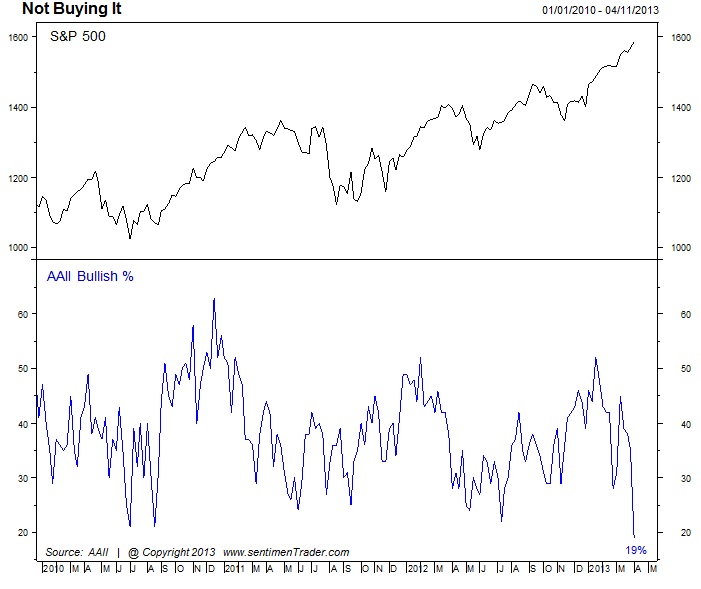
“If the numbers stand, then we’re seeing a remarkable exit from public markets among individuals . . . The latest weekly survey of expectations for the stock market showed that only 19% of respondents expected the market to head higher over the next six months. That’s the lowest reading since near the bottom of the bear market in 2009.
Investors’ skepticism in the face of new highs proved to be a decent sign going forward, especially in the shorter-term of 1-2 weeks. That’s when the S&P’s out-performance after any other 3-month high was the greatest. After that, it evened out and fell more in line with a random return.”
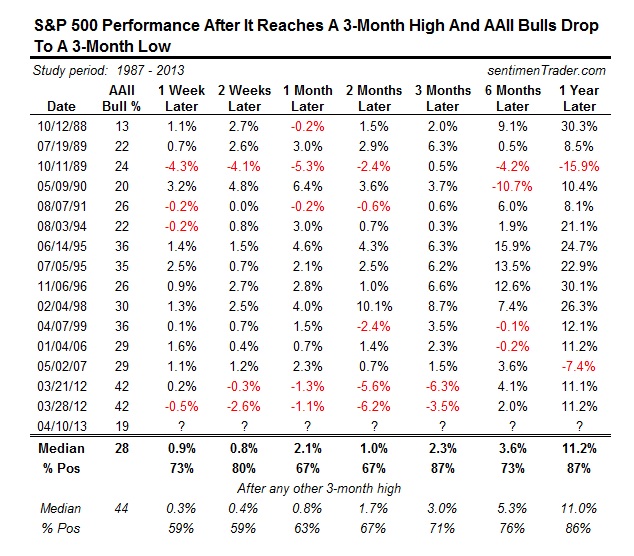
Let’s put this into a more quantitative context than the pure, “too bearish” framework.
In the table above, Jason put the too bearish meme into the richer context of what occurred in the past when markets hit 3 month high (as they have been doing) and at the same time saw sentiment all to 3 month lows.
The results were impressive: Positive 87% of the time, with median gains of 11.2%.
My explanation: Investors being this negative at the same time as markets hitting all time highs suggest to me that they are under-invested in equities and are frustrated they have missed the run up. The past history shown by Goepfert also suggests they will eventually acquiesce, and join the long side.
If you want to use sentiment as Contrary Indicator, that capitulation will set up your top and reversal. We are not, however, anywhere close to that point.
Source: Individual Investors Are Not Buying It Jason Goepfert Sentiment Trader, April 11, 2013 http://www.sentimentrader.com/subscriber/comments/2013/data_brief_20130411.php
My heavy-on-WSJ (for reasons unknown) Friday morning readings:
• Big Round Numbers In Sight for Stocks (WSJ) but see Trading Volumes Fall for Big Firms (WSJ) • Did Intrade Close Because of Embezzlement? (Rajiv Sethi) • Dissecting the Variety of Price-Earnings Ratios (Charles Schwab) see also Making Adjustments (ie What if 2008 Never Happened?) (Mebane Faber Research) • Brain Drain: 120,000 Professionals Leave Greece Amid Crisis (Siegel) • Microsoft Can’t Keep Up in a Mobile World (WSJ) • What currency will challenge the dollar? (MarketWatch) see alsoKrugman: Goldbuggery and the Lust for Gold (NYT) • Will Baby Boomers Drag Down Growth? (WSJ) • 48% of U.S. teens own an iPhone. 62% plan to buy one. (Fortune) see also T-Mobile Debuts $99 iPhone Today in Bid to Stem Customer Exodus (Bloomberg) • Who Killed The Deep Space Climate Observatory? (Popsci) • Elizabeth Warren: Banks Determined Number of Victims of Their Own Foreclosure Frauds (Wall Street on Parade) see also Has financialization gone too far? (New Republic)
What are you reading?
Two Firms Amass Much of World’s Copper Supply Source: WSJ
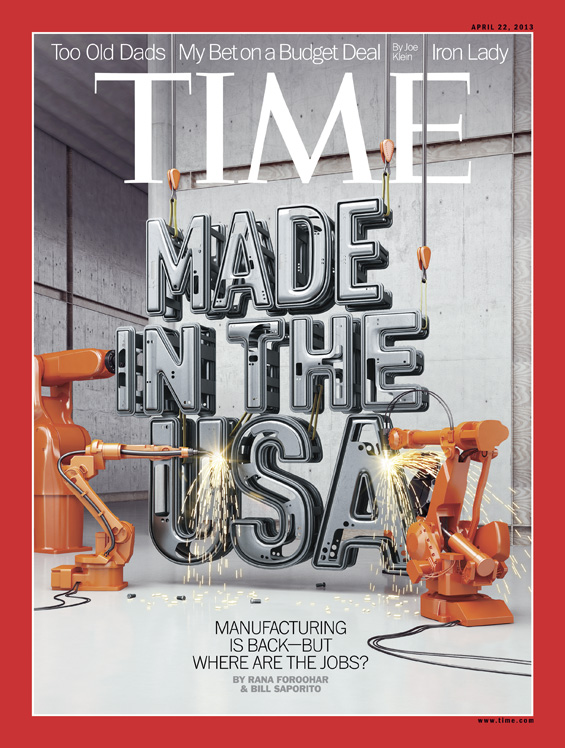
Fascinating cover story in Time magazine about the renaissance in US Manufacturing.
What is so interesting about this is while new businesses are being created, the amount and kinds of jobs that go with this are very different than what the manufacturing sector produced in the past.
Some takeaways from the article:
• Post-recession, U.S. manufacturing growth is outpacing other advanced nations;
• 500,000 manufacturing jobs created in the USA over the past three years;
• U.S. factories access to cheap energy, (oil and gas from the shale boom) means cheaper costs versus expensive overseas Oil and costly shipping prices.
• Energy- and resource-intensive industries (chemicals, wood products, heavy machinery and appliances) do better, powered by that cheaper homegrown energy.
• New made-in-America economics is centered largely on cutting-edge technologies (3D printing, specialized metals, robotics and bioengineering);
• New US factories are “superautomated” and heavily roboticized;
• Employees typically are required to have computer skills and specialized training; Minimum of two-year tech degree, which is likely to rise to four-year degree (eventually);
More machines and fewer workers is the future of manufacturing in the USA. But looking only at factories misses some of the new jobs that are related to these industries. Many of the jobs created are outside the factory floors — R&D, support services, software engineers, data scientists, user-experience designers, transportation & shipping, etc.
Perhaps this helps to explain why every $1 of manufacturing activity returns $1.48 to the economy.
Here is an excerpt:
“Today's U.S. factories aren't the noisy places where your grandfather knocked in four bolts a minute for eight hours a day. Dungarees and lunch pails are out; computer skills and specialized training are in, since the new made-in-America economics is centered largely on cutting-edge technologies. The trick for U.S. companies is to develop new manufacturing techniques ahead of global competitors and then use them to produce goods more efficiently on superautomated factory floors. These factories of the future have more machines and fewer workers—and those workers must be able to master the machines. Many new manufacturing jobs require at least a two-year tech degree to complement artisan skills such as welding and milling. The bar will only get higher. Some experts believe it won't be too long before employers expect a four-year degree—a job qualification that will eventually be required in many other places around the world too.
Understanding this new look is critical if the U.S. wants to nurture manufacturing and grow jobs. There are implications for educators (who must ensure that future workers have the right skills) as well as policymakers (who may have to set new educational standards). "Manufacturing is coming back, but it's evolving into a very different type of animal than the one most people recognize today," says James Manyika, a director at McKinsey Global Institute who specializes in global high tech. "We're going to see new jobs, but nowhere near the number some people expect, especially in the short term."
If the U.S. can get this right, though, the payoff will be tremendous. Labor statistics actually shortchange the importance of manufacturing because they mainly count jobs inside factories, and related positions in, say, Ford's marketing department or at small businesses doing industrial design or creating software for big exporters don't get tallied. Yet those jobs wouldn't exist but for the big factories. The official figure for U.S. manufacturing employment, 9%, belies the importance of the sector for the overall economy. Manufacturing represents a whopping 67% of private-sector R&D spending as well as 30% of the country's productivity growth. Every $1 of manufacturing activity returns $1.48 to the economy. "The ability to make things is fundamental to the ability to innovate things over the long term," says Willy Shih, a Harvard Business School professor and co-author of Producing Prosperity: Why America Needs a Manufacturing Renaissance. "When you give up making products, you lose a lot of the added value." In other words, what you make makes you.”
The full article is well worth your time to read . . .
Source: Made in the USA Rana Foroohar and Bill Saporito Time, April 2013 http://business.time.com/2013/04/11/how-made-in-the-usa-is-making-a-comeback/
The following was written by Jawad Mian, Portfolio Manager based in Dubai. We have run some of his prior research reports in the past, and they have been both interesting and thought provoking.
~~~
Time seems to be gathering pace. Only last year I was single. Now I’m married, Kim Kardashian is pregnant and the Dow is making all-time highs. The stock market is up 11 percent for the year, roughly in line with my weight. While the market may give back some of its gains over the next few months I have no such delusions about my waist – one of the many few downsides of married life.
During the past three months, when I wasn’t helping my lovely wife in the kitchen or taking her out shampoo shopping, I would spend precious time puffing my proverbial pipe, reclining back in my fake leather chair, thinking how blessed I am. Giving up your life to be with someone for the rest of her life is a beautiful thing and only adds to my ”accumulated experience and wisdom” over the years.
I'm all about learning – doing dishes, ironing clothes, putting down the toilet seat. I quickly realized that up until this point, I was wasting my life away sitting on a prop desk taking decisions on $250 million of capital in global equity markets with my face stuffed into the screen. After twenty-nine years of traversing this world aimlessly, my life found meaning. Thank you, God. Who needs boys' night?
Okay, enough… Breathe! I just had to get that out of my system. Now let's move on…
I actually sat down this morning to write about my other love – markets. For those of you that know me, I have been on this strange journey to the ocean of meanings for the past few months. My mind was clouded with only one thought – to figure out the investment trends that will dominate this decade. As I get ready to launch my own little macro fund, I decided to turn away from the world so as to come back with a new understanding. You will find attached in this e-mail the result of my discoveries, "Major Themes: our macro views getting down and semi-dirty in global markets".
Confucius famously said, "Life is really simple, but we insist on making it complicated". At a certain level, perhaps the same can be said about investing. Consider the following: each decade we can identify a few major themes that play out strongly in markets. If we had put our money in large-cap Dow stocks in the early 60's and rode that trend till the end of the decade, rotating into gold during the 70's and staying put for another 10 years, followed by a large allocation to Japanese stocks in the 80s and U.S. stocks in the 90s, and then investing in oil, gold or emerging markets during the early 2000s, we would have reaped significant financial gains without having to worry about the unemployment rate, the next election, or the latest earnings release. The fundamental factors underpinning the long-term trend over-power any short-term friction in markets. I suppose the most difficult aspect of this strategy is the psychological make-up required to stick to your convictions.
Given the extreme uncertainty that currently prevails, I have been obsessively trying to figure out the major themes that will play out over this decade. After much deliberation and thought, I believe I have found the answers. The attached document expresses those views in detail. Have a look if you're interested. But just be kind enough to remember the wisdom of Voltaire, “Judge a man by his questions rather than his answers.”
P.S. Saniha, I love you. Please don't make me clean the bathroom.
"I think [hedge funds] play an important part, particularly from the short side. Short-sellers and hedge funds are actually real-time financial detectives in that they are incentivized through profit to ferret out fraud, and I think that's a very important role that people forget about from time to time."







0 comments:
Post a Comment