| Is the Fed Handing Out Valuable Tips to Insiders? Posted: 14 Apr 2013 10:30 PM PDT Congressman Grayson Asks for an Investigation into Federal Reserve's FOMC leak The Federal Reserve's Open Market Committee released its recent minutes 24 hours early to a handful of big banks, private equity firms and other insiders. Congressman Alan Grayson wrote the following letter to the Chairman of the Committee on Oversight and Government Reform (Darryl Issa) today: I respectfully request an *investigation of the Federal Reserve leak of the Federal Open Market Committee (FOMC) minutes on April 9 and 10, 2013. According to Bloomberg News, the list of individuals who received the information included staff at Barclays PLC, BB&T Corp., BNP Paribas SA, Capital One Financial Corp., Fifth Third Bancorp, HSBC Holdings PLC, Nomura Holdings Inc., PNC Financial Services Group Inc., Regions Financial Corp., U.S. Bancorp, UBS AG and Wells Fargo & Co. I have long been concerned about the Federal Reserve's management of sensitive market-moving information. One example of blatant information "asymmetry" is the five-year lag before FOMC meeting transcripts are released to the public. As the Huffington Post reported in 2012, "Many of those people have since left the central bank and gone to work in the financial industry, taking with them privileged information about the Fed's thinking that is still closed to the public." [Here's the HuffPost article.] This includes Susan Bies, who is now a board member at Bank of America; Laurence Meyer, who founded Macroeconomic Advisors; and Brian Madigan, who is now at Barclays. Some relevant questions to consider during your investigation include: 1) Who specifically received this information early? 2) Did any insider trading result from this leak? 3) Did Goldman Sachs release a note encouraging clients to short gold [see this and this; Goldman's note says: "We recommend initiating a short COMEX gold position ...."] right after receiving the leak information, due to the leak itself? Who else might have profited from the early release of this information? 4) What are the internal control procedures in place for the Federal Reserve to manage sensitive market-moving information? How did these procedures fail? 5) Why does the Federal Reserve continue to withhold the transcripts of FOMC meetings secret for five years, when there are many people who have been present at those meetings who have moved on to private sector employment within that blackout period?
Good questions.
Nobel prize winning economist Joseph Stiglitz agrees, saying that the World Bank would view any country which had a banking structure like the Fed as being corrupt and untrustworthy. The non-partisan Government Accountability Office calls the Fed corrupt and riddled with conflicts of interest, and that insiders can get very rich by stay close to the Fed. We noted last year: Let's start by looking at what information was revealed in response to the previous, watered-down version of Ron Paul's Fed audit bill: - The Fed threw money at "several billionaires and tens of multi-millionaires", including Christy Mack, the wife of Morgan Stanley's John Mack, billionaire businessman H. Wayne Huizenga, and Michael Dell, co-founder of Dell Computer, hedge fund manager John Paulson and private equity honcho J. Christopher Flowers ***
As Senator Sanders noted last October: A new audit of the Federal Reserve released today detailed widespread conflicts of interest involving directors of its regional banks. "The most powerful entity in the United States is riddled with conflicts of interest," Sen. Bernie Sanders (I-Vt.) said after reviewing the Government Accountability Office report. The study required by a Sanders Amendment to last year's Wall Street reform law examined Fed practices never before subjected to such independent, expert scrutiny. The GAO detailed instance after instance of top executives of corporations and financial institutions using their influence as Federal Reserve directors to financially benefit their firms, and, in at least one instance, themselves. "Clearly it is unacceptable for so few people to wield so much unchecked power," Sanders said. "Not only do they run the banks, they run the institutions that regulate the banks." *** The corporate affiliations of Fed directors from such banking and industry giants as General Electric, JP Morgan Chase, and Lehman Brothers pose "reputational risks" to the Federal Reserve System, the report said. Giving the banking industry the power to both elect and serve as Fed directors creates "an appearance of a conflict of interest," the report added. The 108-page report found that at least 18 specific current and former Fed board members were affiliated with banks and companies that received emergency loans from the Federal Reserve during the financial crisis. [T]here are no restrictions in Fed rules on directors communicating concerns about their respective banks to the staff of the Federal Reserve. It also said many directors own stock or work directly for banks that are supervised and regulated by the Federal Reserve. The rules, which the Fed has kept secret, let directors tied to banks participate in decisions involving how much interest to charge financial institutions and how much credit to provide healthy banks and institutions in "hazardous" condition. Even when situations arise that run afoul of Fed's conflict rules and waivers are granted, the GAO said the waivers are kept hidden from the public.
(Indeed, the Fed routinely allows favored bankers to make billions of dollars from inside information.)
 |
| How China Censors the Internet Posted: 14 Apr 2013 03:00 PM PDT |
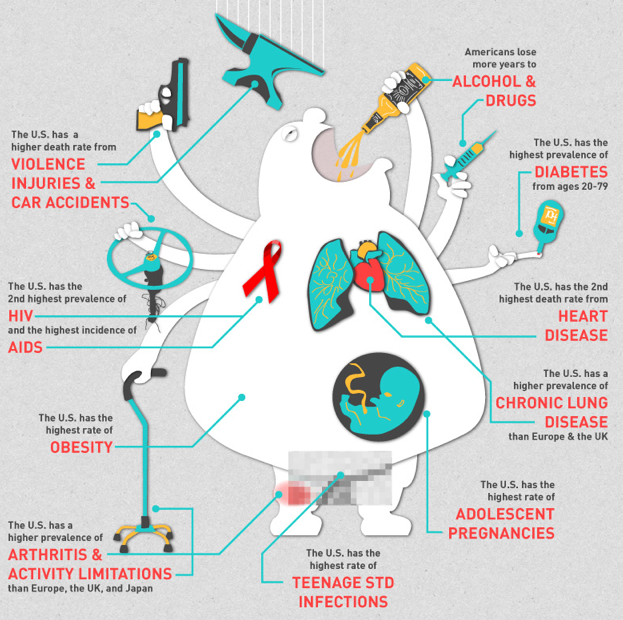
| America’s Inefficient Health Care System Posted: 14 Apr 2013 12:00 PM PDT |
| 10 Sunday Reads Posted: 14 Apr 2013 06:00 AM PDT My Sunday morning round up of whats worth reading: • Why do we tolerate investment ignorance? (Morningstar) see also Sometimes, We Want Prices to Fool Us (NYT)
• 50 Experts on Parties, Management, Zombies, Self-Improvement, and More (Businessweek)
• The Dark Side of ETFs (Barron’s) see also A Mutual Fund Front In The ETF Fee Wars (Index Universe)
• Shiller: Why Home Prices Change (or Don't) (NYT)
• Where the fuck is your Gold Messiah now? (The Reformed Broker)
• Bitcoin: This is What a Bubble Looks Like When it Pops (Barron’s) see also Fool’s Gold: Bitcoin is a Ponzi scheme—the Internet's favorite currency will collapse. (Slate)
• Microsoft Can’t Keep Up in a Mobile World (WSJ) see also Microsoft takes hits after bad PC numbers (Gigaom)
• How BrightScope plans to publicize RIA advisory fees fairly amid all those onion layers (RIABiz)
• Will the Government Shrink Your IRA? (WSJ)
• Magic trick transforms conservatives into liberals (Nature)
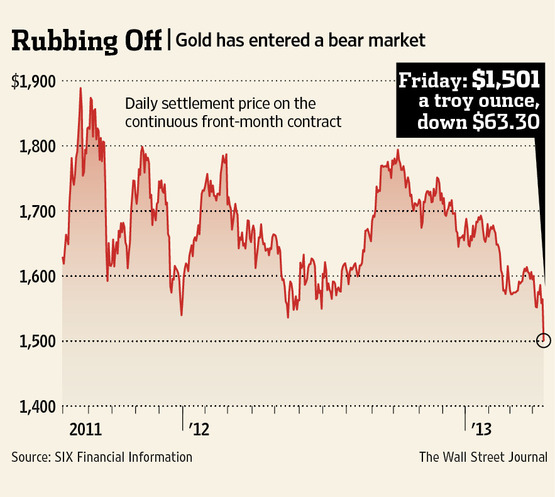
Whats for brunch? Gold Sinks Into Bear Territory
Source: WSJ  |
| The New American Luxury Garage Posted: 14 Apr 2013 04:30 AM PDT Driving Into Luxury Garages Americans are rediscovering their garages—and turning them into luxury showcases for their cars, with high-end finishes, flat-screen TVs, underground car lifts and welding equipment. Sanette Tanaka has details. Source: WSJ  |
| Global Trend Indicators/Overbought and Oversold Markets – April 12 Posted: 14 Apr 2013 03:00 AM PDT Technical Moves: Reclaiming 20-day moving average
S&P500, Nasdaq, Russell 2000, Mexico IPC, Australia ASX Reclaiming 50-day moving average
Russell 2000, FTSE Reclaiming 100-day moving average
Russell 2000, FTSE Reclaiming 200-day moving average
France CAC, Mexico IPC Breaking 100-day moving average
Shanghai Composite Breaking 200-day moving average
Korean KOSPI, India SENSEX 

(click here if charts are not observable)
The Relative Strength Index (RSI) is a momentum oscillator that measures the speed and change of price moves. The RSI moves between zero and 100 and is considered overbought with a reading above 70 and oversold when below 30. Note the RSI can sustain an overbought (oversold) reading in a strong up (down) trend. Click chart to enlarge. 
(click here if chart is not observable)


(click here if charts are not observable)
 |






0 comments:
Post a Comment