


The Big Picture |

- Succinct Summation of Week’s Events (April 5, 2013)
- Weekly Eurozone Watch (April 5, 2013)
- Stockman, Orszag in Budget Battle Royale
- How to Stash Your Cash Abroad
- 10 Friday AM Reads
- NFP: Fill in the Blanks: ____ News is ____ News for Stocks
- Yellen: Communication in Monetary Policy
- Antimatter-Hunting Alpha Magnetic Spectrometer
- Fisher: Cyprus Shows Danger of Too Big to Fail
| Succinct Summation of Week’s Events (April 5, 2013) Posted: 05 Apr 2013 01:00 PM PDT Succinct Summations week ending April 5, 2013. Positives:
Negatives:
|
| Weekly Eurozone Watch (April 5, 2013) Posted: 05 Apr 2013 12:30 PM PDT Key Data Points Large Eurozone banks weekly change, 1.41 to -2.49 percent; Comments
********************************************************************************** Poll boost for Germany's Merkel as she gears up for third term bid **********************************************************************************
**********************************************************************************
|
| Stockman, Orszag in Budget Battle Royale Posted: 05 Apr 2013 11:30 AM PDT Former White House budget directors David Stockman and Peter Orszag spar over the stimulus, healthcare, defense spending and whether President Eisenhower was a monetary genius in a debate moderated by Sir Harold Evans at Reuters’ headquarters |
| Posted: 05 Apr 2013 09:00 AM PDT click for interactive graphic
Fantastic interactive graphic that shows the many ways you can hide taxable income from the authorities. It comes to us from the Center for Public Integrity working with CBC news. It is a bit complex, so ,maybe I will record a video as a walk through (Note: ScreenR seems to be having issues with Java on a Mac today)
Source: |
| Posted: 05 Apr 2013 07:00 AM PDT My Friday morning reads:
What are you reading?
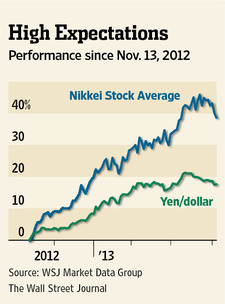
U.S. Economy Adds Just 88,000 Jobs Easing Jolts Japan’s Markets |
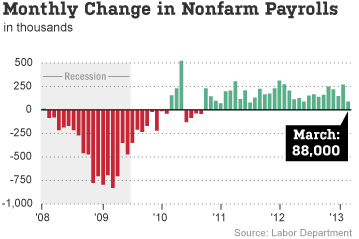
| NFP: Fill in the Blanks: ____ News is ____ News for Stocks Posted: 05 Apr 2013 05:14 AM PDT Today has the possibility of being one of the more interesting Non Farm Payroll reports we have seen in a while. (despite our usual admonition that we do not put a lot of weight on any single NFP report). With Futures down almost 100, and the early reads on employment this week mostly soft — ADP and new jobless claims both disappointed, counterbalanced by Payroll Tax Withholding which was way up in March. The consensus of economists is for a net gain of 190,000 workers in March after a gain of 236,000 in February. There is plenty of angst around the globe, from softness in Asia to recession in Europe. Even the latest rescue in Japan is causing consternation. Where things get surreal is trying to delve the reaction to a better or worse jobs numbers by the primates and algos slapping keyboards on trading desks. What does a weak number mean? What will the impact of an upside surprise be? There are times when a soft employment report comforts portfolio managers, as it confirms the Fed’s accommodation is likely to continue, aka “Bad News is Good News for stocks.” Other times, burgeoning economic strength reduces expectations of how long the Fed will continue ZIRP/QE, aka “Good News is Bad News for stocks.” Here’s where things get tricky: Sometimes, bad news is actually bad news. If the US economy is truly slowing, if the rest of the world is dragging the US economy down, if despite all the Fed has done markets no longer levitate on command, well than that is “Bad News is Bad News for stocks.” Perhaps all the negativity is for naught. Europe’s recession is mild despite the horrific crisis they seem to be working their way through. Even Asia’s softness still means China is growing at 7%+. What the rest of the world needs is some strength and economic leadership from the US, in which case a strong NFP report would give us “Good News is Good News for stocks.” Hence, our conclusion in advance of the Employment Situation is that we will get news, and it will be either Good or Bad, which will be interpreted in the context of cross currents of growth and Central Bank policy and sentiment, from which traders derive an investment thesis that Good or Bad news will be either Good or Bad for stocks. Lights will flash, bells and whistles will go off, and they will make their trades accordingly. Of course, the NFP will get revised next month, and then again the following month, and then updated in a quarter and re-benchmarked in a year. It often ends up looking nothing like the original data release. And that is why the Employment Situation report is the most overrated economic data point of the month. ~~~ Employment situation report released at 8:30am
_________ UPDATE: Nonfarm payroll employment edged up in March (+88,000), and the unemployment rate was little changed at 7.6 percent, the U.S. Bureau of Labor Statistics reported today. Employment grew in professional and business services and in health care but declined |
| Yellen: Communication in Monetary Policy Posted: 05 Apr 2013 04:00 AM PDT Communication in Monetary Policy
Thank you for inviting me here and for offering me what I consider a perfect opportunity to speak on a topic at the heart of the Federal Reserve’s efforts to promote a stronger economy–the vital role and growing use of communication in monetary policy.1 Some of you cover the Federal Reserve and are familiar with how it sets monetary policy through the Federal Open Market Committee (FOMC). You know that the FOMC pays very close attention to what it says in the statements it issues after each meeting. This communication is supplemented by Chairman Bernanke’s postmeeting press conferences and by providing detailed minutes of the Committee’s meetings. Getting this message out to the public depends a good deal on the work you do in reporting on the FOMC, analyzing its statements and actions, and explaining its role and objectives. So let me begin by thanking you for those contributions. But let me also say why I am particularly pleased to speak to you today. As writers and editors, all of you are prodigious consumers and producers of communication. At first glance, the FOMC’s communication may not seem so different from what you’ve heard other government agencies say about their policies or businesses say about their products. I hope to show how communication plays a distinct and special role in monetary policymaking. Let me offer a comparison that may highlight that difference. Suppose, instead of monetary policy, we were talking about an example of transportation policy–widening a road to ease traffic congestion. Whether this road project is announced at a televised press conference or in a low-key press release–or even if there is no announcement–the project is more or less the same. The benefit to drivers will come after the road is widened and won’t be affected by whether drivers knew about the project years in advance. At the heart of everything I’ll be explaining today is the fact that monetary policy is different. The effects of monetary policy depend critically on the public getting the message about what policy will do months or years in the future.2 To develop this idea, I will take you on a tour of past FOMC communication, the present, and what I foresee for the future. Until fairly recently, most central banks actively avoided communicating about monetary policy. Montagu Norman, governor of the Bank of England in the early 20th century, reputedly lived by the motto “never explain, never excuse,” and that approach was still firmly in place at the Federal Reserve when I went to work there as a staff economist in 1977. I’ll begin by discussing how a growing understanding of the importance of transparency shaped FOMC communication in the years before the financial crisis. Next, I’ll relate how the financial crisis brought unprecedented challenges for monetary policy that required the use of unconventional policy tools, including some barely contemplated before the crisis. Communication was a centerpiece of these efforts. Finally, I’ll look ahead. I am encouraged by recent signs that the economy is improving and healing from the trauma of the crisis, and I expect that, at some point, the FOMC will return to a more normal approach to monetary policy. At the conclusion of my remarks, I’ll discuss the communication challenges the FOMC will face when it comes time to make that transition. FOMC communication has long been a topic of great interest to me, and one I have worked on more directly since 2010, when Chairman Bernanke asked me to lead a new FOMC subcommittee on communications. This is probably a good moment to remind you that, as always, I speak for myself and not the FOMC or my colleagues in the Federal Reserve System. From “Never Explain” to Transparency The revolution in the FOMC’s communication, however, isn’t about technology or speed. It’s a revolution in our understanding of how communication can influence the effectiveness of monetary policy. It will help if I start with some basics. The FOMC consists of the 7 members of the Federal Reserve Board in Washington and 5 of the 12 presidents of the regional Federal Reserve Banks. All 12 presidents participate in FOMC meetings but only 5 get a vote, a roster that rotates each year. The FOMC’s job, assigned by the Congress, is to use monetary policy to promote maximum employment and stable prices, objectives that together are known as the Federal Reserve’s dual mandate. In normal times, the Committee pursues these goals by influencing the level of a short-term interest rate called the federal funds rate, which is what banks charge each other for overnight loans. When the FOMC pushes the federal funds rate up or down, other short-term interest rates normally move in tandem. Medium- and longer-term interest rates, including auto loan rates and mortgage rates, generally adjust also, through a mechanism I will return to in a moment. By pushing the federal funds rate up or down, the FOMC seeks to influence a wide range of interest rates that matter to households and businesses. Typically, the FOMC acts to lower the federal funds rate, with the intention of reducing interest rates generally, when the economy is weakening or inflation is declining below the Committee’s longer-run objective. The FOMC raises the federal funds rate when inflation threatens to rise above its objective or when economic activity appears likely to rise above sustainable levels. Raising and lowering the federal funds rate was long the primary means by which the FOMC pursued its economic objectives. It is hard to imagine now, but only two decades ago, the Federal Reserve and other central banks provided the public with very little information about such monetary policy moves–the spirit of “never explain” was very much alive. There were a number of different justifications for this approach. One view was that less disclosure would reduce the risk and tamp down suspicions that some could take advantage of disclosures more readily than others. Some believed that markets would overreact to details about monetary policy decisions. And there was a widespread belief that communicating about how the FOMC might act in the future could limit the Committee’s discretion to change policy in response to future developments. In sum, the conventional wisdom among central bankers was that transparency was of little benefit for monetary policy and, in some cases, could cause problems that would make policy less effective. While communication and transparency steadily increased elsewhere in government and society, change came slowly to the FOMC. It wasn’t until February 1994 that the Committee issued a postmeeting statement disclosing a change in monetary policy. Even then, it only alerted the public that the Committee had changed its policy stance, with scant explanation.4 Something big was changing, however, and it would soon be the force driving major enhancements in the FOMC’s communication. By the early 1990s, a growing body of research challenged widespread assumptions about the how central banks, such as the Federal Reserve, affected the economy. The reevaluation starts with a question that puzzled many of my students when I was a professor: How is it that the Federal Reserve manages to move a vast economy just by raising or lowering the interest rate on overnight loans by 1/4 of a percentage point? The question arises because significant spending decisions–expanding a business, buying a house, or choosing how much to spend on consumer goods over the year–depend on expectations of income, employment, and other economic conditions over the longer term, as well as longer-term interest rates. The crucial insight of that research was that what happens to the federal funds rate today or over the six weeks until the next FOMC meeting is relatively unimportant. What is important is the public’s expectation of how the FOMC will use the federal funds rate to influence economic conditions over the next few years.5 For this reason, the Federal Reserve’s ability to influence economic conditions today depends critically on its ability to shape expectations of the future, specifically by helping the public understand how it intends to conduct policy over time, and what the likely implications of those actions will be for economic conditions. To return to the example I used earlier, contrast this effect on expectations with that of a road project. Today’s commute, alas, will not be improved or changed at all by the news that a road will be widened one day. But the effects of today’s monetary policy actions are largely due to the effect they have on expectations about how policy will be set over the medium term. Let me further illustrate this with some history. Starting in the mid-1960s, the Federal Reserve didn’t act forcefully in the face of rising inflation, and the public grew less certain of the central bank’s commitment to fighting inflation. This uncertainty led expectations of future inflation to become “unanchored” and more likely to react to economic developments. In 1973, an oil price shock led to a large increase in overall inflation. Expectations of higher inflation in the future affected the public’s behavior–workers demanded raises, and businesses set prices and otherwise acted in anticipation of higher costs–and this helped fuel actual inflation. The FOMC’s occasional efforts to reduce inflation in the 1970s were ineffective partly due to the expectation that it ultimately wouldn’t do enough. By contrast, most of you probably know about the Federal Reserve’s successful inflation fighting in the early 1980s. The FOMC raised the federal funds rate very high, causing a deep recession but also convincing the public that it was committed to low and stable inflation. Anchoring inflation expectations at low levels helped ensure that jumps in commodity prices or other supply shocks would not generate persistent inflation problems. This was illustrated by the effect of another escalation in oil prices starting in 2005. Unlike in the 1970s, these price shocks did not result in a broad and lasting increase in overall inflation because the public believed the Federal Reserve would keep inflation in check. The FOMC wasn’t forced to raise interest rates–which softened the blow of higher fuel costs on households and businesses–because of the credibility the Federal Reserve had built since the 1980s. If the public’s expectations have always been important, you might wonder how monetary policy had any effect prior to the transparency revolution. As it turns out, with the notable exception of the late 1960s and 1970s, the FOMC usually responded in a systematic way to economic conditions. In 1993, economist John Taylor documented that FOMC policy changes since the mid-1980s had fairly reliably followed a simple rule based on inflation and output. Changes in the federal funds rate were usually made in several small steps over a number of months. In practice, the Federal Reserve’s approach was “never explain, but behave predictably.” A close analysis of the FOMC’s past behavior was a good guide to future policy, but it had two shortcomings as a substitute for transparency: First, it gave an advantage to sophisticated players who studied the FOMC’s behavior–something that is arguably inappropriate for a government institution. Second, while a policy rule such as the one developed by John Taylor explained the course of the federal funds rate much of the time, there were cases when it didn’t and when even the experts failed to correctly anticipate the FOMC’s actions. The trend toward greater transparency accelerated during the early 2000s. Starting in 2000, the FOMC issued information after every meeting about its economic outlook. It also provided an assessment of the balance of risks to the economy and whether it was leaning toward increasing or decreasing the federal funds rate in the future. Such information about intentions and expectations for the future, known as forward guidance, became crucial in 2003, when the Committee was faced with a stubbornly weak recovery from the 2001 recession. It had cut the federal funds rate to the very low level of 1 percent, but unemployment remained elevated, and the FOMC sought some further way to stimulate the economy. In this situation, it told the public that it intended to keep the federal funds rate low for longer than might have been expected by adding to its statement that “[i]n these circumstances, the Committee believes that policy accommodation can be maintained for a considerable period.”6 Let’s pause here and note what this moment represented. For the first time, the Committee was using communication–mere words–as its primary monetary policy tool. Until then, it was probably common to think of communication about future policy as something that supplemented the setting of the federal funds rate. In this case, communication was an independent and effective tool for influencing the economy. The FOMC had journeyed from “never explain” to a point where sometimes the explanation is the policy. By the eve of the recent financial crisis, it was established that the FOMC could not simply rely on its record of systematic behavior as a substitute for communication–especially under unusual circumstances, for which history had little to teach. I think we’re all fortunate that policymakers had learned this lesson, because the FOMC was about to encounter unprecedented economic conditions and policy challenges. The financial crisis and its aftermath demanded advances in FOMC communication as great as any that had come before. Monetary Policy since the Onset of the Financial Crisis The best known of these unconventional policies is large-scale asset purchases, commonly known as quantitative easing. Starting in late 2008 and continuing through today, the Federal Reserve has purchased longer-term government agency debt securities, agency-guaranteed mortgage-backed securities, and longer-term Treasury securities that have added about $2.5 trillion to its assets. These purchases were intended to, and I believe have, succeeded in significantly lowering longer-term interest rates and raising asset prices to help further the Federal Reserve’s economic objectives. This is an easing of monetary policy, also known as accommodation, beyond what is provided by maintaining the federal funds rate close to zero. It is important to emphasize that the effects of asset purchases also depend on expectations. If the FOMC buys, say, $10 billion in longer-term securities today but is expected to sell them tomorrow or very shortly, there will be little effect on the economy. Current research suggests that the effects of asset purchases today depend on expectations of the total value of securities the FOMC intends to buy and on expectations of how long the FOMC intends to hold those securities. To make these asset purchases as effective as possible in adding accommodation, the FOMC, therefore, needs to communicate the intended path of Federal Reserve securities holdings years into the future. I will return in a moment to current and possible future ways in which the FOMC does and might communicate this information. The other unconventional policy designed to contribute to monetary easing was almost purely communication–enhanced forward guidance about how long the Committee expects to maintain the federal funds rate near zero. The situation in early 2009 was similar to 2003 but even more challenging, because in that earlier episode, the FOMC at least retained the option of a further reduction in the federal funds rate target. In 2009, communication about the future path of the federal funds rate was the only option. Initially, the forward guidance was simple and familiar: The FOMC statement noted that “economic conditions are likely to warrant exceptionally low levels of the federal funds rate for an extended period.”7 The Committee enhanced its forward guidance in August 2011, when it substituted “at least through mid-2013″ for the words “an extended period.”8 This date was moved into the future several times, most recently last September, when it was shifted to mid-2015.9 This “calendar guidance” was an advance over the indefinite “extended period,” but it suffered from an important limitation. The date failed to provide the public with a clear understanding of what conditions the FOMC was trying to achieve or the economic conditions that would warrant a continuation of the policy. As a consequence, it was hard for the public to tell whether a change in the calendar date reflected a shift in policy or a change in the Committee’s economic forecast. To help provide greater clarity about the Committee’s objectives, in January 2012, the FOMC adopted and released a statement of its longer-run goals and monetary policy strategy.10 This statement laid out, for the first time, the rates of inflation and unemployment that the FOMC considers consistent with the dual mandate. Specifically, it stated that the longer-run inflation goal most consistent with the FOMC’s price stability mandate is 2 percent, and that the central tendency of FOMC participants’ estimates of the longer-run normal rate of unemployment ranged from 5.2 to 6 percent. As the statement also made clear, economic developments may cause inflation and unemployment to temporarily move away from the objectives, and the Committee will use a balanced approach to return both, over time, to the longer-run goals. On the one hand, for example, the current rate of unemployment, at 7.7 percent, is far above the 5.2 to 6 percent range in the statement and is expected to decline only gradually. Inflation, on the other hand, has been running at or below 2 percent and is expected to remain at similar levels for several years. In this circumstance, both legs of the dual mandate call for a highly accommodative monetary policy. With unemployment so far from its longer-run normal level, I believe progress on reducing unemployment should take center stage for the FOMC, even if maintaining that progress might result in inflation slightly and temporarily exceeding 2 percent. The Committee reaffirmed this statement in January 2013, and I expect it to remain a valuable roadmap for many years to come, indicating how monetary policy will respond to changes in economic conditions.11 Meanwhile, the FOMC has continued to enhance its communication about how it would use the federal funds rate to return inflation and unemployment to its longer-run objectives. Last December, the Committee replaced its calendar guidance for the federal funds rate with quantitative measures of economic conditions that would warrant continuing that rate at its current very low level. Specifically, the Committee said it anticipates that exceptionally low levels for the federal funds rate will be appropriate “at least as long as the unemployment rate remains above 6-1/2 percent, inflation between one and two years ahead is projected to be no more than a half percentage point above the Committee’s 2 percent longer-run goal, and longer-term inflation expectations continue to be well anchored.”12 I consider these thresholds for possible action a major improvement in forward guidance. They provide much more information than before about the conditions that are likely to prevail when the FOMC decides to raise the federal funds rate. As for the date at which tightening of monetary policy is likely to occur, market participants, armed with this new information about the Committee’s “reaction function,” can form their own judgment and alter their expectations on timing as new information accrues over time. These thresholds will, as a consequence, allow private-sector expectations of the federal funds rate to fulfill an important “automatic stabilizer” function for the economy. If the recovery is stronger than expected, the public should anticipate that one or both of the threshold values will be crossed sooner and, hence, that the federal funds rate could be raised earlier. Conversely, if the outlook for the economy unexpectedly worsens, the public should expect a later “liftoff” in rates–an expectation that would reduce longer-term interest rates and thereby provide more-accommodative financial conditions. Communication and Monetary Policy Challenges Ahead At some point it will be appropriate to cease adding to accommodation and, later, to begin the process of withdrawing the significant accommodation required by the extraordinary conditions caused by the financial crisis. I believe that, once again, communication will play a central role in managing this transition. Let me start with our current program of asset purchases, which was launched in September 2012 and revised in December. Notably, the FOMC has described this program in terms of a monthly pace of purchases rather than as a total amount of expected purchases. The Committee has indicated that it will continue purchases until the outlook for the labor market has improved substantially in a context of price stability. In its most recent statement, the FOMC also indicated that the pace and composition of the purchases may be adjusted based on the likely efficacy and costs of such purchases, as well as the extent of progress toward the Federal Reserve’s economic objectives.13 In my view, adjusting the pace of asset purchases in response to the evolution of the outlook for the labor market will provide the public with information regarding the Committee’s intentions and should reduce the risk of misunderstanding and market disruption as the conclusion of the program draws closer. The Federal Reserve’s ongoing asset purchases continually add to the accommodation that the Federal Reserve is providing to help strengthen the economy. An end to those purchases means that the FOMC has ceased augmenting that support, not that it is withdrawing accommodation. When and how to begin actually removing the significant accommodation provided by the Federal Reserve’s large holdings of longer-term securities is a separate matter. In its March statement, the FOMC reaffirmed its expectation that a highly accommodative stance of monetary policy will remain appropriate for a considerable time after the current asset purchase program ends and the economic recovery has strengthened.14 Accordingly, there will likely be a substantial period after asset purchases conclude but before the FOMC starts removing accommodation by reducing asset holdings or raising the federal funds rate. To guide expectations concerning the process of normalizing the size and composition of the Federal Reserve’s balance sheet, at its June 2011 meeting, the FOMC laid out what it called “exit principles.” In these principles, the FOMC indicated that asset sales would likely follow liftoff of the federal funds rate. It also noted that, in order to minimize the risk of market disruption, the pace of asset sales during this process could be adjusted up or down in response to changes in either the economic outlook or financial conditions. For example, changes in the pace or timing of asset sales might be warranted by concerns over market functioning or excessive volatility in bond markets. While normalization of the Federal Reserve’s portfolio is still well in the future, the FOMC is committed to clear communication about the likely path of the balance sheet. There will come a time when the FOMC begins the process of returning the federal funds rate to a more normal level. In their individual projections submitted for the March FOMC meeting, 13 of the 19 FOMC participants saw the first increase in the target for the federal funds rate as most likely to occur in 2015, and another expected it to occur in 2016. But the course of the economy is uncertain, and the Committee added the thresholds for unemployment and inflation, in part, to help guide the public if economic developments warrant liftoff sooner or later than expected. As the time of the first increase in the federal funds rate moves closer, in my view it will be increasingly important for the Committee to clearly communicate about how the federal funds rate target will be adjusted. I hope I’ve been able today to convey the vital role that communication plays in the Federal Reserve’s efforts to promote maximum employment and stable prices. Communication became even more significant after the onset of the financial crisis when the FOMC turned to unconventional policy tools that relied heavily on communication. Better times and a transition away from unconventional policies may make monetary policy less reliant on communication. But I hope and trust that the days of “never explain, never excuse” are gone for good, and that the Federal Reserve continues to reap the benefits of clearly explaining its actions to the public. I believe further improvements in the FOMC’s communication are possible, and I expect they will continue. It has been my privilege to share these thoughts with you. Thank you for inviting me here today.
1. I am indebted to members of the Board staff–Jon Faust, Thomas Laubach, and John Maggs–who contributed to the preparation of these remarks. 2. Like almost every government policy action, this hypothetical road project could affect expectations–it might influence decisions about where people live or commercial development, for example. The crucial difference is that these are not the primary and stated aim of this policy action, which is to reduce traffic congestion. As these remarks go on to explain, unlike most government policy actions, monetary policy is primarily concerned with affecting expectations of the future. 3. See Janet L. Yellen (2012), “Revolution and Evolution in Central Bank Communications,” speech delivered at the Haas School of Business, University of California, Berkeley, November 13. 4. Previously, the public inferred policy changes by observing the Federal Reserve’s behavior in securities markets. 5. Another factor that adds to the importance of expectations is that changes in monetary policy affect real activity and inflation with a substantial time lag. 6. See Board of Governors of the Federal Reserve System (2003), “FOMC Statement,” press release, August 12. 7. See Board of Governors of the Federal Reserve System (2009), “FOMC Statement,” press release, March 18. 8. See Board of Governors of the Federal Reserve System (2011), “FOMC Statement,” press release, August 9. 9. See Board of Governors of the Federal Reserve System (2012), “Federal Reserve Issues FOMC Statement,” press release, September 13. 10. See Board of Governors of the Federal Reserve System (2012), “Federal Reserve Issues FOMC Statement of Longer-Run Goals and Policy Strategy,” press release, January 25. 11. See “Statement on Longer-Run Goals and Monetary Policy Strategy (PDF),” as amended effective January 29, 2013. 12. See Board of Governors of the Federal Reserve System (2012), “Federal Reserve Issues FOMC Statement,” press release, December 12. 13. See Board of Governors of the Federal Reserve System (2013), “Federal Reserve Issues FOMC Statement,” press release, March 20. 14. See Board of Governors, “FOMC Statement,” March 20, in note 13. |
| Antimatter-Hunting Alpha Magnetic Spectrometer Posted: 05 Apr 2013 03:00 AM PDT |
| Fisher: Cyprus Shows Danger of Too Big to Fail Posted: 05 Apr 2013 02:00 AM PDT Federal Reserve Bank of Dallas President Richard Fisher talks about monetary policy, financial regulation and Bank of Japan’s decision to double monthly bond purchases. Fisher, speaking with Erik Schatzker and Stephanie Ruhle on Bloomberg Television’s “Market Makers,” also discusses Cyprus’s banking crisis.
Video
Fisher on whether the BOJ’s move puts the ECB or the Fed in a corner where they’ll have to continue QE in order to stay on par: The rates are already very low in Japan. I think people will want to wait and see how successful the program really is. Does it put pressure on us to continue? No, we have to conduct monetary policy according to what we feel is best to get our economy moving. There has a consensus on the table to pursue along these lines of quantitative easing. I have voted and spoken against it. There is no QE infinity. I have never heard an argument at the table from anybody that we will take the Fed’s balance sheet to $5 million or whatever number. We already have a very active program. The chairman spoke about this at his press conference. We have to judge the efficacy of what we’re doing and either dial it back or dial it up a little bit. This will not go on forever and ever. It is not a Buzz Lightyear policy. Neither we nor the EBC nor anyone else can follow that because there are limits and we just have to figure out what those limits are.” On whether he believes that QE, up until a certain point, was a success: “I can only speak for myself, not my colleagues. I was in favor of the first tranche of mortgage-backed securities purchases. I am not in favor of continuing that process. I think we have to dial it back. Not go from wild turkey, the liquor by the way, to cold turkey. Certainly slowing it down now. I wasn’t in favor of the second tranche. The housing market has come back significantly…We’ve seen a resurrection in that market and I think Fed policy was very helpful. I’m only giving my position. I think we need to dial that program back. That worked. And it is clearly working from the standpoint of driving up the stock market. It is not yet clear that this has been what has been regenerated, employment to robust degree that we would like to see. It has not happened yet. Corporations have clearly refinanced their balance sheets. Our businesses from a financial standpoint are lean and mean and ripped and strong. But they are not spending it on hiring people. They are refinancing their debt, bolstering their balance sheets, making acquisitions, and it is too early to argue whether it has been successful or not, in my opinion. It has certainly helped the federal government, by the way. It has helped the federal government significantly. We are buying so many treasuries now — and I made this argument a long time before it was enormously unpopular. We have been monetizing the debt, and we continue to do so. At some point, we end up taking it all down. I’m not sure that incents the Congress deal what they have to deal with which is correct our fiscal imbalances. That is what I worry about the most.” On whether he believes that we are subsidizing too-big-to-fail banks right now: “Absolutely. There is no question about it. There is some debate about what the size of the subsidy is. Bloomberg itself had a long report about being in the $80 billion range. There are numbers higher and less than that. It depends on how you calculate this. I can tell you one thing with certainty. There is a cost of funding advantage and it is substantial. It is unfair. We need to level the playing field. I’m not trying to bust these institutions up. Our proposal at the Dallas Fed has been very simple: limit the taxpayer’s liability to covering the deposit base, and making sure through that government guarantee, which is what we do in this country and only allowing the commercial banking operation of a large complex bank holding company to have access to the discount window. The rest of their operations would be totally free standing that each counterparty to those operations, whatever the transaction may be, would sign a simple statement saying they understand there is no government guarantee. It would be agreed upon by both sides. We have drafted it up and shown it. It could be written by a sixth grader. It would make clear that no one would expect the government to step in for the risk taken in those areas…Yes, they currently being subsidized…It puts the smaller banking institutions at a competitive disadvantage and that is not the American way.” On why he believes that it’s up to Congress, not regulators, to create new incentives so market discipline is restored to the banking industry: “You are talking about Dodd-Frank, which does not work and in its preamble its outstated purpose was to stop too big to fail because congress makes the laws of the United States. They make the regulations that we as regulators have to follow. And right now, the Federal Reserve and others under the leadership of Dan Tarullo, one of our governors, is doing our absolute best to follow what is prescribed by Dodd-Frank. I’m not a critic of what we’re doing. We’re doing our very best to follow the law, but regulations have to be made and only Congress can make it.” On whether Dodd-Frank should just be scrapped entirely: “I would not go that far, but I’d think it needs repair. We have advocated a small repair…All we are trying to do at the Dallas Fed is that we do not want to do this again. Cyprus is a great example, once again, as we saw in Iceland, of banks that jeopardize their entire country. We cannot let that happen. We can deal with this now that our financial institutions have been restored and the economy is moving forward. We’re not a crisis situation like we were before. And to be fair to Dodd-Frank, it was forged in the crucible of a crisis.” On whether he’s likening the situation in Cyprus to the situation that the U.S. could face if Dodd-Frank isn’t repaired: “No, I’m not. I’m saying that to solve a problem during a crisis is a lot harder than when you’re on a level plane. That’s where we are right now thanks to Fed policy and other actions that have been taken. We can deal with this now. There is bipartisan accord that too big to fail has not been solved. There is bipartisan agreement, and even the attorney general admitted he is afraid to prosecute these large institutions for whatever their misdeeds are because it might create economic damage. The problems are still there. Now that we are in economic recovery, we can deal with the problem. It is a different situation. The reason I mention Cyprus is because you have an economy that is held hostage by bank failure and institutions that are too big to fail. We cannot let that happen in the U.S. ever again and the American people will not tolerate it, so let’s solve it.” |


| You are subscribed to email updates from The Big Picture To stop receiving these emails, you may unsubscribe now. | Email delivery powered by Google |
| Google Inc., 20 West Kinzie, Chicago IL USA 60610 | |



0 comments:
Post a Comment