


The Big Picture |
- Cyclical Unemployment, Structural Unemployment
- 10 Tuesday PM Reads
- State of the Economy Dashboard
- Morgan Housel Is A Permanent Optimist . . .
- Double Digit Gains for Case/Shiller Home Price Index
- 10 Tuesday AM Reads
- Polling the Public About Investing Is Loads of Fun!
- US vs Canadian Bank Regulations: Money Boo Boo
- That Pesky Marketplace – A Political Fable
| Cyclical Unemployment, Structural Unemployment Posted: 26 Jun 2013 02:00 AM PDT |
| Posted: 25 Jun 2013 01:30 PM PDT My afternoon train reading:
What are you reading?
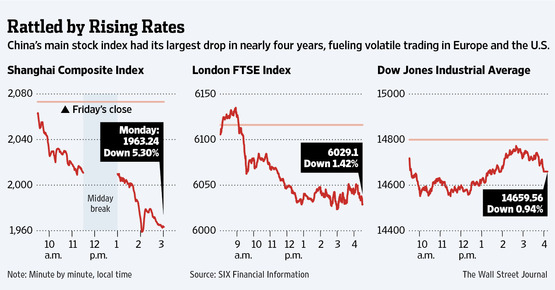
Volatility Lingers as Investors Reset |
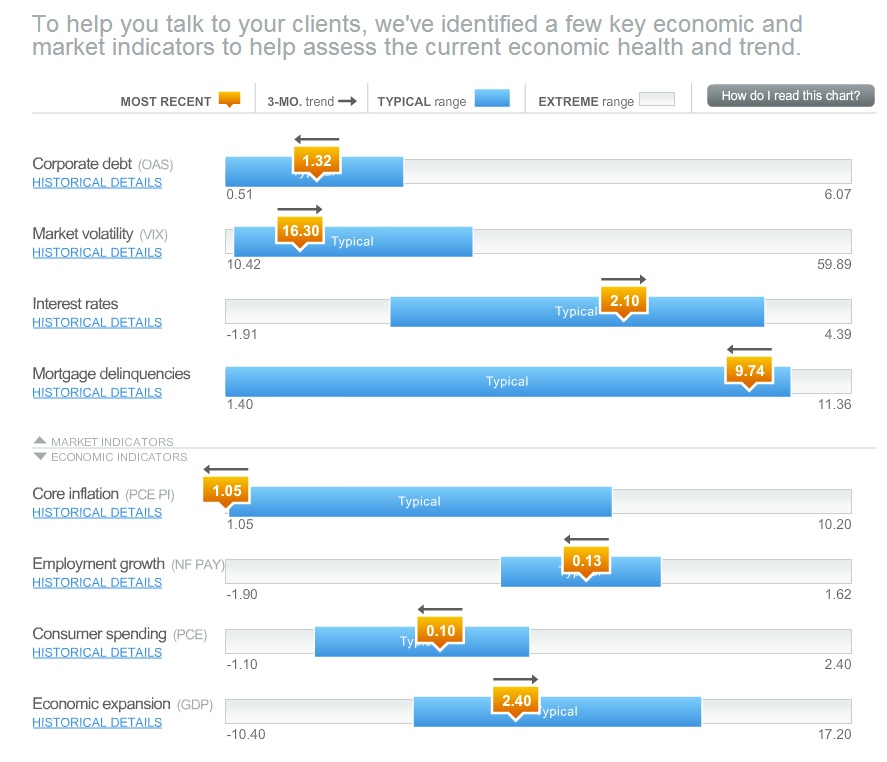
| State of the Economy Dashboard Posted: 25 Jun 2013 11:30 AM PDT |
| Morgan Housel Is A Permanent Optimist . . . Posted: 25 Jun 2013 08:30 AM PDT
Hey, today we are having lunch with the astute Morgan Housel of MF. I have been enjoying his writing for years now — he is my favorite Motley Fool writer. Here is his very simple explanation for why the end-of-worlders have been wrong, and will continue to be wrong, for most of the future millenia (see chart above). Housel noted what has occurred over the past 150 year or so. If you allowed the headlines to drive your investments, how would you respond to these events:
And despite these horrific headline events, our standard of living increased 20X. Investing is about objectively playing the odds — not about giving into emotions. This is a perfect example of how short term events can hurt your long term returns — if you allow yourself emotional reactions to them.
Source: |
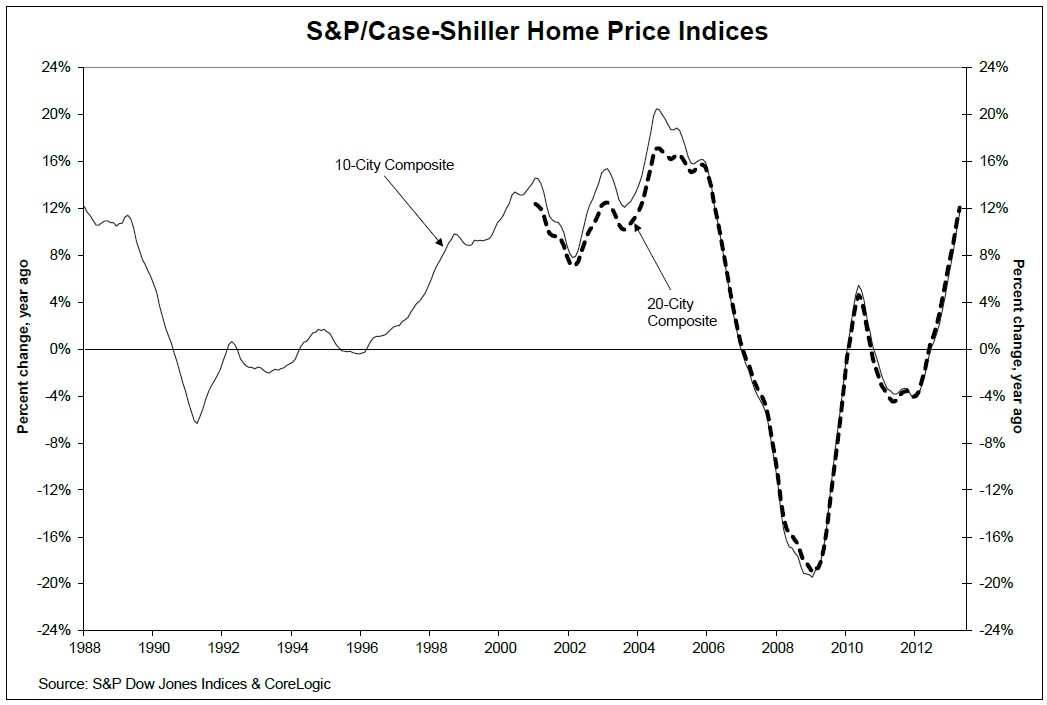
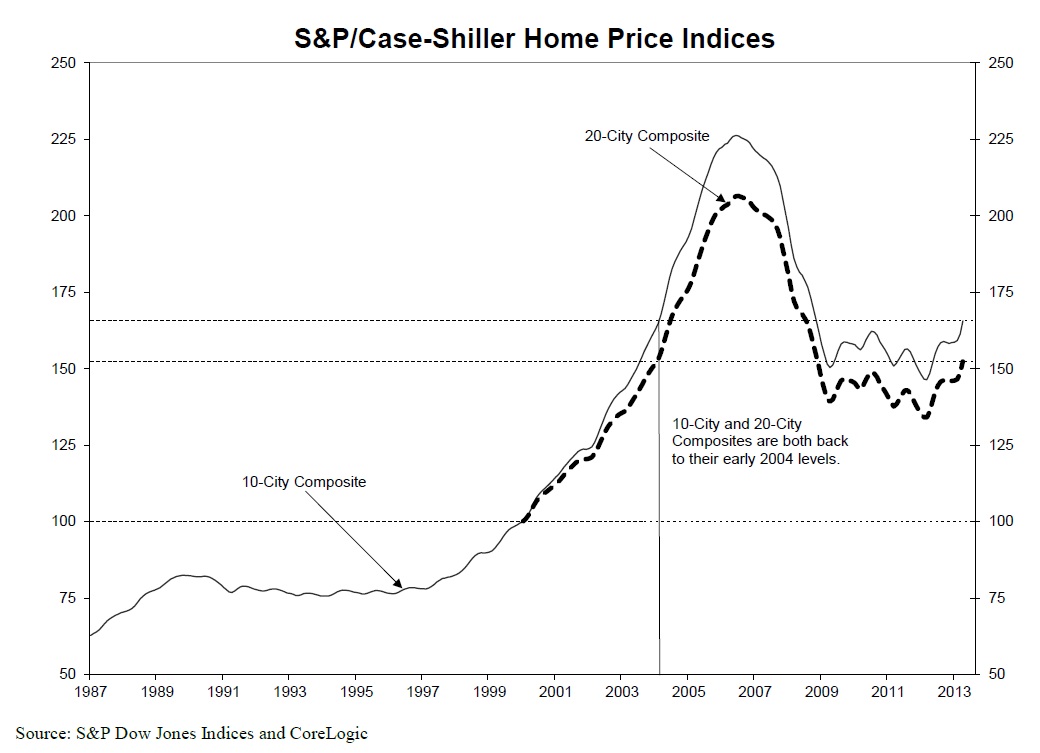
| Double Digit Gains for Case/Shiller Home Price Index Posted: 25 Jun 2013 07:30 AM PDT Is the Fed trying to take some air out of the Housing market?Double digit gains over the past year might have their attention:
Charts below:
The latest results of the Case-Shiller Home Price data through April 2013: Click to enlarge
Source: |
| Posted: 25 Jun 2013 07:00 AM PDT My morning reads:
What are you reading? |
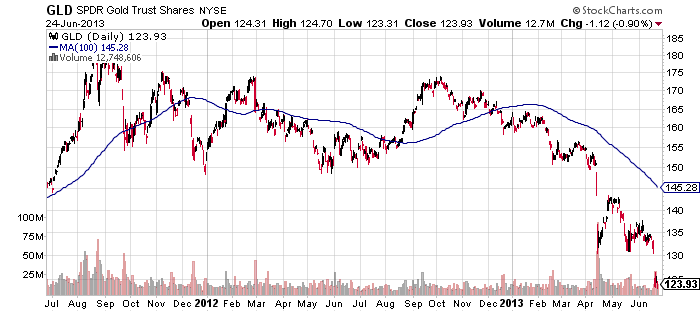
| Polling the Public About Investing Is Loads of Fun! Posted: 25 Jun 2013 04:30 AM PDT Back in August of 2011, Gallup decided to do what they do best — which is poll the American public for their thoughts. In this instance, it was their thoughts on investing. The questions asked was simply: What do you think is the best long term investment? Their answers were very instructive: 34% of Americans said gold is the best long-term investment. Real estate came in second at 19% with stocks at 17% in third, and bonds at 10%. Of course, the public has the tendency to emphasize what just happened, rather than what is likely to happen. We need to keep that in mind when we look at how well the public has done since then. Let’s start with the public’s then favorite investment, Gold: As a reminder, the shiny yellow metal was approaching an all time high of $1900 per ounce, in August 2011, about to embark on a 35% crash, still in progress.
Gold (GLD ETF)
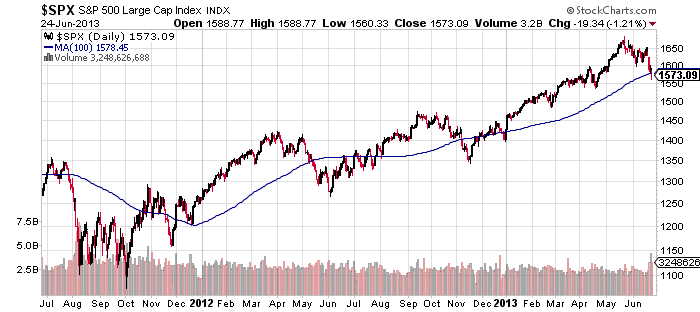
How about Equities? They were the 3rd of the 4 investments — how has the public done with that pick? As the chart below shows, not too well. Back in August 2011, the SPX was around 1100. Its since rallied 50% (including the recent sell off since May).
S&P500
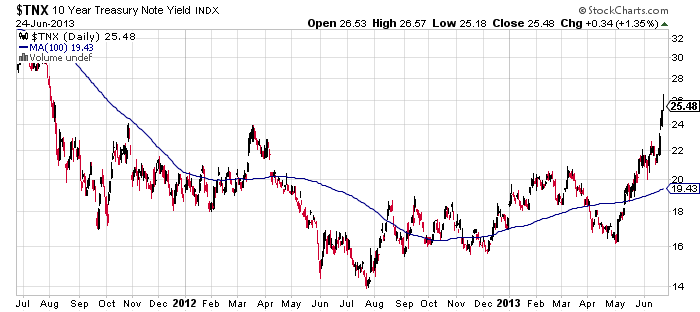
Note that the S&P500 was not the best performing index — others, notably Russell 2000, have done much better. But since its the benchmark, I chose that chart. Nice call, Public! (not). The masses, believe it or not, got their least favorite asset class, Bonds wrong too. Despite the incredible run up in yields this month, bond prices are still above (and yields below) where they were in August 2011.
Treasury Bonds (Yield inverse to price)
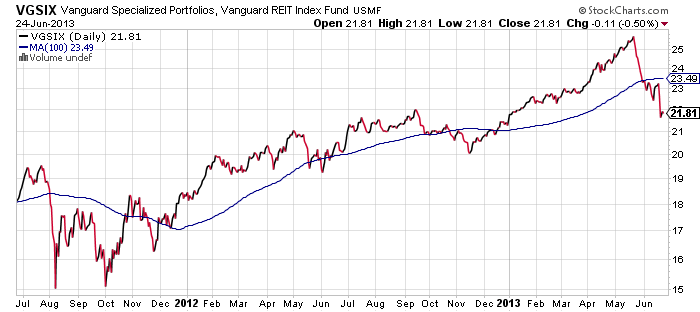
The public did get one things right — Real Estate has been rallying since 2011. It was their second favorite asset class behind gold. The Vanguard REIT index is up about 30% since then — so they did manage to pick one asset class out of 4 that worked out.
Vanguard REIT Index
The public has spoken! As a reminder, you might want to avoid following their advice . . .
Previously: Source: |
| US vs Canadian Bank Regulations: Money Boo Boo Posted: 25 Jun 2013 03:30 AM PDT Internal e-mails implicate credit rating agencies in the 2008 financial crisis. Money Boo Boo Monday June 24, 2013 (04:33) ~~~ Jason Jones teaches regulation-loving Canadian bankers the advantages of harmless free-market fun. Money Boo Boo – The Canadian Banking System Monday June 24, 2013 (05:49) |
| That Pesky Marketplace – A Political Fable Posted: 25 Jun 2013 02:30 AM PDT The Fed Chairman tells the President that his administration must work with Congress to cut spending or else the Fed will begin reducing its balance sheet. The President thanks him for his years of service. The Chairman, concerned with his legacy of having been too accommodative, hints to the public about tapering the Fed's asset purchases. The dollar rallies and asset prices fall. Perturbed, the President then publicly thanks the Fed Chairman for his years of service. The Fed Chairman escalates, publicly setting a time frame when he'll begin tapering. The markets fall even more dramatically. The President, fearful that the Fed's actions could destroy his legacy, quickly names a replacement for the Chairman, one that reliably plays ball. The markets rally. Through the optics of the capital markets, the President successfully perpetuates the temporary appearance of a healthy economy. The Fed Chairman returns to the private sector with dignity, his legacy defined by providing abundant credit when necessary and then trying to set a course back to normalcy. Yet the Fed never diverges from its accommodative posture; its zero interest rate policy remains in force and quantitative easing INCREASES to record levels. The capital markets rally further as the real economy continues to contract. Washington and Wall Street are happy while real output and employment continue to fall. A crisis "no one could have foreseen" occurs. Financial markets plunge. Banks inform the Fed their loan books are deteriorating. The Fed triples QE and yet employment rolls continue to drop. The Fed informs Congress and the President that the monetary system must be reset. The public grows angry that, just like in 2008, banks and the government gained funding through newly created money but it, the public, did not. (Civil unrest?). The State Department concurs with the Fed; foreign exporters to the U.S. no longer want US dollars in exchange and the system must be changed. At the urging of the President, Congress directs the Fed to devalue the Dollar to gold, and to reset a fixed exchange rate. Few still dispute that the capital markets are priced at the pleasure of elected and appointed authorities. The spectacle called "economy" should continue as-is, predictably reflexive, until it is in the interest of authorities to change its rules (not as predictable yet still entirely rational and quite in the American tradition). On and on it goes until it no longer can. Moral: When the financial markets no longer reflect the human condition, authorities must answer to true power – the marketplace.
Source: |

| You are subscribed to email updates from The Big Picture To stop receiving these emails, you may unsubscribe now. | Email delivery powered by Google |
| Google Inc., 20 West Kinzie, Chicago IL USA 60610 | |



0 comments:
Post a Comment