


The Big Picture |
- John Oliver: Ayn Rand – How Is This Still A Thing?
- Getting On The Right Track
- MiB: Jonathan Miller
- 10 Weekend Reads
| John Oliver: Ayn Rand – How Is This Still A Thing? Posted: 06 Dec 2014 04:00 PM PST Ayn Rand, author of “Atlas Shrugged” and “The Fountainhead” is still kind of a thing. How? |
| Posted: 06 Dec 2014 02:00 PM PST 1. Focus on music not money. There’s too much talk about grosses and too much bitching about Spotify. Amazon rolls out robots and we all ooh and ahh, there’s forward motion in the music business and everybody complains. Change is inevitable, the future comes, the social landscape will be rearranged…best to acknowledge this and move forward as opposed to trying ineffectively to hold it back. Yes, people will lose their jobs because of Amazon robots, the same way recording studios closed and CD plants too. This is sad, but this has become the story of the music business, what we have lost instead of what we have gained. This sends the wrong message to the consumer. Yes, there are rabid fans embracing the work of artists. But in order for music to be healthy once again we need to reach the casual consumer, who can tell you the difference between the iPhone 6 and 6 Plus but not that between Iggy Azalea and Ariana Grande. 2. If you fail come back to the marketplace quickly. The Fire phone was a disaster. But instead of licking its wounds, Amazon is now hyping its aforementioned robots. When there’s a failure in the music business the act retires for a year or two and is oftentimes forgotten by time it returns. Create often. Failure is inevitable. One hit trumps a raft of disasters. 3. The SoundScan chart ruined music. Because there was a different number one each week. The business will burgeon when it becomes comprehensible, when the same tracks dominate for a period of time. The chart is all about satisfying the industry, not the consumer. The industry wants to divvy out number ones, wants to influence dying retail. But when a record slips off the chart it’s usually gone for good, whereas movies come and go on the chart but then they get another life on DVD, pay cable, Netflix… The film chart position pays long term dividends in terms of advertising. Music chart positions are momentary. 4. Focus on what people are listening to, not what they’re buying. Buying an album does not mean one listens to it, oftentimes people only listen to the hit. Streaming, whether it be on YouTube or Spotify, indicates what is truly popular. Note to the wannabe…not everything is popular, never was, never will be. 5. The “Voice” is good for television, it’s bad for music. Because it’s a karaoke show and the music business depends on a steady stream of new hits. We need to extol the songwriter, who is sometimes the performer, not the face. Otherwise we’re focusing on the zit, not the acne. And acne is an infection, and that’s the goal of music, to infect people. 6. Acknowledge the inability to get a song out of your head is a good thing. That’s the key to Meghan Trainor’s “All About That Bass.” You may go on in your holier-than-thou fashion that it sucks, but if you hear it once you can’t stop singing it to yourself. We need more of that. 7. Embrace experimentation. Today’s artists are so worried about losing traction that they just replicate what they’ve done before. Test limits. 8. Identity and edge are everything. All the tech titans have rough edges. Hell, Travis Kalanick has dominated the news cycle and Uber just gets bigger. Whereas “artists” dress up instead of down and keep paying penance to their sponsors. Who can believe in that? 9. Utilize your power. Musicians dominate social media. But they don’t use it to move music forward. Only oldsters like Bob Geldof and Bono seem to understand the power of music to open the discussion, to change things. Young artists can do this too. But they have to be educated, they have to realize the advantage, they have to understand that if you don’t stand for something, you don’t stand for anything at all. 10. The music business is the canary in the coal mine, everything happens to it first, yet everybody in it keeps complaining about this change. People run from those who whine, offer no insight and refuse to get with the program. Artists have to give hope. Hope to consumers who too are affected by the new world and are trying to navigate their way. Music needs to run shotgun with these people. Music needs to be indispensable. We’ve got to stop the warring within and acknowledge it’s nearly impossible to break through and boost those who do. The biggest story of the year was Taylor Swift’s media campaign and resulting sales. I wish she wasn’t a front for Max Martin, but everyone agreed her social media campaign was brilliant, the ancient sales construct of a million copies in a week was repeated everywhere, her disdain for Spotify made headlines. Why wasn’t there a concomitant news story when Avicii’s “Wake Me Up” became the biggest track in the history of Spotify? Why do you hate on ~~~ |
| Posted: 06 Dec 2014 07:00 AM PST In the latest "Masters in Business" podcast, I speak with Jonathan Miller, a Bloomberg View contributor and co-founder of Miller Samuel. He blogs at Miller Matrix. Miller is an expert on real estate appraisals and transactions, and runs one of the larger appraisal firms. He has created a variety of real estate data analytics for various regions as well as nationally. He is also sought after as the “go to” appraiser for the many of the most expensive penthouses in Manhattan. In our conversation, Miller notes that all housing is local, but credit is national. Hence, the differences between the middle class housing market, driven primarily by access to credit, and the high end, which has become a nearly an all cash market. You can download the podcast here or on Apple iTunes, or stream it at SoundCloud. All of our prior podcasts are available on iTunes. ~~~ Check back for the updated streaming and embedded audio
|
| Posted: 06 Dec 2014 03:30 AM PST Good Saturday morn. Settle into your favorite easy chair, pour a hot cup of Joe, and enjoy our longer form weekend reads:
Be sure to check out this week’s Masters in Business interview with real estate expert Jonathan Miller
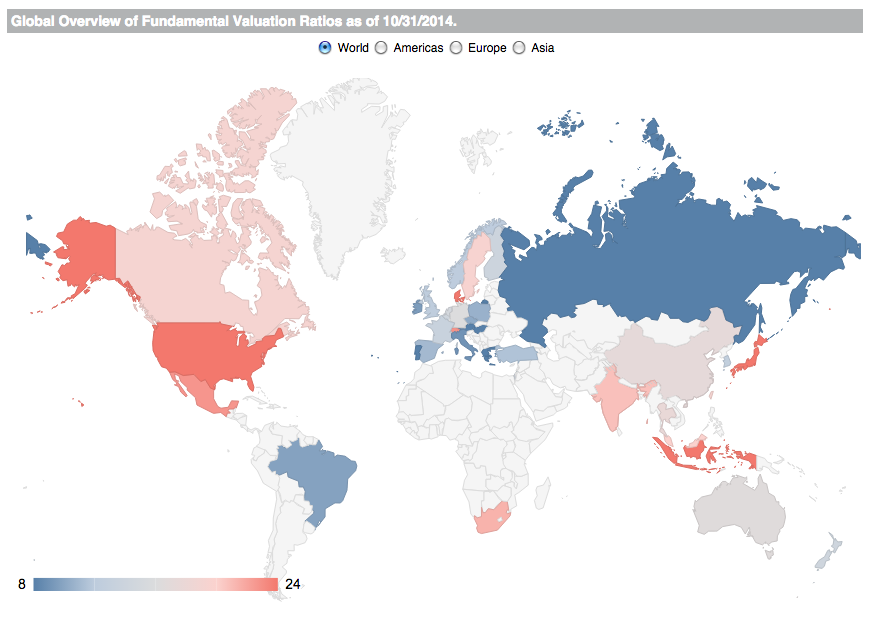
Global Stock Market Valuation Ratios Click for interactive graphic.
|
| You are subscribed to email updates from The Big Picture To stop receiving these emails, you may unsubscribe now. | Email delivery powered by Google |
| Google Inc., 1600 Amphitheatre Parkway, Mountain View, CA 94043, United States | |



0 comments:
Post a Comment