.

{2} GoogleTranslate (H)

English French German Spanish Italian Dutch Russian Portuguese Japanese Korean Arabic Chinese Simplified

Our New Stuff

{3} up AdBrite + eToro

Your Ad Here

Friday, March 22, 2013

The Big Picture

The Big Picture


Cyprus’ Popular (Laiki) Bank Balance Sheet

Posted: 22 Mar 2013 02:40 AM PDT

With the bank's assets at about 175 percent of Cyprus' GDP and advances to customers equivalent to over 80 percent of its asset base (before reserves)  it is pretty safe to say "this isn't your father's bank!"  You decide.


Mar21_PopBank

Mar21_PopBank2


(click here if table is not observable)

Congress Is About to Make Financial System Even WORSE

Posted: 21 Mar 2013 11:00 PM PDT

Congress Did Nothing to Rein In One of the Main Causes of the Financial Crisis … and Is About to Let Things Get Even MORE Insane

Out-of-control derivatives were largely responsible for the 2008 financial crisis … and still pose a massive threat to the economy.

Unchecked derivatives are so harmful to the economy that:

  • Warren Buffet called them "weapons of mass destruction"
  • A Nobel prize winning economist who helped develop derivatives pricing said some of them were so dangerous that they should be "blown up or burned"
  • Newsweek called them "The Monster that Ate Wall Street" after the financial crash

This is especially true since the big banks are manipulating the hundred trillion dollar derivatives market.

No, the big "financial reform" bill passed in the wake of the financial crisis didn't fix anything.  We noted last year:

No, there have not been any reforms or attempts to rein in derivatives, and the Dodd-Frank financial legislation was really just a p.r. stunt which didn't really change anything.

Indeed, the derivatives "reform" legislation previously passed has probably actually weakened existing regulations, and the legislation was "probably written by JP Morgan and Goldman Sachs".

In fact:

Harold Bradley – who oversees almost $2 billion in assets as chief investment officer at the Kauffman Foundation – told the Reuters Global Exchanges and Trading Summit in New York that a cabal is preventing swap derivatives from being forced onto clearing exchanges:

There is no incentive from the moneyed interests in either Washington or New York to change it…I believe we are in a cabal. There are five or six players only who are engaged and dominant in this marketplace and apparently they own the regulatory apparatus. Everybody is afraid to regulate them.

*** Moreover, the big banks are still dumping huge amounts of their toxic derivatives on the taxpayer. And see this.

Indeed, the U.S. has agreed to backstop potential trillions in derivatives in the U.S. … and abroad.

If the big banks are manipulating the derivatives market, they could manipulate every other market on the planet.   Given that the size of the derivatives market dwarfs the entire global economy, and given that derivatives are – by definition – not real assets, but paper abstractions loosely based upon real assets, manipulation of derivatives can drive asset prices up or down at whim.

***

Of course, the big banks own Washington D.C. politicians, lock stock and barrel.  See this, this, this and this.

So don't expect anything to change without a huge public outcry … or worse (and see this).

There wasn't a big enough public outcry.  So the boys are at it again.

Huffington Post notes:

A bipartisan cadre of House lawmakers will move on legislation to deregulate Wall Street derivatives Wednesday ….

"The road to hell is paved with these bills," said Rep. Alan Grayson (D-Fla.), an advocate of financial reform.

The House Agriculture Committee will mark up several derivatives bills on Wednesday despite opposition from a coalition of public interest and consumer advocacy groups ….

In a statement provided to The Huffington Post, [Senator] Levin expressed exasperation at the House efforts.

"Last year, some members of Congress supported watering down Dodd-Frank derivative safeguards, but abandoned those efforts after the world learned that JPMorgan Chase had lost billions of dollars on derivative trades made out of its London office," Levin said. "It is incredible that less than a week after new JPMorgan Whale hearings detailed how the bank's London office piled up risk, hid losses, and dodged regulatory oversight, that some House members are again supporting the weakening of derivative safeguards."

Derivatives were at the heart of the 2008 financial collapse. The preferred financial vehicle for a host of risky bets on the U.S. mortgage market, they created artificial demand for subprime mortgages, encouraging banks and mortgage brokers to extend loans to doomed borrowers. Derivatives pushed insurance giant AIG to the brink of bankruptcy and proved a hotbed for abuse on Wall Street. Goldman Sachs famously settled with the Securities and Exchange Commission for betting against the very derivatives it created and sold to its clients.

Yet in an era of partisan gridlock in the nation's capital, Democrats and Republicans have come together to repeal or weaken those rules. Although Obama may not want to sign a standalone package of Wall Street deregulation into law, bipartisan legislation could be inserted into a broader bill that the president might find difficult to reject.

***

Exempting such trades from oversight could also help foster tax avoidance, however, since companies have used sham derivatives transactions to dodge the Internal Revenue Service. Such activity is usually illegal, but the IRS has been short on resources to investigate and combat it. Requiring companies to post monetary guarantees creates an upfront cost to sham transactions that may serve as a deterrent.

***.

The bills to be considered Wednesday also include legislation from Rep. Jim Himes (D-Conn.) — another Goldman alum — that would roll back Dodd-Frank's ban on taxpayer support for some kinds of derivatives trades.

***

Another bill would force the Commodity Futures Trading Commission, a regulator with derivatives responsibility, to conduct economic cost-benefit analyses for new agency rules using guidelines that would be more favorable to Wall Street banks.

Yves Smith explains the latter bill:

The third bill, HR 1003, is a more straightforward "throw sand in the gears" operation. It seeks to neuter the CFTC by requiring it to make more than twice as many cost-benefit assessments of proposed decisions, which will undermine enforcement actions. It effectively subjects regulation to a second screen, by requiring regulators to jump through another hurdle and prove that rules already passed by Congress don't impose an undue cost relative to the supposed benefits. But that logic is heinous. First, recall that that sort of reasoning led to exploding Pintos. It was cheaper for Ford not to fix its cars and merely pay off the bereaved relatives of people who got fried. Second, the banks will always argue that tail risks, which is what a good deal of regulation is intended to reduce, are lower than they appear. But the cost of tail events, as in financial crises, are so great that it is imperative to be overinsured, since (as Nassim Nicholas Taleb has stressed) is inherently hard to measure and established approaches lowball it. And most important, he has described how complex derivatives risks are inherently unsuited to statistical measurement.

***

So it isn't just that the CTFC will be snowed under with busywork to justify its efforts, but that they are also likely to be shoehorned into a statistical template which will give the banks the upper hand. Well played!

Smith explains that it is still possible to kill these horrible bills:

Please contact your Senator and Representative and tell them you are firmly opposed to these bills since they are all "gimmie my bailout and leave me alone" proposals from the banks. One bit of good news here is that at least on paper, Republicans are not happy about the fact that Dodd Frank resolutions aren't likely to work even before the launch of this effort to assure they won't ever be attempted. Spencer Bachus issued a paper last year criticizing the inadequacy of the Dodd Frank resolution provisions. So it can't hurt to tell Democrats that they need to stand behind Dodd Frank, and remind Republicans that they've stood for "no more bailouts" and they need not to allow those sneaky ex Goldman Democrats to allow Wall Street to suck resources away from Main Street. This sort of bill depends on the complacency and indifference of the public to get passed, and correctly painting its as an egregious piece of pro-bailout pork might make some Congresscritters loath to be associated with it.

Celebrating #Twitter7

Posted: 21 Mar 2013 05:20 PM PDT

Since @jack first tweeted in 2006, Twitter has become a global town square. Well over 200 million active users send more than 400 million Tweets every day.


10 Thursday PM Reads

Posted: 21 Mar 2013 01:30 PM PDT

My afternoon train reading:

• How Franklin Roosevelt Secretly Ended the Gold Standard (Echoes)
• When to take investing advice from Twitter (MarketWatch) see also Twitter Just Crushed Wall Street After The Cyprus Bailout (Business Insider)
• New Reasons to Change Light Bulbs (NYT)
• The London Whale, Richard Fisher and Cyprus (Economix)
• The many failures of the personal finance industry (Abnormal Returns)
Companies: Show Us the (Political) Money (NYT)
• Home sales reach highest rate since 2009 (MarketWatch)
• NRA Poised to Scuttle Gun Legislation Most Americans Want (Bloomberg)
• Why I left Google (MSDN) see also Vulnerabilities Continue to Weigh Down Samsung Android Phones (threat post)
• Is the "Buy to Rent" Party Over? (A Lightning War for Liberty)

What are you reading?


The Yen is the Safest of Safe Havens

Source: All Star Charts

Why Cyprus Keeps Running to Russia

Posted: 21 Mar 2013 11:00 AM PDT

WSJ's Charles Forelle explains the relationship that has built up between Russia and Cyprus since communism fell. The problem now is whether this undermines the country's membership with the euro zone.


3/20/2013 8:29:57 AM3:08

Recession? No, According to Leading Economic Indicators (LEI)

Posted: 21 Mar 2013 09:00 AM PDT

click for ginormous chart

Source: Fusion Analytics


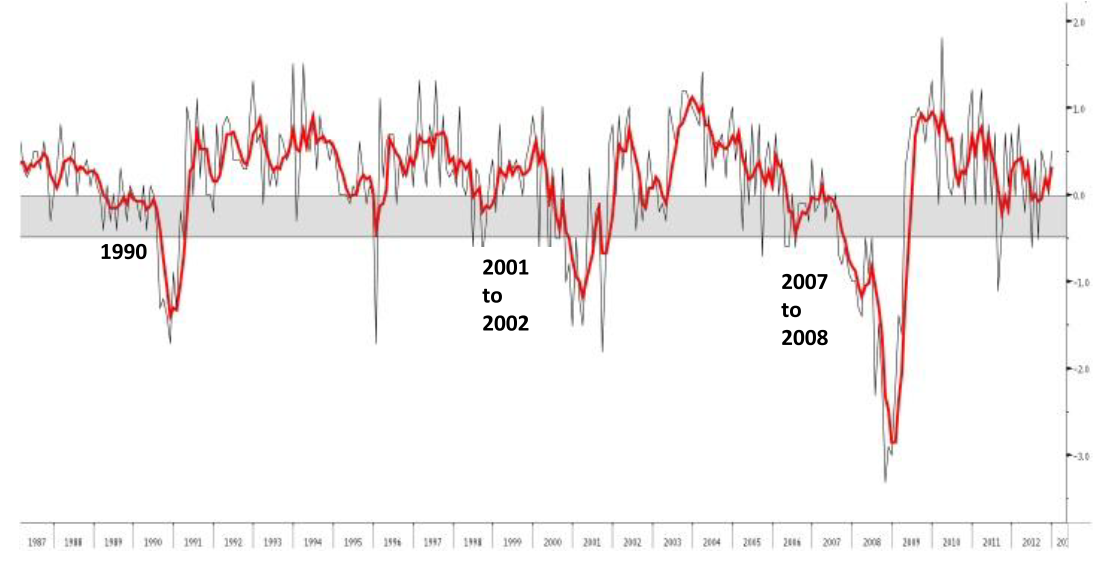
Take a look at the chart above — its the Month/over/month change in the Leading Economic Indicators.

We hold an occasional monthly conference call for FusionIQ subscribers, and this one came up last night.

To avoid whippy or false signals, we use a 4 Month Moving Average of the MoM% change (see red line) watching for a drop below the 0.0 to -0.5% band (gray band). That tends to only occur during pre-recessionary preiods.

The series is not only above the danger zone, but it is trending upwards — meaning that the odds of a recession are minimal.


LEI COMPONENTS:

1. Average weekly hours, manufacturing
2. Average weekly initial jobless claims
3. Manufacturing new orders, consumer goods and materials
4. ISM new orders, consumer
5. Manufacturers’ new orders, nondefense capital
6. Building permits, new private housing
7. Stock prices, 500 common stocks
8. Leading Credit
9. Interest rate
10.Average consumer expectations

10 Thursday AM Reads

Posted: 21 Mar 2013 06:45 AM PDT

My morning reads:

• What Ben Bernanke would say if he stopped being polite and started getting real (Wonkblog)
• Another volatility-based buy signal (MarketWatch)
• Stagnant Japan Rolls Dice on New Era of Easy Money (WSJ)
• Why renters are still driving America’s building boom (Fortune) see also Sudden Rise in Home Demand Takes Builders by Surprise (NYT)
• Emerging Markets: The Next Wave (Barron’s)
• Fitch And Kroll Are Happy To Make Mortgage Securitization Fun Again (Dealbreaker) see also Deal May Signal Thaw in Mortgage Securities (WSJ)
Today’s WTF headline: Congress Moves to DEREGULATE Wall Street (A Lighting War for Liberty)
• Twitter Untangles Its Overgrown Org Chart (All Things D)
• Guy Kawasaki’s Case For Self-Publishing (Fast Company)
Ratigan: Putting Our Money Where Our Mouth Is (Dylan Ratigan)

What are you reading?


UK vs. US: Paths of Real GDP in Current Downturn

Source: Twitter


Modell Deutschland: Youth Unemployment

Posted: 21 Mar 2013 06:30 AM PDT

Youth unemployment has soared in much of Europe, but not in Germany


Mar 20th 2013, 15:04 by Economist.com

Coming Soon: TBTF ETF

Posted: 21 Mar 2013 04:30 AM PDT

TBTF ETF Backtest (Red)

Source: Bespoke


I am putting together a new ETF that consists entirely of companies that have become so large and systemically important that they are guaranteed survival regardless of their own incompetency.

It is a market cap weighted index (naturally) so that those names that represent the greatest threat to the overall economy have the highest weighting. Full universe of potential holdings are here.

Ticker symbol: TBTF

Top 10 Holdings
AIG*
Citigroup
Bank of America
Morgan Stanley
Goldman Sachs
Wells Fargo
Fannie Mae
JPMorgan
US Bancorp
Ally

Note: Because shareholders got wiped out in the GM and Chrysler bankruptcy, they do not qualify.

We expect trading to begin May 1. Full disclosures and documentation available on request.**

We also be rolling out the leveraged version — 200% long, symbol XTBTF, and of course, the Ultra — a triple leveraged ETF, symbol UTBTF.

We will be following the domestic ETF with an international version: TBTFi (not to be confused with the BlackRock’s offering, iTBTF). It will be filled with ECB notes, Japanese banks, Sovereign debt from Greece and Cyprus, etc. For diversification purposes, it is important to own TBTF banks in various geographic regions in case of local central bank collapse or nuclear accident.


____________________

* AIG is really in there as a sentimental favorite, but they are no longer truly TBTF.

** No, not really, as this is sarcasm.

.

0 comments:

Post a Comment

previous home Next

{8} chatroll


{9} AdBrite FOOTER

{8} Nice Blogs (Adgetize)