.

{2} GoogleTranslate (H)

English French German Spanish Italian Dutch Russian Portuguese Japanese Korean Arabic Chinese Simplified

Our New Stuff

{3} up AdBrite + eToro

Your Ad Here

Thursday, June 6, 2013

The Big Picture

The Big Picture


Mr Abe’s comments cause a sell off

Posted: 06 Jun 2013 02:00 AM PDT

Sarkar Global Macro is a newsletter which analyses and comments on market moving global macro issues, including an analysis of political and government policy decisions, which enables subscribers to make informed investment decisions. 

~~~


Japanese PM, Mr Abe's speech on the country's growth strategy disappointed investors. He did not refer to restarting the country's nuclear programme, something a number of analysts had expected. He stated that he would promote private sector investment through the removal of bureaucratic barriers. He also promised to open up the infrastructure, health and energy sectors and promoting FDI into Japan, together with improving career opportunities for women. Certain cities would be allowed to introduce lower taxes and deregulate further creating, in effect special economic zones. Mr Abe also set a goal to increase earnings by 3.0%. All laudable sentiments, but there were few specifics or any meaningful measures and his statement will not make a difference in the short and medium term. The Nikkei reacted negatively with the market -3.8% lower and the Yen strengthening.

Australasia

Australia grew by just +2.5% in Q1 Y/Y, the slowest in nearly 2 years and below the +2.7% forecast. The lower growth, combined with the strong A$ and contained inflation, will add to speculation that the RBA will cut interest rates in the next few months. Analysts suggest that the RBA's benchmark interest rate will be cut to 2.0%, from the current 2.75%. The A$ clearly weakened on the news.

As the EU has announced that it is to impose tariffs on chinese solar panels (see below), the Chinese have reacted by launching an investigation into the European wine sector. China is the fastest growing market for European wine and the 5th largest market globally. The speed of the retaliation has also caught EU officials by surprise, who had thought that the imposition of relatively low tariffs for a first few months would result in the Chinese seeking to negotiate a compromise.

Chinese May services PMI rose to 51.2, from 51.1 previously. However, it was the lowest reading since August 2011. Chinese economic data just continue to slide and there are no signals that the new administration is prepared to stimulate the economy. I remain bearish on China.

Indian authorities have increased curbs on the import of gold, which is a key driver of the current account deficit. Restrictions will be placed on banks and state run trading companies. The authorities are also tightening financing rules for imports. The measures have helped to stabilise (marginally) the Rupee, which was depreciating ahead of the announcement. India was the largest consumer of gold bullion last year, according to the Gold Council. Indian bond yields are drifting lower on speculation that the RBI will cut interest rates further, given the weaker economic growth.

Europe

EZ May final services PMI came in at 47.2, below the 47.5 expected, though above April's 47.0.

Germany services PMI came in at 49.7, as opposed to 49.8 expected.

France came in at 44.3, in line with expectations.

Italy was weaker at 46.5, as opposed to 47.5 expected.

However Spain was much better at 47.3, as opposed to 44.4 previously and expectations of 45.0.

Once again, the PMI's are all in contraction territory, with Markit suggesting that the EZ economy will contract by -0.2% in Q2

The EU has imposed tariffs on solar panels imported from China. The rate of the levy is to be announced today, though will probably come in at a relatively low level and is expected to last for a few months, before increasing, and could be extended to 5 years. The EU in this way is trying to incentivise the Chinese to come to an agreement. The introduction of levies was opposed by a number of EU countries, including Germany, even though one of the main companies affected by this alleged dumping by Chinese manufacturers is a German company.

The EU confirmed that Latvia's bid to join the Euro has been accepted and will happen with effect from the 1st January 2014.

Whilst the EZ May services PMI came in weaker than expected, the UK services PMI came in at 54.9 (the highest since March 2012) and much better than the 52.9 in April and the 53.1 forecast. Markit, the provider of the data reported that the recovery appears to be gaining some traction, which was also evident in the recent manufacturing and construction PMI's. The data reduces the chances that the BoE will increase its QE programme.

Other

In a move to bolster its currency, the Brazilian authorities have cancelled the IOF (a financial transaction tax) of 6.0% on foreign investments in local fixed income markets, which was introduced in 2011 when its currency, the Real, was appreciating. The move is likely to help the Real in the short term, but I fear that Brazil's problems will resurface yet again. Trading volumes should increase, given the removal of the tax, adding to volatility.

Markets

Equities

Australasia. Markets closed lower, with the Nikkei -3.8% weaker.

Europe. European markets are lower and looking weak.

US. Futures suggest a lower open.

I remain cautious to negative. With uncertainty as to the FED's QE programme, the risks appear to be to the downside to me.

Currencies

Euro/US$ 1.3001

US$/Yen 99.53

£/US$1.5354

A$ 0.9557

The US$ is stronger against the Euro and the A$, but the Yen and £ are higher.

Bonds 2/10 year

US 0.31/2.12%

Germany 0.11/1.53%

Japan 0.12/0.85%

UK 0.37/2.02%

Relatively flat on the day.

Commodities

Spot Gold US$1398

July Brent US$103.53

Gold is flat inspite of the news from India.

Brent is creeping up again.

Kiron Sarkar


Housing: Recovery … Or Artificial Bubble Which Is About to Pop?

Posted: 05 Jun 2013 10:30 PM PDT

Housing Prices: Up Or Down?


Preface: Part 1 will discuss what's really going on in the housing market. Part 2 explains why.

CBS News noted in February:

Many of those real estate buyers aren't your everyday bargain-hunters. They're Wall Street and international investors. While the fast money is boosting the housing market, it also poses risks in a key sector of the economy that is just getting back on its feet.

Data show that investment trusts, private equity firms and other institutional investors are purchasing thousands of single-family homes. The idea is to fix them up, rent them out and, when prices rise, sell them.

***

Even at the peak of the bubble in 2005, only 11.5 percent of homes in Los Angeles were purchased by absentee buyers — now 25 percent are.

The next month, CBS News reported:

[Economist Dean Baker notes]: "The rate of increase is alarming. Certainly this cannot be sustained for any substantial period of time. At the moment it is being driven in most of these markets by investor purchases. With rents in no way keeping pace, the fundamentals in these markets will not support much higher prices. This could end badly for homeowners who may again be buying into a bubble."

***

Much of the rebound in prices is attributable to institutional investors piling into housing — such players make up a much larger share of buyers than they did years ago, or should in a normal market.

Bloomberg point out:

Blackstone Group LP, the country's biggest real estate investor–which has already invested $3.5 billion to buy 20,000 single-family homes – has obtained a credit line of $2.1 billion to buy even more. Meanwhile KKR & Co. just raised a $500 million fund for real estate investments. There seems to be no shortage of folks willing to provide money to invest in a housing upturn.

***

This latest report helps unravel a paradox of the current housing economy: With all the real estate investment action, you'd expect the number of new mortgage loans to be shooting upwards. No such luck. Look at the chart below, which shows new purchase mortgages through the 3rd quarter of 2012, using data from the Mortgage Bankers Association. For that quarter, buyers took out $129 billion in purchase loans. Not only is that much lower than the numbers from the boom, but it's less the post-crash levels of 2009. You need to go back to the mid-1990s to get back to numbers like those (and they're not adjusted for inflation).

[Indeed, mortgage applications are plunging.]

Forbes wrote:

Wall Street bulls have been helping fuel the home price surge in some of the hottest housing markets across the U.S.

The March MarketPulse report from CoreLogic examines the rise of institutional investors and the effects they are having on distressed inventory. The analysis, compiled by CoreLogic deputy chief economist Sam Khater, looked at 16 major U.S. housing markets where bank-owned inventory (REOs) have been relatively high since the housing bubble burst. He assessed whether local activity was comprised of mom-and-pop individual investors or institutional investors, defined as either entities that have purchased five-plus properties a year under the same name or under an incorporated name.

Here's what Khater found: institutional investors have been targeting specific markets and then accelerating purchases of REOs in those markets, driving down distressed inventories and leading to notable increases in REO prices that have in turn led to larger market upticks. Institutional investors have focused buying efforts strongly on south and southwestern cities that were hit hardest by the foreclosure crisis. The cities where investors activity has been particularly robust in the past year are Atlanta, Ga., Detroit, Mich., Las Vegas, Nev., Phoenix, Ariz., and Calif.'s Los Angeles, Riverside and Sacramento.

Interestingly, many of these areas have welcomed notable year-over-year price increases as well — though none quite as much as Phoenix, which welcomed a nearly 23% uptick in prices throughout 2012, amid reports of frenzied bidding wars. The share of institutional investors in the desert metropolis was 16% in 2011; it jumped to 26% in 2012. Not surprisingly inventory levels plummeted as demand increased, putting upward pressure on prices that have created a ripple effect. Explains Khater:

"In Q4 2012, Phoenix REO prices were 37% higher than a year ago, followed by Las Vegas (30%) and several California markets. All six markets with rising shares of institutional investors experienced double-digit increases and were among the top nine for REO price appreciation.

"More importantly, the ripple effects are greatly impacting the broader market. Lower-end home prices in markets with rising shares of institutional investors are up 15% from a year ago, compared to only 6% for the remaining markets."

Institutions are most active in five states: Florida, Georgia, Arizona, Nevada and California. Interestingly the metro area that welcomed the most institutional activity in 2012 was Miami, Fla., with firms funding 30% of all sales. Single-family home prices for the Miami metro area rose about 11% in 2012 (including distressed homes), according to CoreLogic.

Institutional investors accounted for 21% of all sales in Charlotte, N.C., 19% in Las Vegas, and 18% in Orlando.

Major investment firms have been setting aside billions of dollars for large scale acquisitions in single family housing since the downturn, with activity jumping in 2012 as analysts called a market bottom. The strategy: snap up dozens, hundreds, even thousands, of distressed homes, fix them up and rent them out for robust returns. JPMorgan Chase recently estimated that institutional investors had amassed a combined $10 billion for single family rentals.

***

JPMorgan Chase, which also offers its wealthiest clients the opportunity to invest directly in a rental portfolio of about 5,000 homes, says its clients can expect annual returns as high as 8%, according to Bloomberg. Colony Capital, a real estate equity company privately owned by billionaire Thomas Barrack, has allocated $2 billion for investments nationwide. It plans to sink more than $150 million per month this year into rental homes, including an anticipated 1,000 units in South Florida, after snapping up 5,000 across the country in 2012.

Waypoint Homes expects to own 10,000 homes by year's end; it has already amassed upward of 3,300 properties. Other investors include BlackRock, which is making housing plays both stateside and in the E.U., Apollo Global Management, Och-Ziff Capital Management Group, KKR& Co, and Oaktree Capital Group — to name a few.

Even Buffett's Berkshire Hathway has been building out a residential real estate brand called Berkshire Hathaway Home Services that it plans to franchise with joint venture partner Brookfield Asset Management this year. [Last year, Warren Buffett told CNBC: "If I had a way of buying a couple hundred thousand single-family homes I would load up on them. It is a very attractive asset class right now. I could buy them at distressed prices and find renters."]  The venture has amassed the loan portfolio of bankrupt Residential Capital, acquired realty firms like Prudential Real Estate and Real Living Real Estate, and bought out several construction companies like brick maker Jenkins Brick.

The Wall Street Journal noted:

U.S. housing recoveries almost always have been ignited by rising demand from families and individuals looking for a place to live. This recovery is different. Investors—including some big Wall Street players—are leading the way, say industry executives and analysts. Their role is noteworthy given that flippers and speculators were blamed for helping to inflate the housing bubble of the past decade.

Today's investors are mostly buying with the intention of holding on to the homes and renting them out. As they pile into the housing market, they have set off a chain reaction that has stabilized prices and changed market psychology, industry executives and analysts say. Fear of buying homes when prices are dropping has been replaced by the fear of missing out on cheap homes.

***

Currently, cash buyers—largely investors—make up about 32% of sales nationally, according to the National Association of Realtors. In Southern California, a favorite target for investors, absentee buyers accounted for 31.4% of purchases last month, up from an average of less than 17% between 2000 and 2010, according to DataQuick MDA, a real-estate research firm.

While some firms have focused only on Sunbelt markets with newer housing stock, others are branching out. [Bloomberg makes the same point.] American Residential Properties Inc., which began amassing hundreds of homes in Phoenix four years ago, earlier this month bought 93 homes in Chicago's southern suburbs, bringing its total there to around 300. On Friday, the company said it planned to raise $300 million in an initial public offering, according to a regulatory filing.

***

Colony American Homes, a subsidiary of Colony Capital. That has created "a big opportunity to rent homes to people who for whatever reason have chosen not to buy or can't buy." Colony has spent more than $1 billion on 8,000 homes in seven states, and Mr. Chang said it isn't through buying. "In each of the markets we're in, we think we can go deeper," he said.

In April, the Washington Post pointed out:

Real estate executives say institutional investors — who in some cases are bidding on hundreds of homes a day — account for as much as 70 percent of sales in some Florida markets. Over the past two years, analysts say, they also have accounted for a majority of purchases in other parts of the country where housing prices are rebounding sharply.The influx of investors may explain why home prices have been rising in parts of the country most affected by the housing crash, despite high jobless rates and relatively few new mortgages being issued by lenders.

***

"I don't know whether things are as good as they seem to be. A lot of properties are being occupied by institutional investors, not the end-user," said Scott Kranz, co-principal of Title Capital Management, a firm that helps big investors scout, buy and manage homes in Florida. "The end-user would need to see a great increase in jobs, availability of mortgage money and a loosening of the reins that have been holding them back. But all the economic indicators are that we are not at that point."

CNBC reported in May:

"If you think about all of the major institutions maybe owning 70,000 total homes compared to the market size of 14 million homes, the long term potential is enormous. Institutions are literally a fly on an elephant," said Aaron Edelheit, CEO of The American Home, an Atlanta-based company that owns and manages about 2,500 homes. "We may look back and realize that the REO [real estate owned] to rental space was only the foundation for an exponentially larger industry with institutions owning hundreds of thousands, if not millions, of homes."

The New York Times explained Monday:

The last time the housing market was this hot in Phoenix and Las Vegas, the buyers pushing up prices were mostly small time. Nowadays, they are big time — Wall Street big.

Large investment firms have spent billions of dollars over the last year buying homes in some of the nation's most depressed markets. The influx has been so great, and the resulting price gains so big, that ordinary buyers are feeling squeezed out. Some are already wondering if prices will slump anew if the big money stops flowing.

"The growth is being propelled by institutional money," said Suzanne Mistretta, an analyst at Fitch Ratings. "The question is how much the change in prices really reflects market demand, rather than one-off market shifts that may not be around in a couple years."

***

With little fanfare, these and other financial companies have become significant landlords on Main Street. Most of the firms are renting out the homes, with the possibility of unloading them at a profit when prices rise far enough.***

These investors … are among the biggest buyers in struggling areas of the country where housing prices have been increasing the fastest. Those gains, in turn, have been at the leading edge of rising home prices nationwide.

***

Nationwide, 68 percent of the damaged homes sold in April went to investors, and only 19 percent to first-time home buyers, according to Campbell HousingPulse.

***

Joe Cusumano, a real estate agent in Riverside County, Calif., said that in recent months 90 percent of his business had been for companies like Invitation Homes, a Blackstone subsidiary. Home values in Riverside County have risen by 15 percent in the last year, according to CoreLogic.

The Trend Is Not Necessarily Our Trend

The Wall Street Journal notes that investors are helping to speed the transition from a homeowner to a rental society:

The rush of investors into the housing market follows a long push by federal policy makers to foster the American dream of homeownership that unraveled for some people in the housing crash. The homeownership rate fell to around 65% last year from 69% in 2005. "We're clearly at the beginning of a rental boom," says Christopher Thornberg of Beacon Economics. "We all saw there had to be a shift towards renting single-family units that owners could no longer afford. Investors played a critical role in that transformation."

***

Around 12% of all U.S. households—more than 14 million people—rented a single-family home in 2011, up from 9% in 2004, according to the most recent U.S. Census figures. Three-fifths of people who lost their homes to foreclosure in the past five years ended up renting a house, said Ms. Zelman.

Similarly, the Washington Post notes:

"There is the possibility that Wall Street and the banks and the affluent 1 percent stand to gain the most from this," said Jack McCabe, a real estate consultant based in Deerfield Beach, Fla. "Meanwhile, lower-income Americans will lose their opportunity for the American Dream of building wealth through owning a home."

Will This End Badly?

CBS News noted in February:

No matter how you slice it, investors are taking up a bigger piece of the pie than they used to, helping to drive inventory down and push prices up. So what happens if they suddenly step out, as home prices get more expensive?

According to the National Association of Realtors, existing home sales rose 9.1 percent year-over-year in January. If investors exit the market altogether in areas where they account for 10 or 15 percent of sales, that would just about eliminate any of the substantial growth in home sales in those neighborhoods.

***

Some housing activists are crying foul over the investor-driven recovery in housing. Under this view, investors are taking away homes from people who otherwise would be able to buy an affordable property. Investment firms also act as a ready buyer for banks that opt for foreclosure and short sales over loan modifications that would keep homeowners in their homes.

Instead, these investors are setting up a new rental market, which could mean transience where there was once stability in neighborhoods across the country. Instead of people building equity in a home they secured at an inexpensive price, with some of the cheapest mortgage interest rates in history, these renters are pouring money back into the hands of investors while they struggle to purchase a home they can call their own.

If this is the case, the housing recovery as it appears today could be nothing more than a mirage.

In March, the Wall Street Journal pointed out:

Not everyone believes that the current level of investor activity is healthy. Some worry that investors will eventually flee the housing market if values erode again or if the expense of maintaining a large number of homes becomes onerous. "Are they going to continue to maintain them? Or are they going to dump them into the single-family market?" said Mr. Thornberg of Beacon Economics.

Some investors have a notorious history in the housing market. During California's housing bust in the late 1980s and early 1990s, the federal government sold hundreds of homes in California's San Bernardino and Riverside counties, about an hour east of Los Angeles. Some homes weren't maintained, turning entire neighborhoods into shabby rental communities.

Yahoo's Daily Ticker asked:

What happens when these investment firms leave the market?

"That's a huge risk," says The Daily Ticker's Aaron Task. "If they decide…they don't really want to be in this business all of a sudden you could have a ton of new homes coming back into the market and then that supply situation will get flipped very badly against the market itself."

Former Budget Director and current deficit hawk David Stockman calls this Housing Bubble part two.

In April, the Washington Post wrote:

Big investors are pouring unprecedented amounts of money into real estate hard hit by the housing crash, bringing those moribund markets back to life but raising the prospect of another Wall Street-fueled bubble that won't be sustainable.

***

Hedge funds, Wall Street investors and other institutions are crowding out individual home buyers.

If the chain of easy credit and dangerous leverage that started on Wall Street fanned the housing bubble and eventual crash, some analysts find it disturbing that major investors are the ones snapping up the bargains — and eventual big profits — left in its wake.

Indeed, numerous institutional investors are starting to cash out. And there are reportedly mass layoffs coming in the mortgage finance industry.

As the New York Times noted Monday:

In a sign of the potential peril ahead, some of the investment firms have recently taken the first steps to cash out.

The investment fund financed by Colony Capital filed last week to go public, the second firm to do so in May. Another early player in the business, the Carrington Holding Company, said last week that prices had risen too far, leading the firm to begin selling some of its holdings.

Fitch Ratings warned last Tuesday that prices for single-family homes in the regions with the biggest housing rebounds had been outpacing the growth rate in the local economies and "could stall or possibly reverse" if big investors start selling.


What Do You Do If You Miss the Move off of the Lows?

Posted: 05 Jun 2013 05:00 PM PDT


I just submitted my Sunday column into be edited. The topic: You Missed the Big Market Rally? What Do You Do Now?

I have my own ideas about what the best response is, but I wanted to open this up to the crowd:

What should investors do when they miss a long rally?

~~~

What say ye?


10 Midweek PM Reads

Posted: 05 Jun 2013 01:30 PM PDT

My afternoon train reads:

Look Out Below: 'Thundering Herd Is Moving the Wrong Way' (Moneybeat) see also Quant hedge funds hit by US bonds sell-off (FT.com)
• Americans Short on Financial Know How (Real Time Economics)
• Madoff, other felons say markets are unfair (MarketWatch)
• Will Bond Market Vigilantes Wreck Your Portfolio? (Fiscal Times) see also Game of negative rates (FT Alphaville)
• Higher Mortgage Rates Won't Kill Housing Recovery (WSJ)
• Madoff-Tarnished Mets Catching Yankees in Ballpark Bond Returns (Bloomberg)
• Sequester’s Bark Worse Than Bite—So Far (WSJ)
• comScore Reports April 2013 U.S. Smartphone Subscriber Market Share (comScore) but see Samsung May Have Passed Apple in U.S. — for Now (Bits)
• Amazon's cloud is how big again? (Gigaom)
• New, Improved Google Maps Lets User Launch Missile At Any Location On Globe (The Onion)

What are you reading?


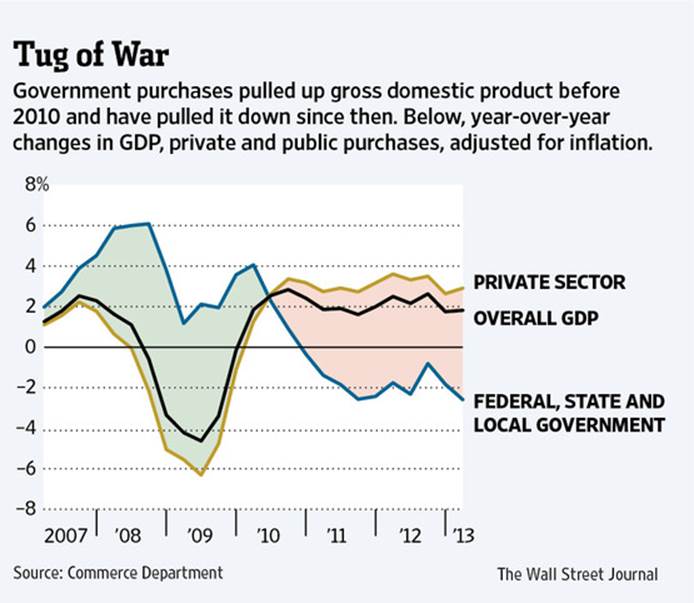
Sequester’s Bark Worse Than Bite—So Far
Chart
Source: WSJ

Every Business Cliche Ever in One Toast

Posted: 05 Jun 2013 12:00 PM PDT

Click to enlarge
Graphic

Source: All Things D

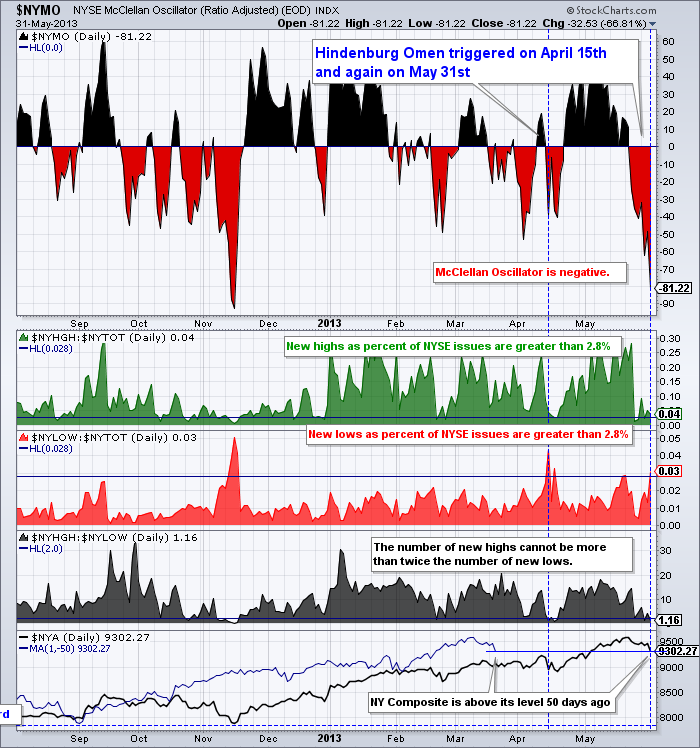
Question: What Is Driving Hindenburg Omen Internals?

Posted: 05 Jun 2013 10:00 AM PDT

6a0105370026df970c019102d5eb31970c-800wi
Source: Stockcharts


Definition: Hindenburg Omen is triggered when: (1) more than 2.2% of stocks on the NYSE are at 52-week highs AND more than 2.2% are at 52-week lows, (2) the 50-day moving average is trending higher, (3) the McClellan Oscillator is negative, and (4) new 52-week highs don’t exceed new lows by more than 100%.


Yesterday, we asked the question Why people fear the Hindenburg Omen? despite its mixed (i.e., awful) track record in forecasting crashes.

Today, I have a more specific technical question: With markets up 16% YTD as of mid-May, we obviously had a huge number of stocks making 52 week highs.

But we also have seen a spike in rates, suggesting that anything credit or bond related — closed end funds, mortgage REITs, bond funds, etc. — trading on the NYSE are going to be trading appreciably lower. Perhaps even to 52 week lows.

Then there is Japan, and the large number of ADRs and ETFs on the NYSE. These may also be trading lower; the same for various European ADRs that are faltering.

My technical question is this: What happens if we look at the NYSE US operating company only for this indicator — does it change its track record? Does removing the non equity names improve the signal’s otherwise mediocre track record?

Alternatively, when successful Hindenburg Omens have been made in the past, are bonds/ADRs/closed end funds/non operating companies a factor?

Is it possible to generate a track record using Nasdaq as the basis instead of the NYSE? What about the 500 names in the S&P500.

Inquiring minds want to know!


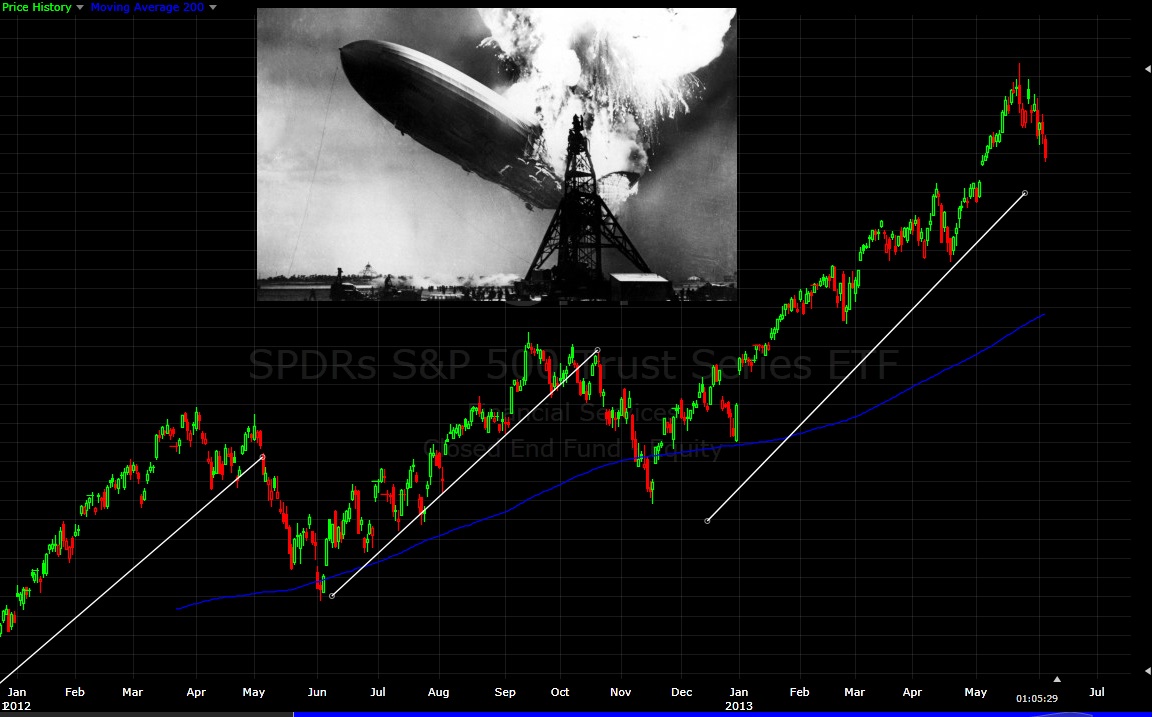
Hindenburg-disaster

10 Midweek AM Reads

Posted: 05 Jun 2013 06:45 AM PDT

My morning reads:

• Prognostications: It’s Not a Stock Bubble (Businessweek) see also Credit Suisse’s Garthwaite: 'Just buy stocks' (FT Alphaville)
Poll: 87% See Risk of Stock Crash by year-end (MarketWatch)
• Survey Says…Economic Risks Bear Watching (WSJ)
• Financial Advice: A Top Ten List (Above the Market) see also Learn Your ABCs Before Hiring a Financial Advisor (Morningstar)
• Will the housing rebound crush the job market? (Fortune) see also The Return of McMansions (Economix)
• Don’t Throw the Baby out With the Bath Water: A Challenge to Paul Tudor Jones (Huffington Post)
• F.B.I. Nominee Could Offer Peek Into the World of Ray Dalio (DealBook)
• Prosecute the patent trolls! (Reuters) see also Obama Orders Regulators to Root Out 'Patent Trolls' (NYT)
• Scientists poke frozen mammoth, liquid blood squirts out (Wired) see also The first pictures of blood from a 10,000 year old Siberian woolly mammoth (Siberian Times)
• Enter Photo Contests and Competitions to Boost Your Photography Skills (lifehacker)

What are you reading?


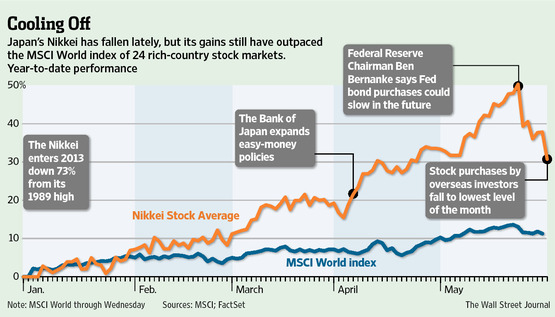
Wall Street Takes Foot Off the Gas
Chart
Source: WSJ

Bureaucratic Blunder or Political Profiling at the IRS?

Posted: 05 Jun 2013 04:30 AM PDT

click for ginormous infographic
irs blunder


IRS: Bureaucratic Blunder or Political Profiling
Source: TopAccountingDegrees.org


Who Won the Iraq War?

Posted: 05 Jun 2013 03:00 AM PDT

Iraq repays America by awarding oil contracts to China.

Chinese Oil Drill

(04:13)

Early Withdrawals from Retirement Accounts During the Great Recession

Posted: 05 Jun 2013 02:00 AM PDT

.

1 comments:

Anonymous said...

Wow, this piece of writing is nice, my
sister is analyzing these things, thus I am going to let
know her.

Look at my web site билайн

Post a Comment

previous home Next

{8} chatroll


{9} AdBrite FOOTER

{8} Nice Blogs (Adgetize)